Pomegra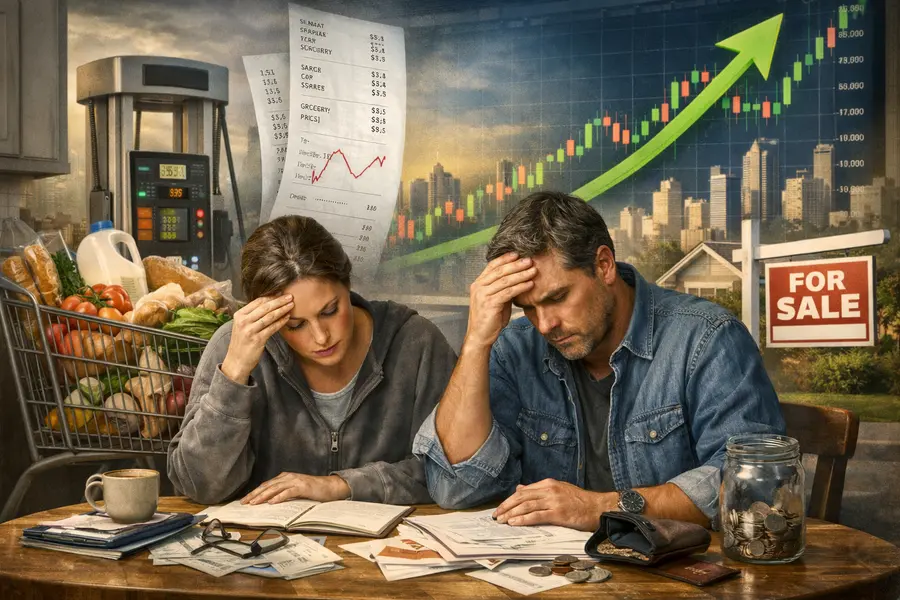
US consumers face a deepening cost-of-living crisis in mid-2026, with inflation at 4.2% and real wages declining, even as the S&P 500 posts 7.7% year-to-date gains.
- University of Michigan consumer sentiment hit a record low of 44.2 in May 2026—the worst reading in the survey's 74-year history, below levels seen during the 1970s oil shock and the Great Recession.
- US annual inflation accelerated to 4.2% through May, outpacing 3.7% nominal wage growth and cutting real pay by roughly $6 per week.
- The S&P 500's AI-driven rally has widened a stark gap between financial markets and household economic reality.
Lead
US consumers entered the second half of 2026 under mounting financial strain, with annual inflation reaching 4.2% through May—its steepest 12-month rise since April 2023—while the S&P 500 logged a 7.7% year-to-date gain fueled almost entirely by artificial intelligence infrastructure spending. The widening divergence between market performance and household wellbeing has become one of the defining economic dynamics of the year, with everyday costs in food, shelter, and energy continuing to erode purchasing power even as equity benchmarks approach record territory.
What Happened
The Bureau of Labor Statistics reported in June that the Consumer Price Index rose 4.2% in the 12 months ending May 2026, accelerating from 3.8% the month prior. The increase was broad-based: shelter costs rose 3.4% year-over-year, food at home increased 2.7%, and fresh vegetable prices are projected to climb 7.7% for the full year. Prices for fresh tomatoes surged 32% compared with May 2025.
Economic sentiment tracked the data's deterioration. The University of Michigan's consumer survey fell to 44.2 in May—an all-time low in a series stretching back to 1952, below levels recorded during the 1970s oil shock, the Great Recession, and the Covid-19 pandemic. A partial rebound in June lifted the index to 49.5 as gasoline prices eased modestly, but the reading remained 13% below January 2026 and 19% below a year earlier.The Wage-Inflation Gap
The arithmetic of US cost of living has turned against workers. Nominal wages rose 3.7% over the year through May 2026, leaving a 0.5-percentage-point gap below inflation—the equivalent of approximately $6 less purchasing power per week. Real average hourly earnings for production and non-supervisory workers posted their first year-over-year decline since 2022 in the first quarter of 2026. In 16 states, real wages were negative on an annual basis, with New Hampshire recording the steepest drop at minus 2.1%.
Year-ahead inflation expectations remained elevated at 4.6% in June, down slightly from 4.8% in May, while long-run expectations eased to 3.4% from 3.9%—indicating that households anticipate continued price pressure well into 2027.
Everyday Costs: Where Americans Feel It Most
The inflation impact is not evenly distributed. Lower-income households and those without college degrees reported the sharpest deterioration in economic sentiment, as elevated energy and food costs account for a disproportionate share of their budgets. A survey of more than 1,500 US consumers found only one in four feeling very confident in their current financial situation, while nearly two-thirds believe a recession is likely within the next 12 months. Consumers across income levels reported intentions to reduce discretionary spending, with the retrenchment most pronounced among lower earners.
Energy costs amplified the pressure. US gasoline prices approached record highs through the spring as disruptions to Strait of Hormuz shipping constrained global crude supply for approximately three months. Labor market confidence also softened: the percentage of consumers describing jobs as "hard to get" reached 22.5% in June, the highest reading since January 2021.
A Market Divorced from Main Street
The S&P 500's 7.7% year-to-date advance has been driven by a concentrated rally in technology and semiconductor stocks tied to an AI infrastructure buildout, rather than by broad-based economic strength. Signs of consumer financial stress have accumulated alongside equity gains: credit card delinquencies have risen, personal bankruptcy filings have increased, and household residual income has fallen to record lows among lower-income renters. Since 2001, lower-income renters' residual income has declined 60% in real terms, to approximately $210 per month.
Housing: A Structural Burden
Shelter remains one of the most persistent components of US cost of living pressure. The average US rent stood at $1,698 per month in early 2026, a 29.8% increase over five years. An estimated 22.7 million renter households are cost-burdened—spending more than 30% of income on housing—including 12.1 million facing severe cost burden above 50%. The supply shortfall remains acute: 11 million extremely low-income renters compete for just 3.8 million affordable, available units, a gap of 7.2 million homes.Outlook
The US economic landscape entering the second half of 2026 is defined by a structural tension between resilient equity markets and deteriorating household financial conditions. With annual inflation at 4.2% outpacing wage growth, shelter and food costs elevated, and consumer sentiment still near historic lows despite June's partial recovery, the burden on American households remains substantial. Whether Federal Reserve policy and any sustained moderation in energy prices can restore real purchasing power before a more pronounced consumer pullback materializes represents the central uncertainty for the remainder of the year.
Mentioned tickers: SPY