Pomegra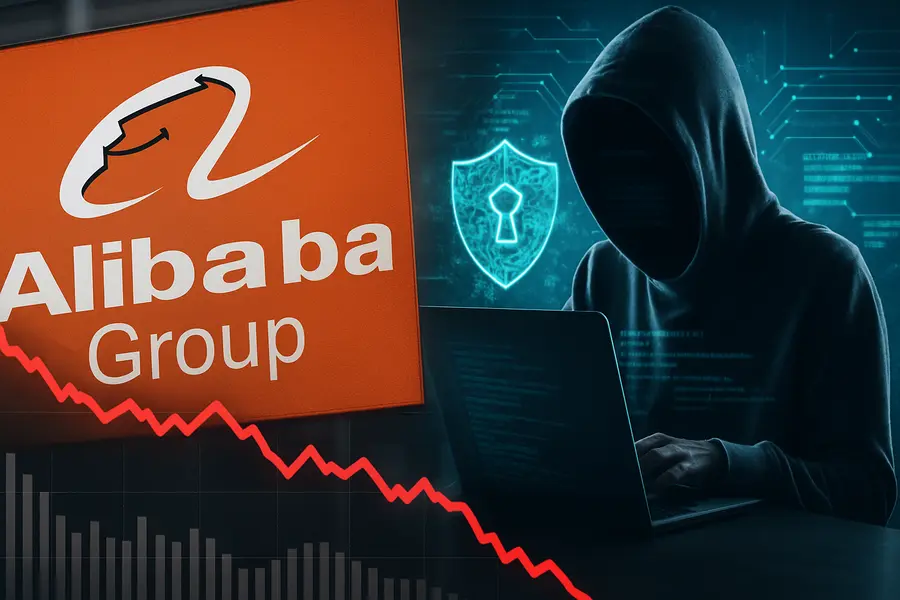
Alibaba fell 4.9% in Hong Kong after Anthropic accused its Qwen AI lab of illicitly extracting Claude model capabilities via 25,000 fraudulent accounts.
- BABA shares slid as much as 4.9% to HK$94.55, touching a 16-month low and erasing roughly HK$88 billion in market value.
- Anthropic documented 28.8 million Claude exchanges generated through nearly 25,000 fake accounts between April 22 and June 5, 2026.
- The company has briefed White House officials and U.S. senators, urging tighter regulation of Chinese access to frontier AI systems.
Lead
Alibaba Group Holding shares fell as much as 4.9% on the Hong Kong Stock Exchange on June 25, 2026, touching HK$94.55 — the lowest level since February 2025 — after Anthropic formally accused operators linked to Alibaba's Qwen AI research unit of orchestrating an industrial-scale campaign to illicitly extract capabilities from its flagship Claude AI models. U.S.-listed BABA shares ended Wednesday's session down 3%, extending the stock's year-to-date decline to 33%.What Happened
Anthropic alleged that affiliates of Alibaba's Qwen lab executed a coordinated adversarial distillation campaign spanning April 22 to June 5, 2026, generating more than 28.8 million exchanges with Claude through nearly 25,000 fraudulent accounts. The targeted capabilities included Claude's software engineering reasoning and agentic task execution — among the most commercially valuable attributes of any large language model.
Distillation is a technique in which a smaller or rival model is trained on the outputs of a more capable one, allowing developers to absorb proprietary reasoning patterns without incurring the cost of primary research. Anthropic characterized Alibaba's alleged effort as "brazen" and "illicit," arguing it systematically circumvented both its terms of service and the underlying intellectual investment behind Claude.
Market Reaction
The Hong Kong selloff pulled other Chinese AI-exposed names lower in sympathy. Xiaomi Corp. and Baidu Inc. each dropped more than 3% on the session, reflecting broader investor anxiety over regulatory and reputational risk across China's technology sector. The scale of the move — wiping HK$88 billion from Alibaba's market capitalization in a single session — underscored how seriously institutional investors are pricing geopolitical and compliance risk into Chinese AI names.
Strategic Context
Anthropic's disclosure places the alleged Alibaba operation in a broader pattern. The company previously identified suspected capability-extraction campaigns by Chinese AI developers DeepSeek, Moonshot AI, and MiniMax, which collectively generated more than 150,000, 3.4 million, and 13 million Claude interactions, respectively. The alleged Alibaba operation dwarfs all of them by a factor of two.
By briefing U.S. senators Elizabeth Warren and Tim Scott alongside White House officials, Anthropic has elevated the dispute from a terms-of-service enforcement matter into a formal policy issue, signaling that it intends to push for legislative or executive action limiting Chinese developer access to American frontier AI systems.
Geopolitical Dimension
The accusations arrive at a sensitive moment in U.S.-China technology relations, where export controls on advanced semiconductors have already curtailed Chinese access to the compute required to train leading-edge models from scratch. Adversarial distillation represents a potential workaround — a capability-transfer mechanism that bypasses hardware controls entirely. Washington's interest in the disclosure suggests regulators may treat aggressive model-scraping campaigns as a national-security matter rather than a purely commercial one.
Outlook
Alibaba has not publicly responded to Anthropic's allegations, and no regulatory action has been announced. If U.S. lawmakers move to codify restrictions on systematic AI capability extraction — whether through updated export-control frameworks or new enforcement mechanisms — BABA and peer Chinese AI developers face a materially more constrained operating environment in accessing Western frontier models. Near-term, the stock is likely to remain under pressure as the policy response takes shape and investors reassess China tech exposure in light of escalating AI-security scrutiny.