Pomegra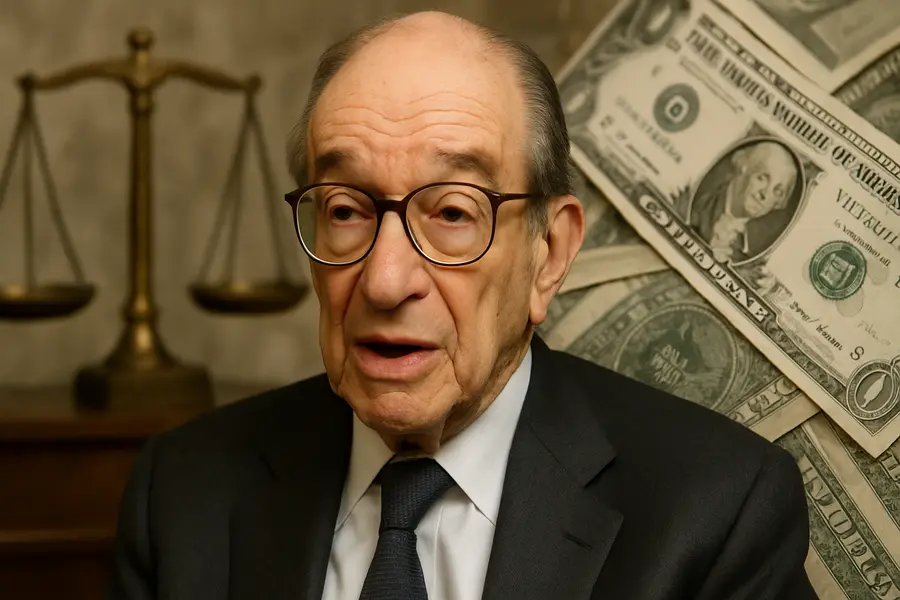
Now I have sufficient verified data. Writing the article now.
- Greenspan died June 22, 2026, of complications from Parkinson's disease; his wife Andrea Mitchell confirmed the death.
- He warned for decades the U.S. was "way underestimating" its true national debt by excluding trillions in unfunded entitlement liabilities.
- Publicly held federal debt now stands at $31.3 trillion — roughly 101% of GDP — with CBO projecting it reaches 120% by 2036.
---
Former Federal Reserve Chairman Alan Greenspan, who spent decades warning that America's swelling entitlement obligations and structural deficits posed a fundamental threat to long-term economic stability, died Monday at age 100.
Lead
Alan Greenspan, who chaired the Federal Reserve from August 1987 to January 2006 under four presidents and became one of the most influential voices in postwar economic policy, died June 22, 2026, in Washington. He was 100. His wife, NBC News correspondent Andrea Mitchell, announced his passing, attributing it to complications from Parkinson's disease. His death arrives as the national debt news he long forewarned has become a defining feature of the U.S. fiscal landscape: federal debt held by the public has reached $31.3 trillion, approaching a level equal to the entire annual output of the American economy.
His Fiscal Warnings, Repeatedly Issued
Greenspan's record at the Fed was contested — he presided over the longest peacetime expansion in U.S. history but was later faulted for policies critics say contributed to the conditions for the 2007–08 financial crisis. His positions on US fiscal policy, however, were consistent and grew more urgent over time.
He argued that the United States was "way underestimating" its true indebtedness by failing to account for accruing obligations under Social Security and Medicare. As early as 2001, he estimated the Social Security liability alone at roughly $10 trillion — a figure that has compounded materially since. "There is no doubt that we cannot keep moving at a $1 trillion deficit without inflation ultimately emerging," he stated in later years, a warning validated by the inflationary cycle that followed aggressive post-2020 fiscal stimulus.
Greenspan identified entitlement programs as the structural root of the problem, contending that rising Social Security and Medicare spending was "draining capital investment dollar for dollar" and that without reform, the economy's productive capacity would "begin to fade out." He further warned that Social Security's own actuarial reports implied benefits would need to be cut by approximately 24 percent annually to achieve long-run program solvency without legislative changes.
On tax policy, his stance was similarly disciplined. In 2017, when Congress pursued a major tax overhaul, Greenspan cautioned that "we've got to get the debt stabilized before we can even think in those terms," calling the legislation a fiscal "mistake" absent corresponding restraint on spending.
The Fiscal Context He Leaves Behind
The economic warnings Greenspan delivered across three decades now frame a measurably deteriorated baseline. The Congressional Budget Office projects the federal deficit at $1.9 trillion in fiscal year 2026 — 5.8 percent of GDP — rising to $3.1 trillion, or 6.7 percent of GDP, by 2036. The Government Accountability Office projects publicly held debt reaching 120 percent of GDP by 2036, well beyond the post-World War II record of 106 percent, and 251 percent by mid-century under current policy trajectories.
Net interest payments on the federal debt exceeded national defense spending in fiscal year 2025 — a threshold widely treated as a fiscal inflection point, as interest costs begin structurally crowding out discretionary investment. The GAO, in its June 2026 annual review of the nation's fiscal health, reiterated that delays in addressing the imbalance require progressively more severe eventual adjustments.
Greenspan's tenure at the Fed ended before these pressures reached their current magnitude, but his Alan Greenspan 2026 legacy is inseparable from the warnings he issued while those pressures were still manageable.
Outlook
Greenspan's death forecloses one of the most recognizable voices in the long-running debate over US fiscal policy sustainability. The structural dynamics he identified — entitlement-driven spending growth, insufficient revenue, and political disinclination to address either — remain unresolved. With publicly held debt near historic highs, net interest costs surpassing defense spending, and CBO projections pointing to sustained deficits exceeding $2 trillion annually, the urgency embedded in his economic warnings over three decades has outlasted the man who delivered them.
Mentioned tickers: