Pomegra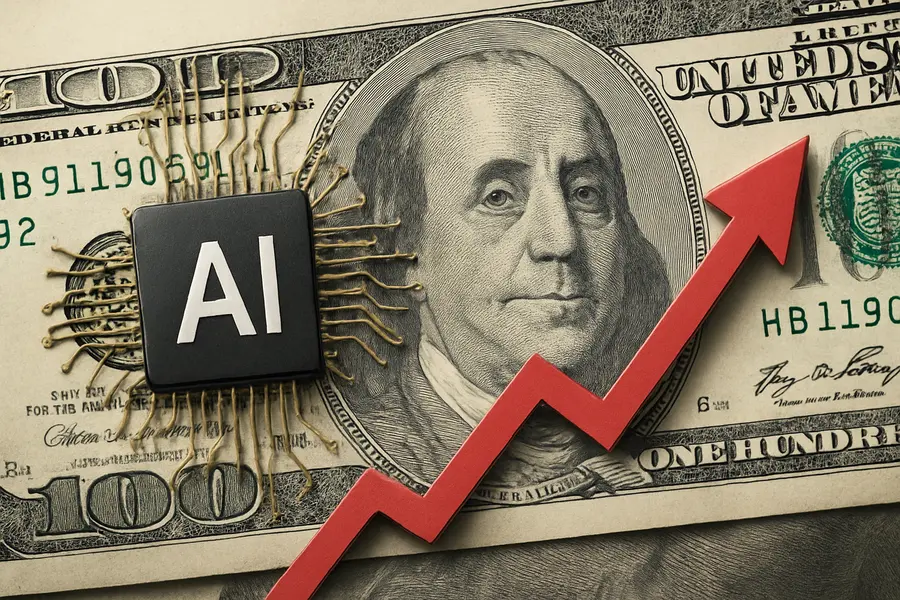
The four largest U.S. technology companies will spend $725 billion on AI infrastructure in 2026—on a path to $1 trillion by 2027—while productivity gains remain elusive and inflation and debt risks mount across the broader economy.
- Microsoft, Amazon, Alphabet, and Meta are on track to spend ~$725B on AI in 2026, up 77% from $410B in 2025, with analysts projecting that figure to top $1 trillion in 2027.
- Goldman Sachs found no meaningful relationship between AI investment and economy-wide productivity through early 2026, while a major study of 6,000 executives confirmed the same.
- Federal Reserve Governor Lisa Cook warned in May 2026 that AI concentration poses systemic financial stability risks, including the potential to trigger flash-crash-style market events.
Lead
The United States is in the grip of an AI spending surge with few precedents in the history of corporate capital allocation. Microsoft ($190 billion), Amazon ($200 billion), Alphabet ($175–185 billion), and Meta ($115–135 billion) are collectively committing roughly $725 billion to AI infrastructure in 2026 alone — a 77 percent increase from $410 billion in 2025. Analysts at multiple Wall Street firms now project Big Tech's combined capital expenditure will cross the $1 trillion threshold in 2027. Goldman Sachs estimates the four largest hyperscalers will spend a cumulative $5.3 trillion between fiscal 2025 and fiscal 2030.
The scale of the AI economy impact is already visible in the aggregate economic data. Yet the direction of that impact is becoming a flashpoint: the buildout is inflationary, increasingly debt-financed, and so far disconnected from measurable gains in economic output.
The Spending Architecture
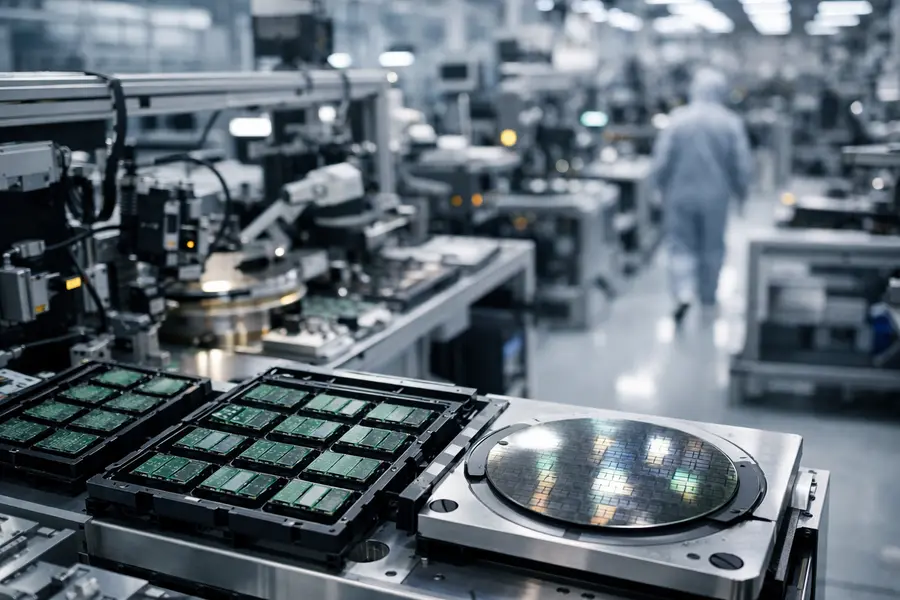
The 2026 AI capital surge extends well beyond the four hyperscalers. Full-year 2025 AI infrastructure spending across the broader market — encompassing GPU clusters, custom silicon, data center construction, and power infrastructure — totaled $318 billion, more than double the $153 billion recorded in 2024. IDC projects that figure reaching $487 billion in 2026, a 53 percent year-over-year increase.
The United States commands a disproportionate share: American firms account for roughly 77 percent of global AI infrastructure investment. NVIDIA remains the dominant beneficiary of the buildout, supplying the majority of high-performance AI accelerators powering data centers from Virginia to Arizona. Goldman Sachs's baseline model places annual AI capex at $765 billion in 2026, rising to $1.6 trillion by 2031, with cumulative spend between those years approaching $7.6 trillion.
The Inflation Effect and the AI Affordability Crisis
The AI affordability crisis is not only a consumer-facing phenomenon — it is structural. Goldman Sachs, J.P. Morgan Asset Management, and Stifel have each concluded that the AI buildout is inflationary in the near term, as demand for power, land, specialized labor, and advanced semiconductors outpaces supply. Global data-center power demand is projected to more than double by 2030, forcing costly upgrades to electrical grids, water systems, and connectivity infrastructure.
The price effects are already passing through supply chains. Consumer electronics prices have risen as AI-driven demand absorbs chipmaking capacity. Americans now pay an average of $265 per month in utilities, up 12 percent year-over-year, with data center load concentration contributing to regional grid strain. The Federal Reserve's dual mandate — maximum employment alongside price stability — is being tested by the buildout's inflationary footprint before the productivity dividend materializes.
The Productivity Paradox
The central tension of the current AI economic risk landscape is what economists have begun calling the productivity paradox: the gap between perceived and measured gains. Goldman Sachs published findings in March 2026 showing no meaningful relationship between AI investment and economy-wide productivity. A separate National Bureau of Economic Research study surveying 6,000 chief executives and senior executives found the vast majority report little discernible operational impact from AI.
ManpowerGroup's 2026 Global Talent Barometer documented a parallel dynamic among workers: regular AI use rose 13 percent in 2025, yet confidence in the technology's utility fell 18 percent. A working paper circulated by economists studying the effects identified the core mechanism — revenue realizations lag perceived efficiency gains, leaving the economic contribution invisible in standard productivity metrics.
AI-related components contributed an estimated 40 to 50 basis points to real U.S. GDP growth in the first three quarters of 2025, once imports of AI-related equipment are netted out — approximately 20 to 25 percent of real GDP growth over that period. Notwithstanding the spending scale, AI spending $1 trillion has not generated a commensurate jump in output.
Debt and Financial Stability
Capital expenditure at the leading hyperscalers began to exceed operating cash flows in late 2025. Firms raised more than $100 billion in new debt — including off-balance-sheet project finance vehicles — to sustain the buildout, with much of the financing predicated on AI productivity returns that have not yet appeared in the data. Moody's has flagged AI-related fiscal exposure as an emerging sovereign risk category, noting that governments increasing AI infrastructure commitments risk taking on debt burdens whose payoffs remain uncertain.
Federal Reserve Governor Lisa Cook, speaking at the Stanford Institute for Economic Policy Research on May 27, 2026, addressed the systemic dimension of those risks directly. Concentrations around specific pre-trained models, third-party service providers, and shared business strategies create conditions under which AI systems could push financial decision-making toward correlated outcomes — the same dynamic that produced the 2010 flash crash. The growing use of generative AI in trading strategies, Cook noted, could generate or amplify such events at scale.
Outlook
The trajectory of AI economy impact over the next 12 to 24 months turns on a single question: whether the productivity dividend arrives before the financial system absorbs the full cost of financing the buildout. Economists project AI could lift productivity and GDP by 1.5 percent by 2035 — gains that, if realized, would justify the current investment cycle in retrospect. In the near term, the dominant effects are inflationary pressure, rising corporate and sovereign debt exposure, and growing systemic financial risk. The $1 trillion annual AI spending threshold is not a milestone of achievement; it is a stress test for the U.S. economy that is only beginning to register in the data.
Mentioned tickers: MSFT, GOOGL, AMZN, META, NVDA