 Pomegra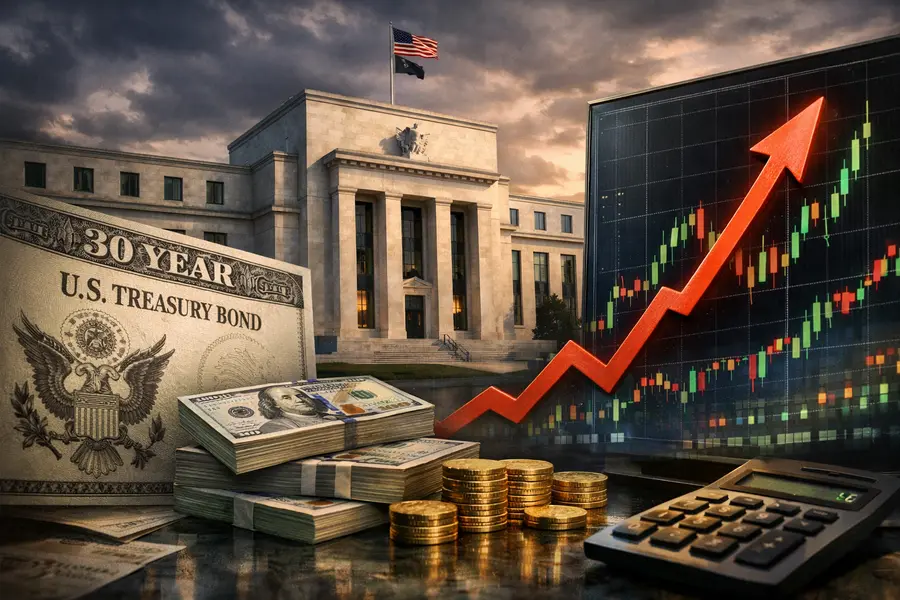
The 30-year Treasury yield surged to a 19-year high of 5.21% on Wednesday, as bond markets delivered a blunt verdict on the Federal Reserve's fifth consecutive rate hold under Chair Kevin Warsh.
- The 30-year Treasury yield reached 5.21%, its highest since July 2007, up ~11 basis points on the day.
- The FOMC voted 9-3 to hold rates at 3.50–3.75%; three hawkish dissenters pushed September hike odds above 57%.
- Warsh affirmed the 2% inflation target is "binding," but long-end treasury bonds priced in deeper skepticism.
Lead
Washington / New York, July 30, 2026 — The U.S. bond market administered its sharpest rebuke yet to Federal Reserve Chairman Kevin Warsh on Wednesday, driving the 30-year Treasury yield to 5.21% — a level not seen since the eve of the 2008 financial crisis — after the Federal Open Market Committee voted 9-3 to hold the benchmark federal funds rate in the 3.50%–3.75% range for a fifth straight meeting. The move added roughly 11 basis points to the long end of the yield curve chart within hours of Warsh's post-decision press conference, erasing earlier session gains in equities and widening credit spreads across asset classes.What Happened
The FOMC's July 29 decision carried the most hawkish dissent since September 2016. Dallas Fed President Lorie Logan, Minneapolis Fed President Neel Kashkari, and Cleveland Fed President Beth Hammack each voted for an immediate 25-basis-point hike — the first three-way dissent in nearly a decade. Their concern: headline inflation has not retreated fast enough toward the Fed's 2% target, in part because the U.S.-Israeli military campaign against Iran has sustained an energy price shock that has filtered through to core goods and services.
Warsh, addressing reporters after the decision, was unequivocal. "There is no soft inflation target," he said. "The 2% goal remains binding. We will not hesitate." Yet even as he spoke, treasury bonds at the long end sold off sharply, a signal that bond investors judged the hold — not the rhetoric — as the operative policy signal.
The 30-year yield climbed from approximately 5.10% at the start of Warsh's remarks to 5.21% by the session close, crossing the 5.20% threshold that had served as a psychological line of resistance throughout the spring. The 10-year Treasury yield rose to 4.69%, approaching its highest level in more than a year. The 2-year yield, more sensitive to near-term Fed expectations, edged up to 4.33%, steepening the yield curve and reflecting a surge in term premium rather than a simple repricing of the Fed's policy path.
Market Reaction
U.S. equity markets sold off broadly on the yield surge. The Dow Jones Industrial Average fell more than 400 points intraday before a partial recovery; the S&P 500 ended lower by roughly 0.9%. The technology-heavy Nasdaq Composite bore the brunt, as long-duration growth stocks are most sensitive to a rising discount rate.
In the Treasury complex, the yield curve chart steepened notably: the 30-year-to-10-year spread widened to approximately 52 basis points, and the 10-year-to-2-year spread extended further positive territory — a structural shift from the inverted curve that had prevailed for much of 2023–2024. A positively sloped yield curve at these absolute levels reflects a market that is simultaneously pricing in persistent inflation and a central bank falling behind.
The dollar strengthened modestly against major peers. Gold rose 0.7% as real rates remained ambiguous. Crude oil held above $90 per barrel, sustained by ongoing tensions in the Persian Gulf shipping corridor.
Strategic Context
Warsh took the Fed helm in May 2026, inheriting an inflation problem that had re-accelerated after a brief mid-2025 lull. His initial communication strategy leaned on credibility-signaling — tough language, references to Paul Volcker, explicit rejection of any implied tolerance for above-target inflation. For several months, treasury bonds absorbed the rhetoric without a dramatic yield response.
That equilibrium broke. The three FOMC dissenters represent the Fed's internal acknowledgment that the hold is increasingly difficult to defend. Futures markets now price a 57% probability of a 25-basis-point rate increase at the September FOMC meeting, up from roughly 30% before Wednesday's decision. If realized, it would be the first hike in over two years and would mark a significant pivot from Warsh's stated preference for patience.
The bond market's behavior echoes early-1990s dynamics, when so-called bond vigilantes forced fiscal and monetary discipline by pushing long yields to punitive levels. Then, as now, the sell-off in long-dated treasury bonds functioned as a market-imposed tightening — raising mortgage rates, widening corporate credit spreads, and increasing the government's own debt-servicing costs on new issuance.
Geopolitical Dimension
The Iran oil shock is central to understanding why the yield curve chart is pricing in sustained inflation risk rather than a temporary spike. With Persian Gulf shipping disruptions keeping Brent crude in the $88–$92 range, energy costs continue to bleed into transportation, petrochemicals, and food production. Core PCE inflation — the Fed's preferred measure — ran at 3.1% year-over-year in the most recent reading, well above target and showing no clear deceleration trend.
Geopolitical risk premia embedded in long treasury bonds have widened as a result. Investors demand higher term compensation not only for expected future short rates, but for the uncertainty premium around a conflict with no clear off-ramp.
What Comes Next
The September 16–17 FOMC meeting is now the fulcrum for markets. A second consecutive hold, with three dissenters, could push the 30-year yield toward 5.40% and reignite comparisons to the 1994 bond massacre. A 25-basis-point hike, conversely, would likely flatten the yield curve modestly and offer Warsh a credibility restoration — at the cost of additional pressure on a housing market already contending with 30-year mortgage rates above 7.5%.
Warsh's signaling in the weeks between now and September — via speeches, interviews, and the release of July meeting minutes — will be closely parsed. The treasury bonds market, for the moment, has its own answer.
Outlook
The breach of 5.20% on the 30-year Treasury is more than a technical milestone. It reflects a structural repricing of term premium, inflation expectations, and Fed credibility that will not reverse quickly. With three FOMC dissenters, a September hike now on the table, and geopolitical forces keeping energy prices elevated, the yield curve chart signals that the bond market's patience with Warsh's hold strategy has run out. The next six weeks will determine whether the Fed leads the market — or follows it.
Mentioned tickers: TLT, IEF, SHY, TNX, TBT, UUP, GLD, SPY, QQQ, DIA


