The Iron Condor: A Staple for Range-Bound Markets
🌟 The Ultimate Defined-Risk, Income-Generating Machine
In our last article, we explored the raw power and unlimited risk of short straddles and strangles. These are fantastic strategies for profiting from market calm, but the threat of unlimited loss can be daunting. What if there was a way to get all the benefits of selling premium—profiting from time decay and low volatility—but with a strictly defined, capped risk?
Enter the iron condor. This is arguably one of the most popular and versatile options strategies in the world, and for good reason. It takes the core concept of a short strangle and adds a layer of protection, creating a defined-risk, high-probability strategy that is a staple for income-focused traders. This article will deconstruct the iron condor, showing you how to build it, manage it, and make it a cornerstone of your trading arsenal.
The Anatomy of an Iron Condor
At its core, an iron condor is simply a short strangle with "wings." You are selling a strangle, but you are also buying further out-of-the-money options to protect yourself from a large move.
An iron condor is constructed with four legs, consisting of two vertical spreads:
- A Bear Call Credit Spread: Sell an OTM call and buy a further OTM call.
- A Bull Put Credit Spread: Sell an OTM put and buy a further OTM put.
All four options must have the same expiration date. The result is a trade that collects a net credit and has a wide profit range between the short strike prices.
The long options (the "wings") act as insurance, capping your maximum possible loss.
The P&L Profile: A High Probability Profit Range
The P&L diagram of an iron condor is a flat-topped shape, clearly illustrating the defined risk and reward.
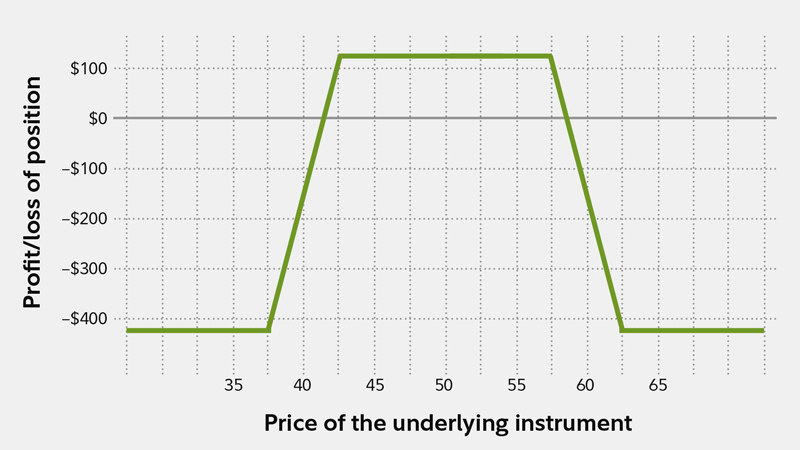
- Maximum Profit: The net credit received when opening the position. This is achieved if the stock price closes between the two short strike prices at expiration.
- Maximum Loss: The difference between the strikes on one of the spreads, minus the net credit received. This loss is realized if the stock price moves beyond one of the long strike prices.
- Break-Even Points:
- Upper: Short Call Strike + Net Credit
- Lower: Short Put Strike - Net Credit
Example:
- Stock: XYZ trading at $100.
- Action:
- Sell the $105 call / Buy the $110 call for a $1.00 credit.
- Sell the $95 put / Buy the $90 put for a $1.00 credit.
- Net Credit (Max Profit): $1.00 + $1.00 = $2.00 per share ($200 per condor).
- Max Loss: ($5.00 spread width - $2.00 credit) = $3.00 per share ($300 per condor).
- Profit Range: Between $97 ($95 - $2) and $107 ($105 + $2).
As long as XYZ stays between $97 and $107 at expiration, the trade will be profitable.
The Art of Strike Selection
The beauty of the iron condor is its flexibility. The placement of your strikes is the primary way you control the trade's risk and reward profile.
- Narrow Condor (Short strikes closer to the stock price):
- Pros: Higher premium collected, higher max profit.
- Cons: Narrower profit range, lower probability of success.
- Wide Condor (Short strikes further from the stock price):
- Pros: Wider profit range, higher probability of success.
- Cons: Lower premium collected, lower max profit.
A common approach is to use delta to guide strike selection. For example, many traders will sell the 15 or 20 delta options for their short strikes. This provides a systematic way to balance the trade-off between premium collected and probability of success.
Managing the Iron Condor
The iron condor is not a "set it and forget it" strategy. Active management is key to long-term success. While the defined-risk nature of the trade prevents catastrophic losses, poor management can lead to a steady drain on your portfolio.
- Profit Taking: Don't be greedy. A good rule of thumb is to take profits when you've captured 50% of the maximum potential profit. For example, if you collect a $2.00 credit, you would look to close the trade when you can buy it back for $1.00. This gets you out of the trade early, reduces your risk, and frees up capital for new opportunities. Holding on for the full profit increases your risk as expiration approaches (gamma risk).
- Adjustments: If the stock price starts to challenge one of your short strikes, you can make adjustments. A common adjustment is to "roll" the untested side of the condor closer to the stock price. For example, if the stock is moving up towards your short call, you can roll the put spread up to collect more premium, which widens your break-even point and gives you more room to be right. This is a defensive maneuver designed to improve your position.
- Exiting for a Loss: If the stock makes a strong move against you and breaches a short strike, it's often best to close the trade for a small loss rather than hoping it comes back. A common rule of thumb is to exit if the loss reaches 2-3 times the credit received. Adhering to a predefined stop-loss is crucial for long-term success.
- Time to Expiration: Many traders will close their iron condors with 7-21 days left until expiration, regardless of the P&L. This is because as expiration gets closer, gamma risk increases, meaning the position's value can change dramatically with small moves in the stock price.
Iron Condor vs. Iron Butterfly
A close cousin of the iron condor is the iron butterfly. The structure is very similar, but with one key difference: the short call and short put of an iron butterfly share the same strike price, typically at-the-money.
| Feature | Iron Condor | Iron Butterfly |
|---|---|---|
| Structure | Short strangle + long wings | Short straddle + long wings |
| Premium | Lower credit received | Higher credit received |
| Profit Range | Wider | Narrower |
| Max Profit | Lower | Higher |
| Probability | Higher probability of profit | Lower probability of profit |
The Trade-Off: The iron butterfly offers a much higher potential profit (a larger credit) but has a much narrower profit range. It's a sharper bet on the stock finishing very close to a specific price. The iron condor, with its wider profit range, is more forgiving and has a higher probability of success, but offers a lower reward. Your choice between the two depends on your forecast for the stock's trading range.
Why the Iron Condor is a Trader's Favorite
The iron condor has become a cornerstone strategy for many traders for several key reasons:
- Defined Risk: You know your maximum possible loss before you even enter the trade. This provides peace of mind and allows for precise position sizing.
- High Probability: When structured correctly, iron condors can have a high probability of success (often 70-80% or more).
- Positive Theta: The strategy profits from time decay, meaning you make money as each day passes, as long as the stock stays in range.
- Capital Efficiency: Because the risk is defined, the margin requirement for an iron condor is significantly lower than for a short strangle.
💡 Conclusion: Your Go-To Strategy for Consistent Income
The iron condor is the perfect synthesis of the concepts we've been discussing. It takes the income-generating power of a short strangle and wraps it in a defined-risk structure, creating a versatile and robust strategy. It's a trade that puts time on your side and pays you for being right about a stock's lack of movement.
Here’s what to remember:
- It's a Bet on a Range: You are betting that the stock will stay between your short strikes until expiration.
- Risk is Always Defined: Your maximum loss is capped, making it a much safer way to sell premium than a naked strangle.
- Management is Key: Proactive management through profit-taking and adjustments is what separates successful condor traders from the rest.
Challenge Yourself: Pick a relatively stable, non-volatile stock (like a utility or consumer staples company). Go to the options chain for an expiration about 45 days out. Construct a 15-delta iron condor. Note the net credit, the max loss, and the break-even points. Now, track this "paper trade" over the next few weeks. How does it behave as the stock moves and time passes?
➡️ What's Next?
The iron condor is the king of range-bound strategies, but what if you have a slightly sharper view on where the stock will end up? In the next article, "The Iron Butterfly: A Sharper Bet on Stability", we'll explore a close cousin of the condor that offers a higher potential reward in exchange for a narrower profit range.
📚 Glossary & Further Reading
Glossary:
- Iron Condor: A four-legged, defined-risk options strategy consisting of a bull put spread and a bear call spread, designed to profit from low volatility.
- Bear Call Spread: A credit spread constructed by selling a call and buying a further OTM call.
- Bull Put Spread: A credit spread constructed by selling a put and buying a further OTM put.
Further Reading: