Pomegra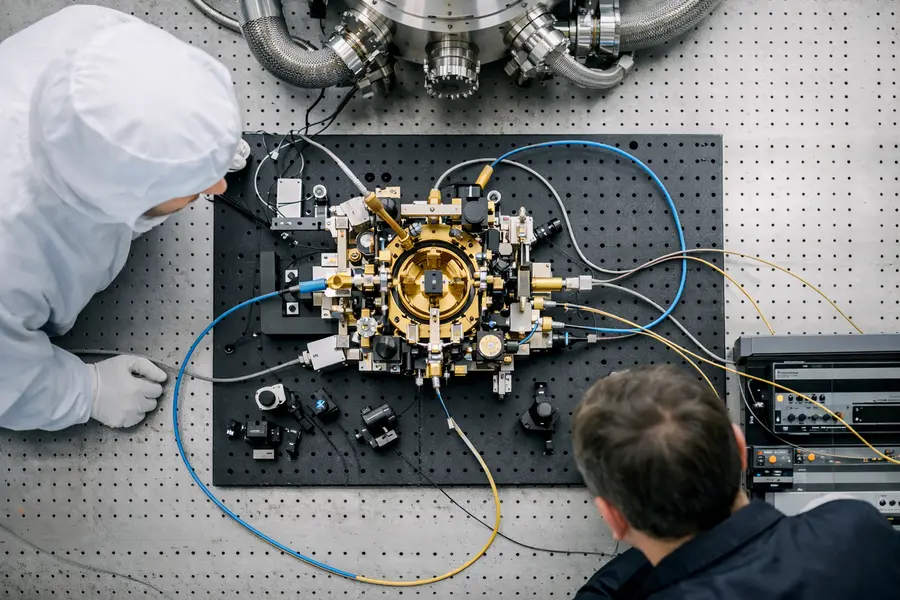
Universal Quantum's Series A, co-led by DCVC and Firgun Ventures, is the largest Series A ever raised by a UK quantum company, funding its trapped-ion computers.
Key Takeaways
- Universal Quantum raised more than $100M in a Series A announced October 8, 2026, the largest by a UK quantum firm.
- DCVC and Firgun Ventures co-led; EDBI, Artal, Main Sequence and Nauta Capital joined. Valuation is undisclosed.
- Funds go to modular trapped-ion hardware, a Singapore R&D center, and expansion in the US, Japan and Hamburg.
Lead
Universal Quantum, a University of Sussex spinout building modular trapped-ion quantum computers, announced on October 8, 2026 that it had raised more than $100 million in a Series A. Silicon Valley deep-tech investor DCVC and London quantum specialist Firgun Ventures co-led the round, which the company describes as the largest Series A ever raised by a UK-headquartered quantum computing company. The figure converts to roughly €89 million. The company did not disclose valuation.
Who Else Is in the Round?
The syndicate is unusually broad for a Series A. Singapore's sovereign-linked investor EDBI, Artal (advised by Invus), Integral GlobalTech, Main Sequence, Australian pension funds Hostplus and NGS Super, IAG Capital, EdenBase and Eigenstate.holdings participated. Roblox founder and CEO Dave Baszucki joined as an individual investor, and existing backer Nauta Capital returned.
Firgun's founding partner, Zeynep Korutürk, now sits on the board. James Hardiman of DCVC said the firm backed the company because its modular architecture addresses "the hardest challenges in scaling ion trap systems."
What Does Universal Quantum Actually Build?
The company builds trapped-ion quantum computers in which charged atoms held by electric fields serve as qubits. Its approach tiles many small chips together, with patented interconnects between them, rather than relying on photonic links or large laser systems. Control uses microwaves and voltages instead of lasers, and the machines run at roughly 70 kelvin, far warmer than superconducting rivals. Chips are made with standard silicon processing.
Founders Sebastian Weidt, now chief executive, and Winfried Hensinger, chief scientist, published the first practical blueprint for a large-scale trapped-ion machine in 2017. The company was founded in 2018 and now employs more than 100 technical staff across three continents.
How Is the Money Being Spent?
The proceeds go toward developing and commercializing the modular architecture, plus geographic expansion. The company plans a research center in Singapore, its first outside Europe, which Singapore's National Quantum Office is supporting with more than S$30 million in funding and about 25 staff. It will also expand in the United States, Japan and Hamburg, Germany.
Weidt said the round "unites an extraordinary group of investors from the world's most important pools of capital around a single mission: delivering utility-scale quantum computing."
Why Is This Round Different From the Usual Quantum Raise?
Universal Quantum has a paying government customer before the round, which is rare at this stage. In November 2022 the German Aerospace Center (DLR) awarded it a €67 million contract (about $77 million by the company's valuation) to deliver two trapped-ion systems, one single-chip and one multi-chip, in Hamburg. The delivery window runs about four years, closing around the end of 2026.
The financials show why fresh capital matters. Company accounts show revenue of £17.0 million in 2023, £11.3 million in 2024 and £9.2 million in 2025. Profit of £9.5 million in 2023 turned into a £5.8 million loss in 2025, and cash fell from £14.1 million in 2024 to £3.6 million. Headcount rose from 37 in 2023 to an average of 85 in 2025. The earlier funding was modest: a £3.6 million seed round in June 2020.
How Does It Compare With Trapped-Ion Rivals?
The sector has set high price markers. Quantinuum raised $600 million at a $10 billion pre-money valuation in September 2025. IonQ agreed to acquire Oxford Ionics, another UK trapped-ion company, for $1.075 billion in June 2025. Against those figures, a $100 million Series A with no disclosed valuation is small in absolute terms, and the undisclosed price leaves investors' view of the company's worth unstated.
The company's pitch also depends on execution risk. The DLR deliverables are due within months, and a modular design must show that tiling chips preserves qubit quality as systems grow. Market forecasts of $60 billion to $100 billion in annual quantum revenue by 2035, cited by the company, remain projections.
What Comes Next?
The near-term test is delivery of the two DLR machines, which would convert a research roadmap into hardware customers can inspect. The Singapore center and the US and Japan expansion should show whether the company can sell beyond government-funded programs. A further, larger round is likely if the Hamburg systems perform, given the cash position before this raise.
Outlook
Universal Quantum has secured a record UK quantum Series A, a deep bench of sovereign, pension and venture backers, and a funded path to scale its tiled trapped-ion design. The coming 12 months hinge on the DLR deliveries and on whether non-government customers emerge. Competition from far better-capitalized trapped-ion peers will keep the pressure on.