Pomegra
Vienna-based Tumbleweed closed a €6.9M seed round led by Pact to fund three 2027 microgravity missions after Austria's first commercial satellite launch.
Key Takeaways
- Tumbleweed raised €6.9M in seed funding in November 2026, which it calls Austria's largest SpaceTech seed round.
- Pact led the round. Vanagon Ventures, Prototype Capital and EWOR also participated. The valuation is undisclosed.
- The money pays for three missions in 2027 with more than 10 customers, and for the Oasis Beta platform due in 2028.
Lead
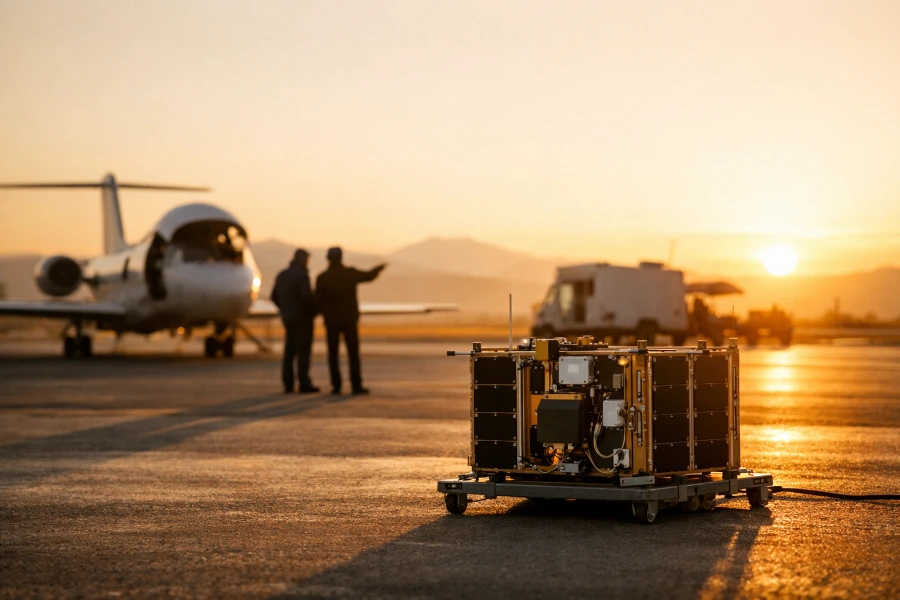
Tumbleweed, a space startup based in Vienna and Delft, announced a €6.9M seed round in early November 2026. The announcement came four months after its Oasis Alpha satellite reached orbit on July 7, 2026, aboard SpaceX's Transporter-17 rideshare mission. Pact led the round. The company did not disclose a valuation.
The company builds small laboratory pods that fly on its Oasis orbital platform. Universities, biotech firms and materials researchers can run microgravity experiments without building or operating a spacecraft.
What Does Tumbleweed Actually Sell?
Tumbleweed sells access to microgravity as a packaged service, not a satellite. A customer receives a pod, development support, launch, operational support and remote data access. Entry-level missions start at €15,000, and lead times run two to three months.
Experiments on the first flight cost roughly €30,000 for a run of three to four months. The Oasis Alpha customers work in materials science, protein synthesis and recrystallization. All four were first-time space users, and the flight was fully booked a year before launch.
CEO and co-founder Julian Rothenbuchner has framed the problem as one of process, not hardware. "The bigger challenge isn't the vehicle itself. It's the entire process of accessing microgravity," he said. He also argued that the market will grow only when space access becomes "as unremarkable as the internet."
Who Backed the Round?
Pact led the seed, with Vanagon Ventures, Prototype Capital and EWOR joining. Koro Capital, ABCapital, Dutch Operator Fund and rule30 are also listed, alongside international angels. EWOR's chief executive, Dippold, said the model means "every lab and manufacturer can use space without becoming a space company first."
Staff also put in their own money. Over one-third of the 25 employees have invested personally, with six-figure sums in total across funding rounds. Earlier round sizes and investors were not detailed.
Why Did Tumbleweed Raise Now?
The launch gave investors something rare in European space seed rounds: a flown spacecraft and paying customers. Tumbleweed built Oasis Alpha in nine months, which it puts at five times faster than the industry norm. It also reports a customer conversion rate of about 40%, and about two-thirds of its customers came through inbound inquiries.
Those figures come from the company. Four customers is a small base, and the revenue per mission is low next to the cost of a satellite. The seed round therefore tests whether volume can follow. Three flights with more than 10 customers in 2027 would roughly triple the customer count in a year.
What Will the Money Pay For?
The proceeds fund three missions in 2027 and the development of Oasis Beta, which is scheduled for 2028. Beta adds re-entry capability, so experimental samples can come back to Earth. Alpha's pods return only data, a limit for biotech and pharmaceutical work that needs physical samples for analysis.
Interest in the 2027 flights already extends beyond the first customers. Medical research, biotechnology and agritech laboratories have signed up for payloads.
How Does This Fit Europe's Space Market?
Tumbleweed competes for a niche already contested by in-space manufacturing and research-platform companies in the US and Europe. Many of those have focused on larger, costlier payloads. A €15,000 entry price aims at laboratories that would otherwise rely on parabolic flights or sounding rockets. Both give minutes of weightlessness. A satellite offers months.
Rideshare launches keep marginal launch costs low, but the model depends on regular Transporter slots. A delay in that schedule would shift Tumbleweed's 2027 plan directly.
Outlook
The round gives Tumbleweed funding for three flights and a return-capable platform. The next test is the 2027 manifest. If the company fills it at current prices and delivers on schedule, Oasis Beta in 2028 becomes the more consequential bet, because sample return widens the customer base and the price it can charge. The valuation is undisclosed, so the terms of that bet stay private for now.