Pomegra
Transpharmation acquired Luxembourg's OrganoTherapeutics on October 28, 2026, adding patient-derived brain organoids to its animal-model neuroscience CRO.
Key Takeaways
- Transpharmation announced the OrganoTherapeutics acquisition on October 28, 2026; financial terms were not disclosed.
- OrganoTherapeutics, a 2019 University of Luxembourg spin-off, will run as a named Transpharmation subsidiary.
- The buyer has 25 years in in vivo pharmacology and now adds human iPSC-derived organoid and assembloid models.
Lead
Transpharmation Ltd., a contract research organisation focused on neuroscience, pain and metabolic disease, has bought OrganoTherapeutics SARL, a Luxembourg company that builds patient-derived brain organoid models. The deal was announced on October 28, 2026. Price, structure and any earn-out were not disclosed.
OrganoTherapeutics will keep its name and operate as a subsidiary. Transpharmation CEO Mark Duxon called the purchase the "first step" in an ambition to build translational CRO services that include human tissues and systems.
What Did Transpharmation Actually Buy?
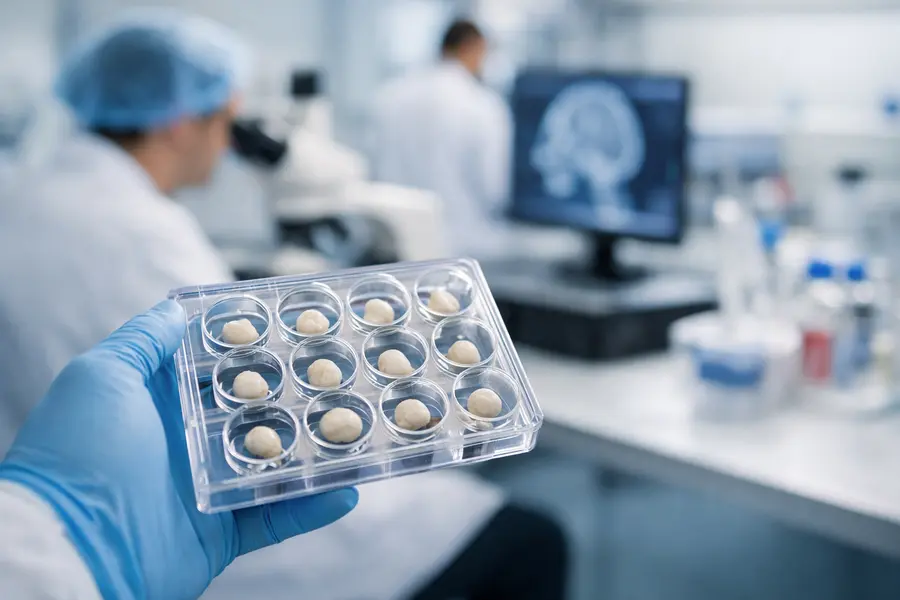
Transpharmation bought a platform for growing three-dimensional human brain tissue from patient stem cells. OrganoTherapeutics makes midbrain organoids and more complex assembloids from induced pluripotent stem cells, with disease models covering Parkinson's disease, Huntington's disease, ALS and frontotemporal dementia.
The company was founded in 2019 as a spin-off of the University of Luxembourg. Co-founder Jens Schwamborn, a principal investigator at the university's Luxembourg Centre for Systems Biomedicine, built the underlying midbrain organoid work. Its outside capital history is thin on the public record: KHAN-I, a fund managed by Khanu Management GmbH with about €70 million under management, took a stake in August 2023, and the amount was not disclosed.
Commercial traction came mainly through partnerships. Vyant Bio announced a Parkinson's collaboration in March 2022, and Japan's molmir followed with an R&D agreement in July 2025.
Why Would a Pharmacology CRO Want Brain Organoids?
A CRO built on animal studies needs a human-tissue offer because sponsors increasingly want both kinds of evidence before committing to a CNS program. Transpharmation has spent 25 years running in vivo studies. Neuroscience is also a field where mouse and rat results have a long record of failing to carry over to patients.
The combined pitch is triangulation. A sponsor could test a compound in an animal model and in patient-derived organoids within one contract, then use the two datasets for an earlier go or no-go call. Schwamborn framed it as offering "both approaches under one roof."
Regulation adds pressure. The US FDA said in 2025 that it would begin phasing out animal testing requirements for some drug classes, starting with monoclonal antibodies, and that signal has pushed CROs toward non-animal methods. Buying a working organoid group is faster than building one, particularly when the founding scientist joins the buyer.
How Does the Deal Fit the Wider Organoid Market?
The purchase follows a pattern of established service providers absorbing small organoid specialists. InSphero acquired PhenoVista in May, and Merck added organoid capacity through its purchase of HUB Organoids. In each case the acquirer owned customer relationships and regulatory know-how, while the target held the biology.
This looks like a strategic capability purchase, not an acquihire. OrganoTherapeutics brings a product line, existing partners and a defined disease focus, not only a team. The undisclosed price suggests a modest transaction, though that is an inference from the lack of any announced consideration.
Risks and Open Questions
Organoids carry reproducibility problems. Batch variation, limited maturity of the tissue and the lack of vasculature and immune cells all restrict how far a result can be trusted. Pharma buyers will want evidence that the models predict clinical outcomes, not just that they look like diseased brain.
Integration is the other test. A Luxembourg lab culturing stem-cell-derived tissue and an in vivo pharmacology business run on very different workflows, and the subsidiary structure suggests Transpharmation intends to keep them separate at first. Existing partners of OrganoTherapeutics will watch whether their agreements and IP terms stay unchanged.
Outlook
Transpharmation has used its first acquisition in human-tissue models to close a gap that its animal-only offer left open. The next signals are whether it announces integrated studies combining in vivo and organoid readouts, and whether it buys additional human-system assets. If sponsors adopt the dual-evidence approach for CNS programs, further consolidation among small organoid companies looks likely.