Pomegra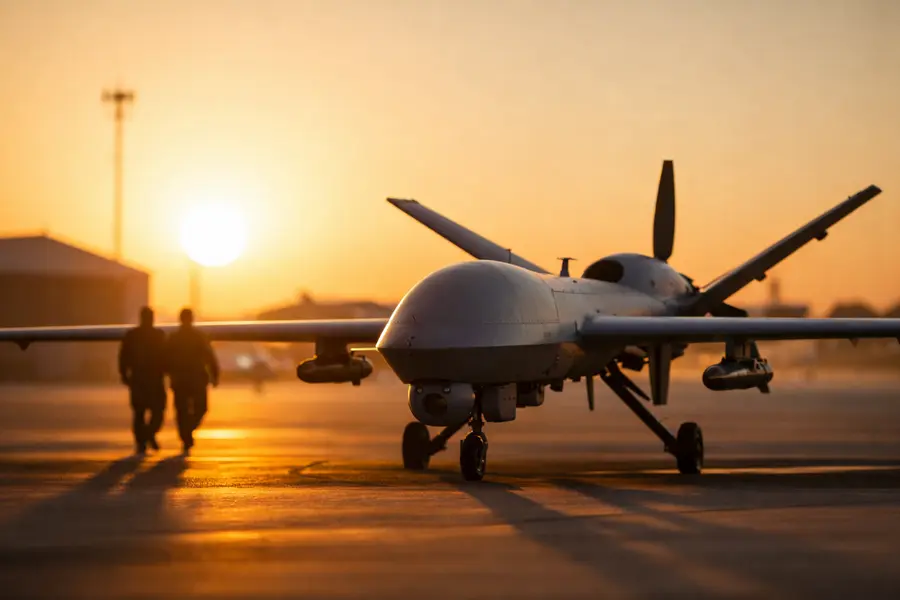
TEKEVER, the Portuguese-British AI drone maker battle-tested in Ukraine, closes a $580M Series D led by UC Investments and Baillie Gifford at a $6.4 billion valuation.
- TEKEVER's $580M Series D was co-led by UC Investments and Baillie Gifford, valuing the company at $6.4 billion - nearly five times its May 2025 mark.
- The company's AR5 surveillance drones have logged more than 50,000 operational flight hours in Ukraine since Russia's 2022 invasion.
- TEKEVER holds a £400M, 10-year UK Ministry of Defence contract for CORVUS, the British Army's new persistent surveillance capability.
Lead
TEKEVER closed the first tranche of a $580 million Series D on September 23, 2026, valuing the Portuguese-British AI drone maker at $6.4 billion - nearly five times the $1.32 billion it carried after its May 2025 raise. UC Investments, the University of California system's investment arm, co-led the round alongside Edinburgh-based fund manager Baillie Gifford. Merlyn Advisors joined as a new investor; Crescent Cove, Ventura Capital, and Iberis Capital participated as existing shareholders. The company will use the capital to expand internationally, scale manufacturing, and pursue acquisitions in a defense market it expects to consolidate.
What Did Investors Actually Pay For?
The investment thesis rests on 50,000 operational flight hours. TEKEVER's AR5 maritime and surveillance drones have been operating in Ukraine since Russia's full-scale invasion in February 2022, accumulating that track record in active combat conditions. No lab test replicates it. That operational data is the core asset underpinning a multi-billion dollar valuation. The AR5 platform has since been selected by the UK Ministry of Defence as the foundation for CORVUS, the British Army's new persistent surveillance capability, under a contract worth up to £400 million over ten years announced in August 2026.
Ukraine as a Proving Ground
The war in Ukraine has functioned as an extended field trial for an entire generation of European defense startups. TEKEVER is among the clearest beneficiaries: continuous demand from a live conflict zone forced rapid iteration on its autonomous flight software and sensor fusion. No comparable test environment exists commercially. That operational heritage has translated directly into procurement credibility with NATO-adjacent buyers. TEKEVER's systems are now in service with multiple European maritime and border agencies alongside their Ukrainian deployment, a customer base that carries weight in ministerial procurement discussions.
Why Has TEKEVER's Valuation Jumped Nearly Fivefold in 16 Months?
The short answer is contract wins combined with a structural shift in European defense budgets. NATO members have moved from aspirational targets to accelerating spend, with many pushing toward 3% of GDP. That fiscal shift has translated into faster procurement pipelines for surveillance, reconnaissance, and autonomous systems - the categories where TEKEVER competes directly. The CORVUS award provided the kind of concrete revenue visibility that justifies a valuation step-change. The company's previous round priced it as a promising startup. This one prices it as a serious defense contractor.
UC Investments' participation carries its own signal. The University of California endowment is making its first direct investment in a European company, indicating how far European defense tech has moved in institutional investor consciousness. Baillie Gifford, known for holding long-duration growth positions, adds a different kind of backing: patient capital betting on a multi-year build rather than a near-term exit.
The Acquisition Question
TEKEVER has been explicit about three priorities: geographic expansion, industrial capacity, and acquisitions. The defense hardware market is fragmenting as governments seek domestic or allied suppliers over traditional prime contractors, creating targets across sensor, communications, and integration subsystems. A company with a validated platform and fresh capital is positioned to consolidate smaller suppliers rather than build every component internally. The first close represents the majority of the planned raise, with further closings expected to bring in additional strategic investors over coming months.
Outlook
TEKEVER's path from Lisbon-founded research project to $6.4 billion defense platform took 25 years, but its valuation has moved mostly in the last 16 months. The combination of live operational data from Ukraine, a large UK government contract, and capital from institutional investors with long-horizon mandates positions the company to move beyond selling drones and into building a broader defense systems business. Acquisition risk in hardware-heavy sectors is real - integrations in this space frequently underdeliver. The underlying demand from European rearmament, however, shows no sign of softening. Further Series D closings and the strategic investors they may bring will indicate how far the ambition actually extends.