Pomegra
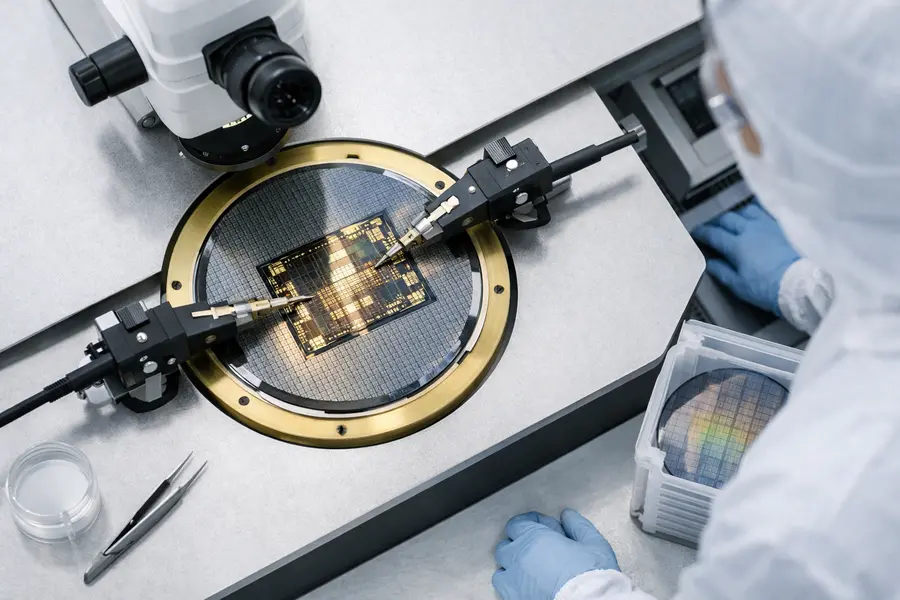
Salience Labs raised a $125M Series B led by Bullhound Capital to scale optical circuit switches that link GPUs in AI data centres, with AMD and Intel backing.
Key Takeaways
- Oxford-based Salience Labs closed an oversubscribed $125M Series B on 14 October 2026, led by Bullhound Capital.
- AMD Ventures and Intel Capital joined the round. The valuation was not disclosed.
- Funds go to volume manufacturing, 128- and 256-port switches, and a second Silicon Valley site.
Lead
Salience Labs, a UK developer of silicon-photonic networking chips, announced a $125M Series B on 14 October 2026. Bullhound Capital led the oversubscribed round. The company, based in Oxford, builds all-optical circuit switches meant to connect thousands of GPUs across multiple racks inside AI data centres. The raise is roughly three times the $41.5M the company had raised in total before this round, and it arrives weeks after a live demonstration of a 64-port switch at the ECOC 2026 conference.
Who Backed the Round?
Bullhound Capital led, and its principal, Callum Stewart, joins the Salience Labs board. New investors include AMD Ventures, Intel Capital, SBI Group, Hudson River Trading and the British Business Bank. Existing backers Applied Ventures, Oxford Science Enterprises, Cambridge Innovation Capital and Silicon Catalyst Ventures also participated.
The company did not disclose a valuation. That omission matters, because a step from a $30M Series A in February 2025 to $125M roughly 20 months later implies a large mark-up, and the pricing is not visible. The Series A was led by ICM HPQC Fund and Applied Ventures, after an $11.5M seed in 2022.
Two chipmakers that sell competing and complementary silicon are on the cap table. Strategic money from AMD and Intel signals interest in the switching layer, though neither has announced a supply or purchase commitment with Salience.
What Does Salience Labs Actually Build?
Salience builds optical circuit switches (OCS), devices that steer light between ports without converting it to electrical signals and back. The company says its design is fully integrated on silicon photonics, which removes the conversion step that adds latency and power draw in conventional packet switches. Its current product is a 64-port all-optical switch, shown at ECOC 2026 in September and described by the company as an industry first for silicon photonics OCS.
The pitch is aimed at AI data centre operators whose training clusters keep growing. Optical switching reconfigures physical paths between GPUs rather than inspecting and forwarding packets, which suits large, predictable training traffic. CEO and co-founder Vaysh Kewada said customers rolling out optical links need high-performance optical switches to deliver the "token economics" AI workloads demand. Cignal AI forecasts the OCS market will exceed $8 billion by the end of the decade.
Technology partners named by the company include Keysight Technologies and Tower Semiconductor, which point to the test and foundry sides of the supply chain.
How Will the Money Be Spent?
The company will spend the proceeds on three things: volume manufacturing, next-generation switches and geographic expansion. On the product side, Salience plans to move from 64 ports to 128- and 256-port configurations. On the commercial side, it will open a second West Coast location in Silicon Valley and expand its engineering team.
Manufacturing is the harder part. A working demo switch and a part that ships in volume with acceptable yield are different milestones, and the company has not published a production date or named customers. Insertion loss, port count and switching speed will decide whether hyperscalers qualify the part.
What Competition Does Salience Face?
Salience enters a market where optical switching is already deployed at scale by a few large operators, mostly using MEMS-based mirror switches built in-house or bought from specialist vendors. The company's argument is that silicon photonics offers better integration and manufacturing economics than mirror arrays. The article source material did not name competitors, and the company has not published head-to-head performance data.
The counterargument is practical. Incumbent MEMS designs have field history, and buyers in data centres are conservative about network components that sit in the path of expensive GPU clusters. Salience needs to show reliability at 128 and 256 ports before that conservatism eases.
Outlook
The round gives Salience a multi-year runway and two strategic chip-industry investors, but not yet a disclosed customer or valuation. The next signals to watch are the 128-port prototype, a named design win with a data centre operator, and evidence of foundry-scale output through Tower Semiconductor. If AI cluster sizes keep rising, optical switching demand should follow; if packet-switch vendors close the power gap, the window narrows.