Pomegra
San Francisco's Sabi raised a $50M seed round led by Khosla Ventures to build a non-invasive EEG baseball cap that turns imagined speech into AI commands.
Key Takeaways
- Sabi announced a $50M seed round on October 9, 2026, led by Khosla Ventures. Valuation is undisclosed.
- Accel, Initialized Capital, Kevin Weil, DST Global, Collaborative Fund and Ascend also invested.
- An early prototype of the cap is due at CES 2027. Sabi has not given a shipping date.
Lead
Sabi, a San Francisco startup building a wearable brain-AI interface, announced a $50M seed round on October 9, 2026. Khosla Ventures led the round. Accel, Initialized Capital, former OpenAI Chief Product Officer Kevin Weil, DST Global, Collaborative Fund and Ascend also participated. The company did not disclose a valuation or any earlier funding.
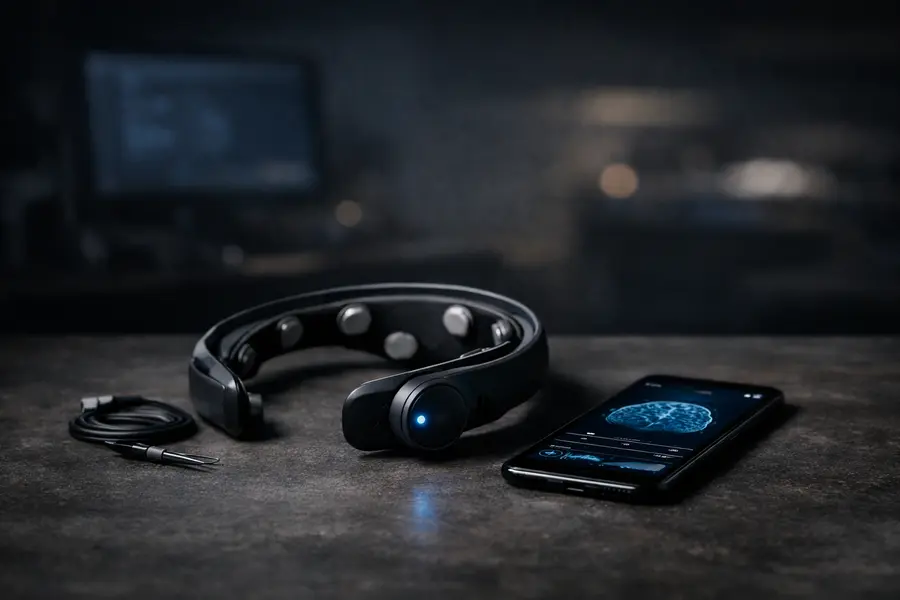
Sabi's first product looks like an ordinary baseball cap. Sensors hidden inside read neural signals through hair, with no surgery, gel or direct scalp contact. The company plans to show an early prototype at CES 2027 in January.
What Is Sabi Building?
Sabi is building a cap that translates brain activity into input for AI systems. It is developing three interaction modes: imagined speech converted to on-screen text, a trained mental command that triggers an instruction to an AI assistant, and intent prediction that anticipates a user's next keystroke or action.
The hardware rests on a custom EEG chip with sensors measuring 1 to 5 millimeters. Sabi says the chip uses 50 times less power than the Texas Instruments ADS1299, a widely used EEG front-end component. The cap connects wirelessly to phones and computers.
CEO Rahul Chhabra framed the pitch around a mismatch. "AI can write, reason and act, yet we still communicate with it by tapping on keyboards," he said. CTO Atmadeep Banerjee is a co-first author of MindEye, a NeurIPS 2023 paper on decoding viewed images from non-invasive brain recordings. The team also includes people from Kernel, Apple, Microsoft, Meta, Adobe and Nike, plus neuroscientists from Stanford.
How Big Is the Dataset Behind It?
Sabi says it has collected more than 100,000 hours of labeled, non-invasive neural recordings, which it calls the largest disclosed dataset of its kind. Participants imagined words and performed specific mental tasks while the recordings were made. The data trains the company's Brain Foundation Model, which decodes the signals.
That figure is a company claim, and no independent benchmark has been published. Decoding imagined speech from scalp EEG is a hard problem. The skull and hair blur the signal, and a model that works for one wearer often degrades for the next. Accuracy, latency and per-user calibration time will matter more than hours of data, and Sabi has not released numbers for any of them.
Why Does a $50M Seed Matter for Brain-Computer Interfaces?
A $50M seed is large for a hardware company with no shipping product, and it shows how much capital now flows to anything that links AI to a person. Khosla Ventures has a record of backing long-horizon hardware and AI bets, and the round's mix of AI-focused and consumer-focused investors suggests a bet on a new input device rather than a medical one.
The approach also separates Sabi from implant-based players such as Synchron. Sabi's own materials name Synchron, Neurable and Merge Labs as competitors. Implants capture cleaner signals but require surgery and regulatory approval. A cap avoids both, at the cost of weaker signal. Sabi is wagering that a large dataset and a custom chip can close that gap.
The round leaves open what a $50M seed implies about the company's prior traction. Sabi has disclosed no earlier raise, revenue or user numbers. The size suggests investors are funding the dataset and the chip, both of which cost money before any product exists.
What Happens to Neural Data?
Sabi says neural data is encrypted at the sensor level and that inference runs on encrypted data. Its servers therefore never receive a user's unencrypted neural signals. The company also describes controls for recording, app permissions and action confirmations.
Those claims will draw scrutiny. Neural data is a privacy category that several US states have begun to address in legislation, and a consumer device that records brain activity all day invites regulators' questions. Sabi has not published details of its encryption scheme or any third-party audit.
What Will the Money Pay For?
Sabi plans to expand its neural dataset, finish the custom chip, manufacture early devices and hire across neuroscience, hardware and machine learning. It also intends to prepare units for an early-access waitlist. The CES 2027 prototype is the first public checkpoint.
Outlook
Sabi enters the field with a $50M seed, a notable investor group and a form factor that asks nothing of the wearer beyond putting on a hat. The unproven parts are decoding accuracy, usable latency and whether imagined-speech input beats a keyboard or voice for ordinary tasks. The CES 2027 prototype will give the first outside look at those questions, and the early-access waitlist will show whether consumers want the product. Valuation, revenue and a shipping date remain undisclosed.