Pomegra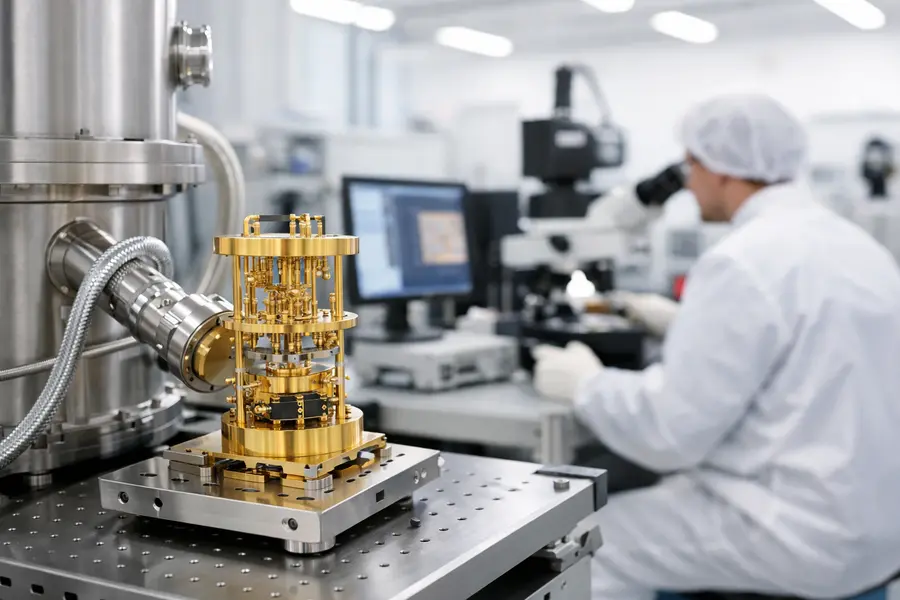
Finnish VTT spinout S-Transistors raised €2.6M pre-seed to develop superconducting transistors that put control electronics inside the cryostat, bypassing the wiring bottleneck choking qubit scaling.
- S-Transistors, founded by VTT researchers, closed a €2.6M pre-seed led by Lifeline Ventures on August 31, 2026.
- The startup's superconducting transistors operate at cryogenic temperatures, eliminating the cable-per-qubit wiring problem slowing quantum scale-up.
- First product is a multiplexer targeting signal control inside cryogenic systems; funds also go toward a pilot manufacturing line and dedicated cryo lab.
Lead
S-Transistors, a spinout from VTT Technical Research Centre of Finland, raised €2.6 million in pre-seed funding on August 31, 2026, led by Helsinki-based Lifeline Ventures with participation from an undisclosed angel investor. The company was founded by Dr. Heorhii Bohuslavskyi (CEO), Dr. Andrey Generalov (CTO), and Markus Lehtisalo, all of whom built the underlying technology at VTT. Valuation was not disclosed.
What Is the Wiring Problem in Quantum Computing?
Every additional qubit in today's superconducting quantum computers demands its own set of control and readout cables running from inside the cryostat - where temperatures hover around 15 millikelvin - all the way out to classical electronics operating at room temperature. At small qubit counts, this is manageable. At the hundreds or thousands of qubits needed for fault-tolerant computation, it becomes a physical absurdity: the cable infrastructure grows faster than the processor it feeds, heat leaks in along every wire, and the refrigeration systems required to compensate balloon in size and cost.
The constraint is not software, not qubit quality, and not even the refrigerators themselves. It is the fundamental incompatibility between where the qubits live and where their control electronics have to sit.
How Do Superconducting Transistors Change the Equation?
S-Transistors is building transistors that function at cryogenic temperatures using superconducting materials. Conventional transistors dissipate heat that the cryostat cannot handle; superconducting transistors sidestep that constraint entirely. Because they can operate at the same temperatures as the qubits themselves, control electronics built from them can move inside the cryostat, dramatically cutting the number of cables needed between the quantum processor and the outside world.
The company frames its target product as a "quantum motherboard" - an integrated circuit platform that provides energy- and cost-efficient orchestration of cryogenic quantum processors at scale. The first commercial product will be a multiplexer designed to reduce the wiring and power demands of controlling quantum devices inside cryogenic systems. The broader pitch is that superconducting transistors are the missing substrate layer that allows quantum computing to follow a trajectory resembling the scaling of classical chips - an analogy the founders invoke deliberately, noting the transistor's status as the most mass-manufactured device in human history.
Why Does the VTT Lineage Matter?
VTT is Finland's primary state-owned technical research institute and has been one of the more credible non-US entrants in the quantum hardware space. Spinning a company directly from that research base gives S-Transistors access to institutional fabrication know-how that is genuinely difficult to replicate from scratch. The founding team's background in cryogenic device physics at VTT means the pre-seed funding is going into execution - a manufacturing pilot line, a proprietary cryogenic laboratory, and team growth - rather than basic feasibility work.
Lifeline Ventures has a track record in deep-tech bets out of the Nordic region; the firm's involvement signals at least one experienced European early-stage investor views the technical risk as acceptable at this stage.
Strategic Context
S-Transistors is not the only group pursuing cryo-compatible control electronics. Several larger players, including quantum hardware companies and established semiconductor firms, have explored cryogenic CMOS as an intermediate solution. The key distinction S-Transistors draws is power dissipation: cryogenic CMOS still generates heat inside the fridge, while superconducting transistors, by design, dissipate far less. Whether that advantage holds through manufacturing scale and real-system integration is the central question the pre-seed round is meant to begin answering.
The applications extend beyond quantum. Superconducting transistors could offer efficiency gains in classical high-performance computing and in spacecraft electronics, where power constraints are severe. But quantum is the near-term market with the clearest pain point, and that is where the company is pointing its first product.
Outlook
S-Transistors enters a field where the engineering problem is real, well-understood, and growing more acute as quantum processor qubit counts climb. The €2.6M pre-seed is a modest opening for deep hardware - enough to build prototypes and validate manufacturing, not enough to ship at scale. The next funding test will come when the multiplexer exits the lab and encounters the integration demands of actual quantum computing customers. If the cryo-compatible control stack holds up, the company's position at the interface between classical semiconductor manufacturing and quantum hardware could become a durable one.