 Pomegra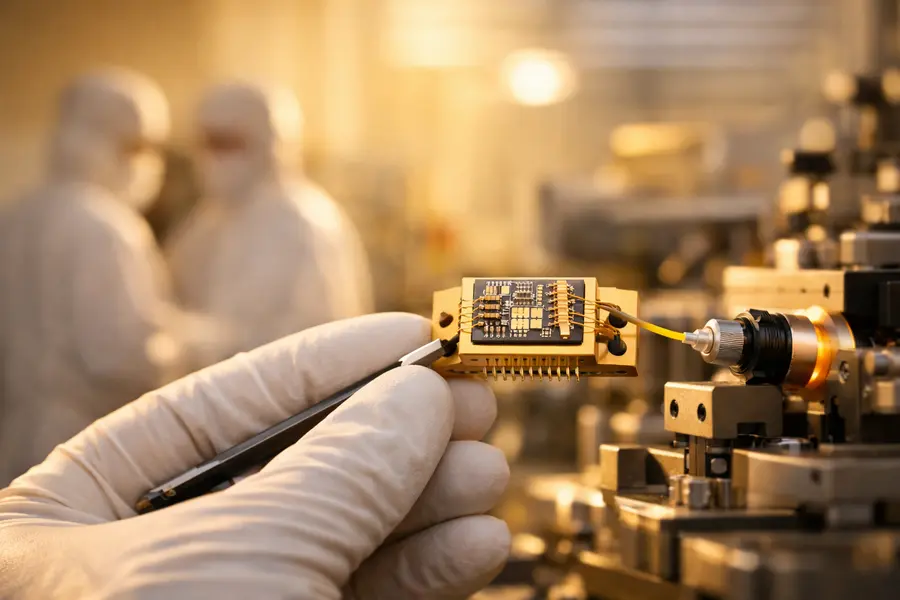
Quintessent raised $40 million in an oversubscribed Series A led by Cycle Capital, with Goldman Sachs and Ciena among backers, to commercialize a single-chip quantum dot DWDM comb laser designed to cut optical component complexity inside AI data centers.
Key Takeaways:
- Quintessent closed a $40M oversubscribed Series A on August 24, 2026, led by Cycle Capital.
- Goldman Sachs XIG-Industry Ventures and networking vendor Ciena joined as new strategic investors.
- The company's single-chip comb laser generates 8 DWDM wavelengths from one device and has entered customer sampling.
The Deal
Santa Barbara-based Quintessent closed a $40 million Series A on August 24, 2026 - oversubscribed, a detail the company chose to publicize - to scale commercial production of its quantum dot DWDM comb laser for AI data center interconnects. Cycle Capital led the round. New investors included Goldman Sachs XIG-Industry Ventures, Hina Liberty Capital, Susquehanna International Group, InterVest, Safar Partners, and optical networking vendor Ciena. Returning backers Foothill Ventures, M Ventures, Osage University Partners, and Sierra Ventures also participated. Valuation was not disclosed.
The round follows a $11.5 million seed closed in early 2024, a roughly 3.5x step-up in capital that reflects both the rising cost of getting photonic chips to commercial readiness and the compressed timeline AI infrastructure demand has imposed on component suppliers.
What Does the Product Actually Do?
The comb laser generates eight precisely spaced optical wavelengths from a single chip, controlled by a single bias current. Conventional AI cluster interconnects use a separate, individually tuned laser for each wavelength - multiplying component count, thermal management complexity, and failure points. Quintessent's device collapses that stack into one package.
The underlying material choice is deliberate. The chip uses gallium arsenide (GaAs) O-band quantum dot gain material rather than the more common indium phosphide (InP). GaAs quantum dots are more thermally stable and allow heterogeneous integration on standard silicon photonics wafers, enabling wafer-scale manufacturing economics that InP-based approaches have struggled to match. Customer sampling began on the same day the funding was announced.
Why Did Strategic Investors Show Up?
The presence of Ciena alongside Goldman's industrial and innovation vehicle is the tell. Ciena is a publicly traded optical networking equipment vendor; a manufacturable comb laser source that simplifies dense wavelength-division multiplexing fits directly into its existing hardware roadmap and supplier base.
Goldman Sachs XIG-Industry Ventures focuses on deep-tech sectors where physical infrastructure intersects with AI buildout. Their participation reflects a broader capital migration: away from software layers and toward the hardware that moves data between GPUs at scale. That the round was oversubscribed suggests the $40 million ceiling was Quintessent's choice, not a ceiling set by investor appetite - a posture that preserves leverage heading into future raises.
The AI Datacenter Bottleneck
Optical interconnects inside AI data centers are approaching a scaling wall. As GPU clusters expand into configurations of hundreds of thousands of accelerators, the electrical links between them become congestion points. The industry's answer is co-packaged optics and DWDM - more wavelengths per fiber, tighter integration with compute hardware. That path requires lasers that are dense, power-efficient, and available at the volumes chip fabs produce.
Eight wavelengths per chip, at the same power budget as individual laser arrays, means eight times the data density per optical source. Across a hyperscale build, the reduction in component count and assembly cost is substantial rather than marginal.
Quintessent also holds a foundry partnership with Tower Semiconductor, established in 2021, to manufacture the platform on Tower's PH18 silicon photonics process. That arrangement provides fab access without the capital expenditure of building captive manufacturing - a significant cost advantage for a company still in the sampling phase.
Outlook
Quintessent will apply the Series A toward reliability qualification and manufacturing ramp for the comb laser, development of semiconductor optical amplifiers to extend its product line, and construction of an optical engine targeting pluggable module interconnects within AI data centers. The decision to announce customer sampling and funding simultaneously compresses the narrative distance between capital and commercial traction. Qualification cycles for optical components in hyperscale deployments typically run 12 to 18 months, which means design wins - and the revenue that follows - remain roughly a year out. Whether the $40 million carries the company through that window and into a production ramp is the central question the next round will have to answer.