Pomegra
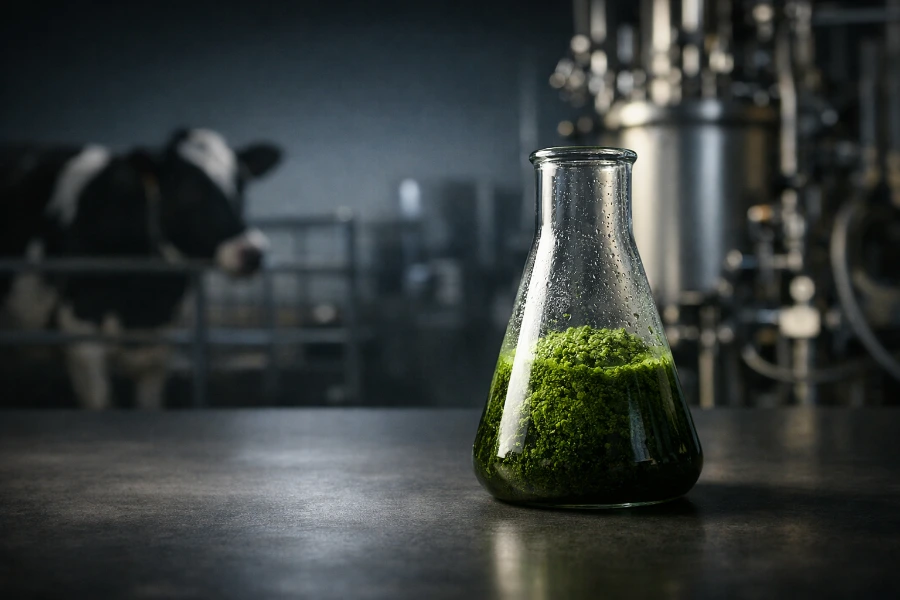
Provectus Algae closed a $4.3M Series A extension led by At One Ventures to scale Surf'N'Turf, a methane-cutting cattle feed additive targeting 250,000 head in 2027.
Key Takeaways
- Provectus Algae closed a US$4.3M (A$6.3M) Series A extension on November 17, 2026, led by At One Ventures.
- Queensland Investment Corporation put in A$2.8M; the Series A now totals more than US$14M. Valuation is undisclosed.
- Surf'N'Turf is meant to reach up to 250,000 cattle in 2027 through the spinout Proteus Ag.
Lead
Provectus Algae, a Noosaville, Queensland, agtech company, announced on November 17, 2026 that it closed a US$4.3M (A$6.3M) extension to its Series A. At One Ventures led the round. The money will fund manufacturing and commercial build-out for Surf'N'Turf, an algae-derived feed additive that cuts methane from cattle, as the company moves from trials to sales. The company did not disclose a valuation.
Who Put Money In?
At One Ventures led, and the Queensland Investment Corporation (QIC) joined as a new investor. QIC invested A$2.8M (about US$2M) through the Queensland Government's A$30M Sowing the Seeds of Farming Innovation Fund. That brings total Queensland Government backing for Provectus to A$3.8M.
Existing shareholders also took part. The investor base already included Methane Mitigation Ventures, Mort & Co, Sturgess Holdings and the Korean group CJ. Mort & Co is also the feedlot operator that hosted the largest commercial trial, so it is both a customer and a shareholder.
What Does Surf'N'Turf Actually Do?
Surf'N'Turf is a granular and liquid feed additive that cuts the methane cattle belch out. It recreates the active compounds of the red seaweed Asparagopsis, which CSIRO researchers identified as a methane suppressor, using algae and photosynthetic microbes grown in tanks rather than harvested from the ocean. The company says the additive leaves no detectable residue in animals and needs no withholding period.
In a commercial trial with Mort & Co covering more than 2,700 cattle, the company reported a 67% reduction in methane measured in expired air. Total trial exposure is just under 3,000 to over 3,000 animals across feedlot and pasture settings, depending on the count cited. Cost is roughly 8 cents per animal per day at one gram per kilogram of feed, a figure the CEO has put forward.
The product competes with direct-harvest seaweed supplements and with synthetic inhibitors such as 3-NOP. Its pitch is that microbial fermentation avoids the supply limits of farmed seaweed.
Why Is This an Extension and Not a New Round?
An extension means the company topped up an existing round rather than priced a new one, and that usually signals incremental progress. Provectus raised US$10.1M in its Series A in July 2025, so this extension arrives about 16 months later and pushes the Series A past US$14M. Earlier rounds were a US$3.25M seed in 2020 and an US$11.4M pre-Series A in 2021, plus an undisclosed investment from CJ in 2023. Cumulative funding sits near US$28.65M.
The lack of a disclosed valuation limits how much can be read into the terms. Government capital makes up almost half the extension, which tends to be patient but also tied to local manufacturing commitments. The lead investor's participation, and the fact that existing backers followed on, point to confidence in the trial data rather than a rescue.
How Big Is the Commercial Step?
The company is targeting supply for up to 250,000 cattle in 2027, up from roughly 3,000 animals tested so far. That is a jump of about 80 times in a single year, and it depends on Queensland manufacturing capacity scaling on schedule. Commercial sales will run through Proteus Ag, a spinout created to handle manufacturing, supply and sales for the livestock product.
The global opportunity is large, with about 1.5 billion head of cattle worldwide, a figure QIC cited. Reaching that population is a different problem from reaching 250,000. Feed additives succeed when producers have a financial reason to adopt them, and methane reduction alone rarely pays unless carbon credits, supply-chain mandates or improved feed efficiency cover the cost.
Provectus is also pursuing human nutraceuticals and crop-protection biologics from the same Precision Photosynthesis platform, which uses AI-enabled compound discovery. Those programs give the company other revenue paths, though the livestock product is clearly the nearest to market. The company has about 25 staff and expects to add more as manufacturing grows.
What Comes Next for Livestock Methane Feed Additives?
The next test is whether Provectus can hold its reported reduction rate at 100 times the trial volume and deliver at a price producers accept. Regulatory clearance outside Australia, buyer programs that pay for lower-emission beef and dairy, and competing products will decide how fast adoption moves. A larger Series B or strategic partnership would likely follow if 2027 deliveries land near target.
Outlook
Provectus has a trial result of 67% methane reduction, a lead investor that stayed in, and state funding to build capacity. What it lacks is disclosed pricing for the round and proof at commercial scale. The 2027 supply target for 250,000 cattle is the measure that will show whether the extension bought a product or only more runway.