Pomegra
Eindhoven's Photon Bridge raised €10M, co-led by Amadeus APEX and 360 Capital, to build multi-wavelength laser sources for AI data centres and telecom.
Key Takeaways
- Photon Bridge raised €10M on 21 October 2026, co-led by Amadeus APEX Technology Fund and 360 Capital.
- First samples are due in 2027, with preparation for volume manufacturing from 2028.
- Valuation and customers were not disclosed.
Lead
Photon Bridge, an Eindhoven startup building optical engines for AI and telecom, announced a €10 million round on 21 October 2026. New investors Amadeus APEX Technology Fund and 360 Capital co-led it. Existing backers Innovation Industries, Faber and the Brabant Development Agency (BOM) increased their stakes. The company did not disclose a valuation.
The money follows a €4.75 million seed round led by Innovation Industries in January 2025. Photon Bridge has therefore raised at least €14.75 million in under two years, and the second cheque is more than double the first.
What Does Photon Bridge Build?
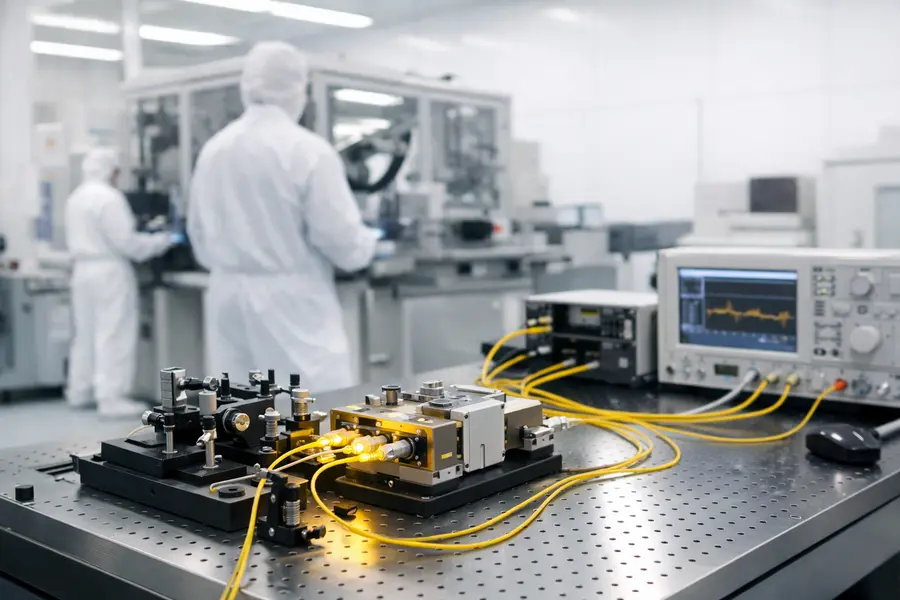
Photon Bridge builds laser sources that feed the optical links connecting AI chips. The company, founded in Eindhoven in 2020 by Rui Santos and Xaveer Leijtens, combines and multiplexes light from several lower-power semiconductor lasers instead of relying on one high-power laser.
Its platform delivers up to 40 mW of optical power per wavelength, across many wavelengths, through a single fiber. It uses spring-like connectors that let components align themselves, and it is designed for production across several indium phosphide foundries. The company pairs III-V laser materials with silicon photonics.
Why Do AI Clusters Need So Many Lasers?
AI clusters need lasers because moving data between chips optically requires a light source for every link. CEO Paul Marchal said the industry will soon need millions of laser sources every year. His argument is that making individual lasers ever more powerful makes them harder to manufacture, so Photon Bridge moves the scaling problem into the architecture.
That framing explains the investor interest. Ion Hauer of APEX Ventures called lasers the next bottleneck created by the AI boom. Cesare Maifredi of 360 Capital said AI is turning lasers from a telecom component into a semiconductor-scale product, and that manufacturing yield becomes essential at that scale.
The claim is plausible but unproven. Telecom lasers have historically sold in volumes far below those of chips, and no one has yet shown that a multiplexed design of this kind can hit semiconductor yields at a competitive cost.
Who Is Backing the Round?
Two new funds lead the round, and all three existing investors returned. Innovation Industries, Faber and BOM each put in more money, which is a modest signal that the first 21 months met their expectations. A Dutch regional development agency alongside venture funds is typical of European deep tech, where public money often fills early capital gaps.
The new co-leads bring a different profile. Amadeus APEX is a technology fund, and 360 Capital is a pan-European venture firm. Neither has disclosed its cheque size in the round.
What Are the Gaps in the Story?
Three details are missing. No valuation was disclosed, so the price of the step-up from the 2025 round is unknown. No customers were named, and the announcement describes "customer qualification" as a goal rather than a result. The company has not published revenue.
The timeline sets the pace. Samples arrive in 2027, and volume manufacturing preparation begins in 2028. That leaves roughly a year before a customer can test hardware and two years before any production ramp. The company plans to use the money for product development, customer qualification and hiring in Eindhoven, where it has a team of about 17.
What Comes Next for Photon Bridge?
Next comes the sample phase in 2027, when qualification with optical-module and chip makers decides whether the architecture holds up. Foundry compatibility matters here. Designing for multiple indium phosphide foundries reduces supply risk, but each foundry still needs process work before yields are proven.
Eindhoven's photonics cluster, anchored by the local university and a chip-integration ecosystem, offers talent and fabrication access. Competition will come from established laser and transceiver suppliers, which are also racing to supply AI interconnects. Photon Bridge's edge, if it holds, depends on yield economics that are visible only at volume.
Outlook
Photon Bridge has doubled its funding in under two years and kept its full investor base while adding two new co-leads. The €10 million covers the path to samples in 2027 but probably not volume production, which will need a larger round once customers validate the product. The next milestones are customer qualification, a first look at yields and a disclosed priced round.