Pomegra
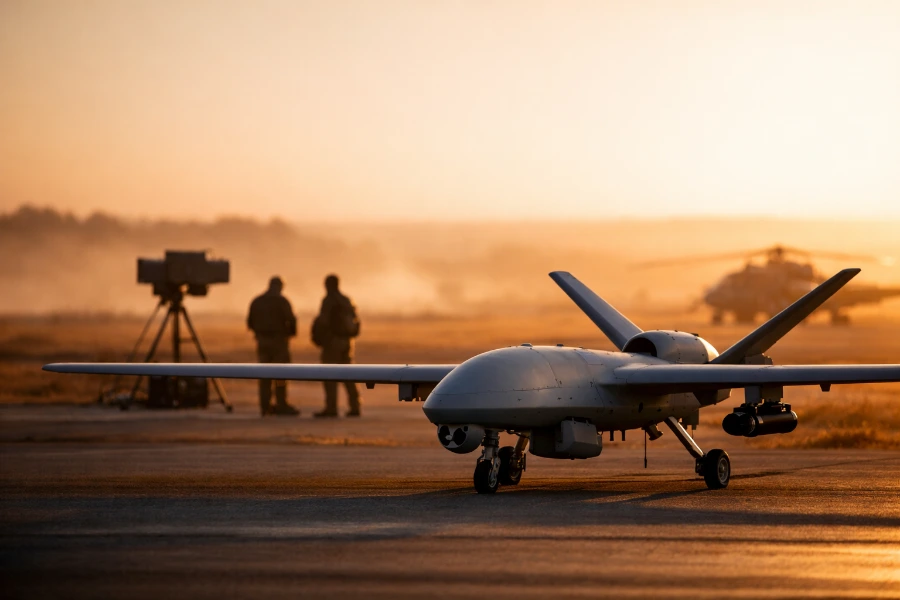
British-Ukrainian startup Pai Defence has closed a €4.58M (about $5M) pre-seed round led by Nordic fund Gardar to map drone activity along Ukraine's front line with passive sensors.
Key Takeaways
- Pai Defence raised a €4.58M (~$5M) pre-seed round, led by Gardar. Valuation is undisclosed.
- Its passive radio sensors have tracked more than 100,000 drone flights in Ukraine.
- Nine other backers joined, most of them Ukrainian defence-tech investors.
Lead
Pai Defence, a British-Ukrainian defence startup founded in 2025, announced a €4.58M (about $5M) pre-seed round on 24 November 2026. The Nordic venture fund Gardar led it. The company will use the money to widen its network of frontline sensors, improve its machine-learning software and add engineers.
Pai is coming out of stealth with a product already in use. It says its system has been tested in combat with Ukrainian military units and has tracked more than 100,000 drone flights. Pai has not disclosed the valuation, the names of its military customers or its headcount.
What Does Pai Defence Actually Build?
Pai builds an airspace monitoring system that detects drones through passive radio-frequency sensors and machine-learning software. The sensors emit no signal of their own, so they do not reveal their position to enemy electronic warfare teams. The software classifies drones by type, tracks them and builds a picture of activity over a sector.
The pitch is lead time. Zakorchemna, the company's aerospace engineer co-founder, has said that for the most lethal weapon on the front line, a detector's beep when the drone is almost overhead is far too late. Pai wants to show units where drones fly, which routes they favour and where their operators sit, so crews can prepare before a drone arrives. That is a different product from the handheld detectors and jammers that most units carry now.
Who Is Behind the Round?
Gardar led the round, and nine investors followed: UA1, D3, Green Flag, Defence Builder, 1991 Ventures, Motanka, WildField, TA Ventures and Angel One. Most are Ukrainian funds or angels. That mix suggests local investors see Pai as a product with a real customer base, while the Nordic lead brings a European fund into the cap table.
Gardar managing partner Erlend Prestgard has said that, depending on the sector, 70 to 90 percent of front-line fatalities come from FPV drones. That figure is the investor's own framing of the market and should be read as such. It does explain why detection tools attract money in a market where pre-seed rounds in defence hardware rarely reach $5M.
Pai was founded by Tonia Zakorchemna and Dmytro Pulmanovsky, a Ukrainian military volunteer and commander. A founder with direct command experience and an engineer with an aerospace background is a common pairing in Ukrainian defence startups. It tends to shorten the loop between a battlefield complaint and a software update.
What Are the Limits of the Technology?
Passive radio detection works only on drones that transmit. Fiber-optic drones and fully autonomous ones that fly without radio links produce no emissions for the sensors to pick up. Both types are spreading, and Russian units have adopted them to defeat electronic warfare.
Radio-controlled drones still carry much of the load. Data on Russia's Rubikon formation in 2026 shows that RF-controlled drones accounted for 67 percent of its tactical strike missions. A system built for that traffic has a large addressable share today. It also carries a clear risk as the share declines. Pai has said it plans to adapt to evolving threats, but it has not described how it would cover non-emitting drones.
How Crowded Is the Market for Drone Detection?
The market is crowded and getting more so. Ukrainian and Western firms sell acoustic, radar and radio-frequency detectors, and the state has pushed procurement of airspace awareness tools. Pai's differentiator is the analytics layer: pattern analysis and operator location, rather than a simple alert. The 100,000 tracked flights give it a training dataset that newer entrants lack.
The pre-seed size also sets expectations. A $5M first round buys roughly one to two years of hardware iteration and field deployment. The next round will depend on whether Pai can show units paying for coverage, and on whether the data advantage holds as the threat changes.
What Comes Next for Pai?
Pai says it will scale across Ukraine and strengthen its engineering team. It also plans to move beyond military use, with counterterrorism and public safety named as future applications. Those markets are further from the company's current evidence base, and they carry different procurement cycles and regulatory demands.
Outlook
Pai Defence enters the market with a €4.58M pre-seed, a Nordic lead and a record of 100,000 tracked drone flights. Its main strength is early warning without emissions. Its main exposure is the shift toward fiber-optic and autonomous drones that passive RF sensors cannot see. The next milestones are broader sensor coverage across Ukraine, evidence of paying military customers and a credible answer to non-emitting threats.