Pomegra
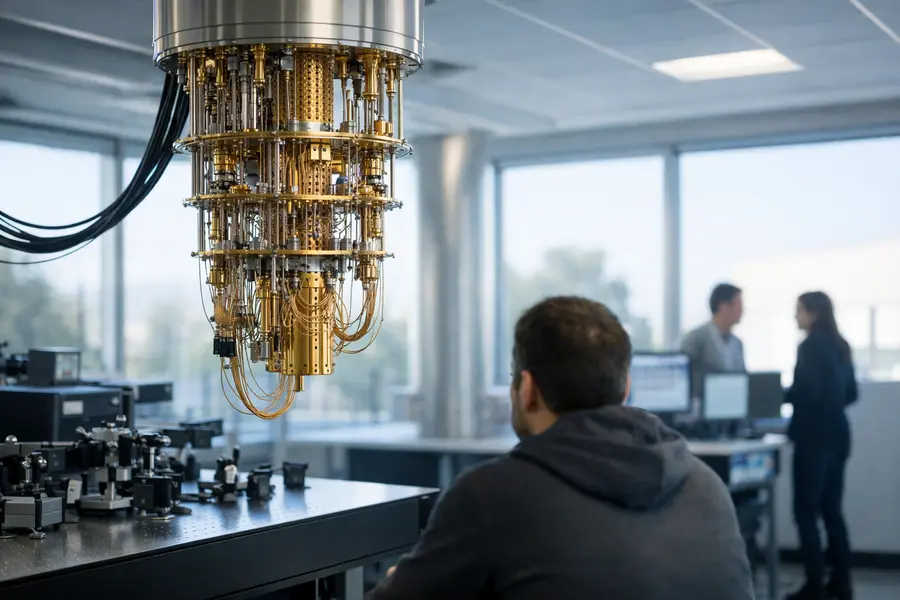
Pasadena startup Oratomic raised a $475 million Series B in October 2026, reportedly at a $5.4 billion valuation, to build a fault-tolerant neutral-atom quantum computer by 2030.
Key Takeaways
- Oratomic announced a $475M Series B on October 8, 2026, bringing total funding to $775M.
- Six firms co-led the round, including ARCH Venture Partners, Spark Capital and Khosla Ventures.
- Reported valuation of $5.4B to $5.5B compares with about $1.5B after a July Series A.
Lead
Oratomic, a Pasadena, California quantum computing company founded in 2025, announced a $475 million Series B on October 8, 2026. ARCH Venture Partners, Spark Capital, Khosla Ventures, Index Ventures, General Catalyst and Bezos Expeditions co-led the round. Total funding now stands at $775 million, and the valuation is reported at between $5.4 billion and $5.5 billion.
The company builds quantum computers from individual neutral atoms held in arrays of focused laser beams known as optical tweezers. Its stated goal is a fault-tolerant machine capable of useful, large-scale calculations, with CEO Dolev Bluvstein targeting 2030.
What Happened to the Valuation in Three Months?
The valuation rose roughly fourfold in about three months. Oratomic closed a $300 million Series A on July 7, 2026, co-led by ARCH, Spark and Khosla, at a reported $1.5 billion valuation. The Series B lifts that figure to roughly $5.4 billion.
Two rounds totaling $775 million in seven months, for a company that emerged from stealth only in March 2026, is unusual even by deep-tech standards. The Series A investors Bezos Expeditions, Index Ventures and General Catalyst moved up to co-lead status in the new round. That pattern suggests existing backers chose to increase their exposure rather than let new investors set the price.
The valuation figures come from press reports rather than a company disclosure, and the two reported numbers differ by $100 million. Neither Oratomic nor its investors have confirmed a precise figure.
What Does Oratomic Actually Build?
Oratomic is developing a neutral-atom quantum computer based on reconfigurable atom arrays. The atoms act as qubits, and the system can rearrange them mid-computation, which the company argues makes error correction more efficient.
Its central claim is that a useful fault-tolerant machine needs only about 10,000 to 20,000 physical qubits. Many competitors have discussed targets near one million. If the lower figure holds, the engineering and cost burden falls sharply. That remains a research-backed projection, and no one has yet demonstrated a machine of that size operating with full error correction.
The company is skipping the intermediate products many quantum startups sell to build revenue. It is concentrating on the final system. Bluvstein has said plainly that the business model is not yet settled, and that the priority is crossing the point where a working computer can be built cheaply and manufactured at volume.
Who Is Behind the Company?
The founding team draws on Caltech and Harvard. Bluvstein, the CEO and co-founder, worked in the Harvard group led by Mikhail Lukin. Co-founder Manuel Endres is a Caltech professor known for trapping roughly 6,000 atoms in a single array. Physicist John Preskill is an advisor, and other researchers include Madelyn Cain, Harry Levine and Hsin-Yuan Robert Huang.
Other Series A participants included Lowercarbon Capital, Bain Capital, Formation and Nebular. The company has also partnered with Monarch Quantum on optical infrastructure and manufacturing integration.
How Will the Money Be Spent?
Oratomic says the capital will expand its scientific and engineering teams, build laboratory infrastructure and develop its quantum computer systems. Its earlier Series A funds were earmarked for recruiting in optics, atomic physics and classical control hardware.
The round arrived the same day as a $100 million-plus Series A for Universal Quantum, a UK company using trapped-ion systems. Capital is flowing across competing hardware approaches at once, and no modality has clearly won.
What Comes Next for Fault-Tolerant Quantum Computing?
Oratomic now has funding to pursue a 2030 target, but the hard milestones lie ahead. Scaling from thousands of trapped atoms to a 10,000-qubit system with real-time error correction is an engineering problem, not just a physics one. Rivals pursuing different architectures, and larger incumbents with their own neutral-atom programs, will test whether the lower-qubit-count thesis survives contact with hardware.
Investors are also pricing a company with no commercial product. Intermediate demonstrations over the next 12 to 24 months will show whether the roadmap is on schedule. A miss would be costly at a $5.4 billion valuation, since follow-on capital at this scale depends on visible progress.
Outlook
Oratomic has raised $775 million in seven months on a thesis that fault-tolerant quantum computing needs far fewer qubits than the industry assumes. The $475 million Series B gives it runway to test that claim, with 2030 as the stated deadline. The next few years will show whether the valuation reflects engineering progress or enthusiasm for the sector.