Pomegra
Mueon, the Portland chip-infrastructure startup, closed a $65M Series A led by Maverick Silicon to build stacked "Cubelets" servers for AI and hyperscale data centers.
Key Takeaways
- Mueon raised a $65M Series A led by Maverick Silicon; Intel Capital and IQT also participated.
- Total funding exceeds $80M after a $15.5M seed round announced in 2025.
- Valuation is undisclosed; Mueon targets up to 10x power and cost efficiency per rack.
Lead
Mueon Corporation, a Portland, Oregon company building modular three-dimensional computing hardware, announced a $65M Series A on October 15, 2026. Maverick Silicon led the round. Participants included Intel Capital, IQT, Geodesic Capital, Oregon Venture Fund, M-Ventures, Wellington Management and Defined. Mueon did not disclose a valuation.
The financing follows a $15.5M seed round announced in 2025 and lifts total capital raised to more than $80M. Mueon will spend the money on engineering and operations hiring and on moving its Cubelets platform from development toward validation and production readiness.
What Does Mueon Actually Build?
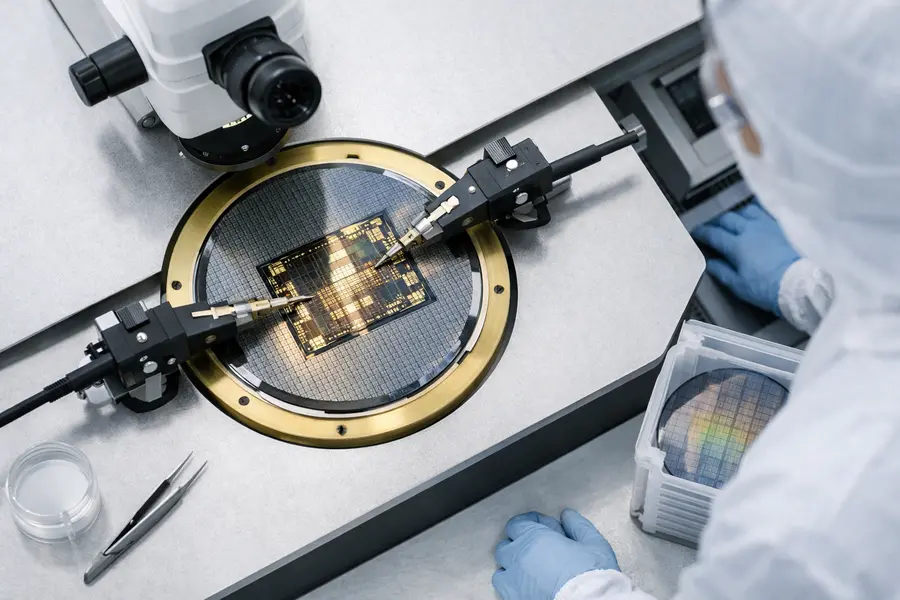
Mueon builds Cubelets, modular 3D blocks that stack compute and memory on top of one another. Each unit integrates interconnect, power delivery and thermal management. Shortening the physical distance data travels between components lowers the energy spent moving it, which is the stated basis for the company's efficiency claims.
The company says the architecture can deliver up to 10x gains in power and cost efficiency within the same rack footprint. It is designed to scale toward megawatt-class density. Mueon also plans software that lets customers run familiar AI frameworks on the hardware, and the platform is meant to work with GPUs and Arm processors.
Those efficiency figures are targets, not measured production results. Nothing in the announcement points to shipping systems or named customers.
Who Is Behind the Company?
Wilfred Gomes, co-founder and CEO, previously worked at Intel on die-stacking technologies. Co-founder and CTO Jack Hwang helped develop transistor-etching techniques at Intel. Both come from the engineering side of the packaging problem that Mueon is now trying to turn into a product.
Manish Muthal of Maverick Silicon and Srini Ananth of Intel Capital are joining the board. Gomes said the financing lets Mueon "deliver next-generation compute and memory integration and move beyond current rack-level limitations."
Why Do Intel Capital and IQT Matter in This Round?
Their presence signals strategic interest rather than only financial interest. Intel Capital is the venture arm of the company where both founders built their careers. IQT, the investor tied to the US intelligence community, is a frequent backer of hardware companies with potential government and defense relevance.
Neither investor's participation says anything about commercial commitments. Strategic money can open doors to design partners and manufacturing relationships, but it can also create dependencies. The round's size does not clarify which of those outcomes is more likely.
How Does This Round Compare With the Seed?
The Series A is roughly 4.2 times the $15.5M seed, a step-up that fits a hardware company moving from design to validation. Chip-adjacent startups burn capital quickly on prototyping, packaging partners and test equipment. $65M funds a validation phase, but it is small next to the cost of qualifying hardware at hyperscaler scale.
The undisclosed valuation limits any read on investor conviction. A lead from a specialist semiconductor investor such as Maverick Silicon, combined with a strategic from Intel and a government-linked fund, suggests the diligence centered on technical feasibility. Pricing may reflect a pre-revenue profile.
What Comes Next for Cubelets?
Validation is the next test. Hyperscalers and AI cloud operators will want to see whether the stacked design delivers its efficiency gains under real thermal and power loads. Dense 3D stacking concentrates heat, so thermal management is the engineering constraint most likely to decide the outcome.
Customer traction will matter as much as the physics. Data center operators are cautious about adopting unfamiliar rack architectures, and Mueon's software layer for existing AI frameworks is meant to lower that barrier. Larger incumbents in advanced packaging and memory integration are working on the same power-density problem, so a lead measured in months could erode.
Outlook
Mueon enters 2027 with more than $80M raised, a founding team from Intel's packaging work and strategic backers on its cap table. The 10x efficiency claim is the number to watch, and it remains unproven outside the company. Validation results and a first named customer would show whether Cubelets can move from a stacked-chip concept to deployable data center hardware.