Pomegra
Motorola Solutions paid $1.5 billion for Israeli counter-drone maker D-Fend Solutions, about 8.1 times its projected 2026 revenue, and gets a product that takes over rogue drones instead of jamming them.
Key Takeaways
- Motorola Solutions paid $1.5B in cash at closing for D-Fend, which expects $185M of 2026 revenue.
- The deal closed August 20, 2026, after the May 31 agreement and June 1 announcement.
- D-Fend's last round, in December 2024, was led by Israel Growth Partners at a reported valuation near $250M.
Lead
Motorola Solutions completed its acquisition of D-Fend Solutions on August 20, 2026. The agreement, signed May 31 and announced June 1, set a price of $1.5 billion at closing, subject to customary adjustments. D-Fend, founded in 2017 and based in Israel, expects about $185 million in revenue this year after growing more than 50% annually over the past three years. Motorola did not disclose how it financed the purchase in its announcement.
How Much Did Motorola Pay, and Is It a Fair Price?
Motorola paid roughly 8.1 times projected 2026 revenue, a software-like multiple for a company that sells a hardware-and-software system to governments. The price is six times the roughly $250 million valuation D-Fend carried at its previous funding round, which closed in December 2024. D-Fend had raised about $65 million to $67 million in total, so the founders and early backers saw a large return on modest capital.
That return rests on timing. D-Fend's revenue growth and a change in US law arrived together, and the buyer was willing to pay for both. A multiple near 8x leaves little margin if law enforcement procurement moves more slowly than Motorola expects.
Why Did Motorola Want D-Fend?
Motorola bought a ready-made product for a market that US law opened this year. The Safer Skies Act, enacted as part of the fiscal 2026 National Defense Authorization Act, lets trained and certified state and local law enforcement detect, track and, where permitted, mitigate drone threats. Mitigation was previously a federal-only power.
Motorola already sells radios, body cameras, video security and command-center software to police, fire and emergency agencies. Those departments are the likeliest new buyers of counter-drone tools. This is a strategic purchase of a product line, not an acquihire. D-Fend's flagship EnforceAir system has been deployed thousands of times in more than 30 countries, so Motorola gets field history along with the technology.
Chairman and CEO Greg Brown framed the logic in terms of the existing portfolio. "Safety on the ground demands security in the air," he said, calling D-Fend's technology a complement to Motorola's mission-critical ecosystem.
What Does D-Fend's Technology Do Differently?
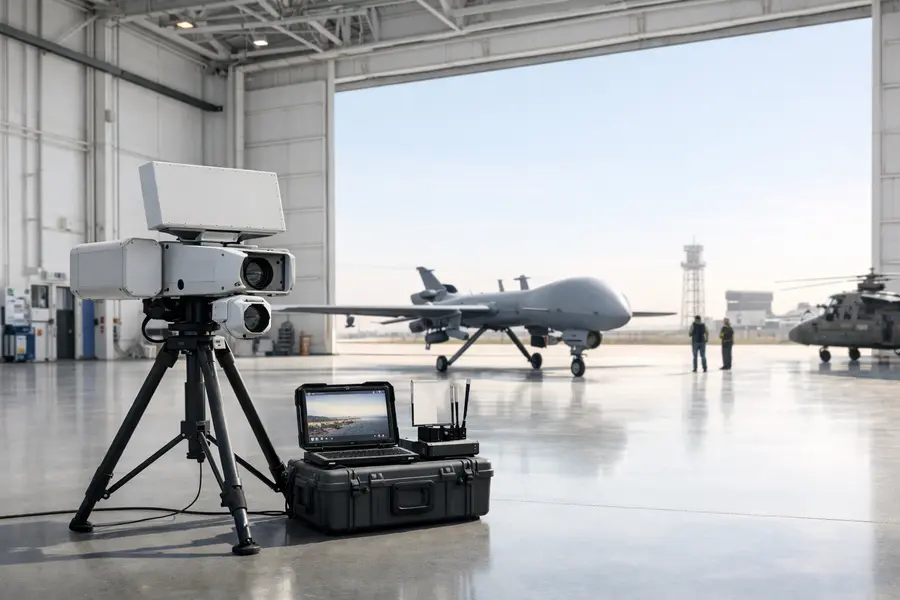
D-Fend's system takes control of a drone's communications link instead of jamming it or shooting it down. The company calls this RF cyber-takeover. An operator detects and identifies the drone, overrides its radio communications, and steers it to a designated landing zone.
That approach matters in crowded places. Jamming can disrupt legitimate radio traffic near airports and stadiums, and kinetic options risk debris falling on people. D-Fend's customers include airports, critical infrastructure operators, military bases, border authorities and stadium security teams.
Motorola plans to fold the technology into its public safety products, giving front-line teams situational awareness and tools to assess drone risk, with mitigation where the law allows. The company has also invested in drone maker BRINC, which suggests it wants both sides of the airspace: drones that responders fly and drones they need to stop.
Who Backed D-Fend, and What Happens to the Team?
D-Fend raised three rounds before the sale. The $6 million Series A in May 2018 was led by Vertex Ventures Israel. The $28 million Series B in September 2019 was led by Claridge Israel, with Vertex participating. The $31 million Series C in December 2024 was led by Israel Growth Partners, with Vertex Ventures Israel and the Vertex Growth Fund also in the round.
Co-founder and CEO Zohar Halachmi stays on. He will also serve as Motorola's senior vice president of Counter-Drone Solutions, leading its counter-drone platform. Keeping the founder suggests Motorola intends D-Fend to be a standalone product line inside the company, not just a feature added to existing products.
What Are the Risks and What Comes Next?
The main risk is demand, not technology. Local police agencies buy slowly, and many will need certification, training and legal clearance before they can use mitigation tools. State-level rules on drone interception will vary, and operators who take control of an aircraft carry liability if something goes wrong.
Competition is also growing. Defense contractors and specialist counter-drone firms are chasing the same federal, airport and stadium budgets that D-Fend served on its own. Motorola's advantage is distribution. Its sales teams already hold contracts with thousands of public safety agencies, and the deal will be judged on whether it converts those relationships into counter-drone orders.
Outlook
Motorola turned a $65 million-funded Israeli startup into a $1.5 billion division within three months of signing. The price assumes that revenue near $185 million keeps growing as US local agencies gain legal authority to act against drones. Results from Motorola's counter-drone segment over the coming quarters will show whether the 8x multiple was reasonable.