Pomegra
Mosaic Intelligence Labs exits stealth with a $47M seed round to build sensing surgical robots that navigate blood vessels without relying on X-ray alone.
Key Takeaways
- Mosaic Intelligence Labs announced a $47M seed round on November 10, 2026, as it left stealth in San Francisco.
- 8VC, Fundomo, Lingotto Innovation and Obvious Ventures are the named backers; valuation and a single lead are undisclosed.
- The first target is endovascular surgery, and the company has published no clinical results.
Lead
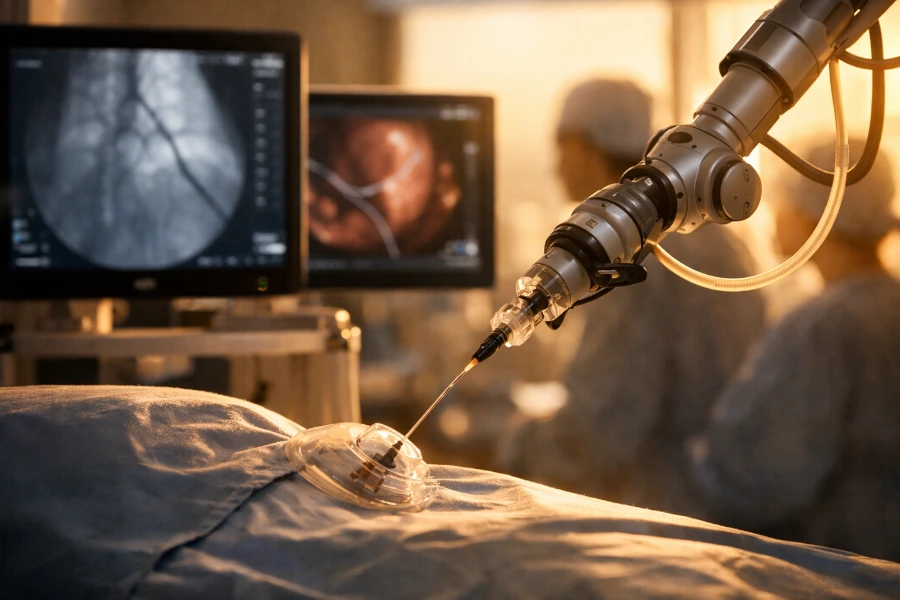
Mosaic Intelligence Labs came out of stealth on November 10, 2026 with a $47 million seed round. The San Francisco company is building what it calls intelligent surgical machines: instruments that sense the anatomy around them, paired with robotic control. Its first focus is endovascular intervention, in which physicians thread flexible wires and catheters through blood vessels to deliver treatment.
The company names 8VC, Fundomo, Lingotto Innovation and Obvious Ventures as investors. It did not disclose a valuation, and its announcement does not single out one lead investor. Trade coverage citing The Information has described two seed rounds led by 8VC and Fundomo, though Mosaic has not confirmed that structure.
What Does Mosaic Actually Build?
Mosaic builds catheter-based instruments with their own sensors, plus software that turns that data into a live three-dimensional model of the anatomy and the instrument's position inside it. A robotic interface then lets a physician control the tool with greater precision. The company describes this as sensing-enabled spatial intelligence and robotic infrastructure.
The problem it targets is familiar to interventional teams. Physicians steering a catheter through vessels have no direct view of the surrounding tissue. They depend on X-ray imaging, which exposes patients and staff to radiation, and on tactile feedback learned over years of practice.
Mosaic's pitch is that sensors on the instrument can supply part of what a veteran operator feels. The company says it will capture synchronized data on the environment, instrument movement and physician actions. It will combine that data with physical models so its machines can relate what they sense to what happens when they move.
Who Is Behind the Company?
Two Stanford doctoral alumni lead Mosaic: CEO Ileana Pirozzi and CTO Alison "Ali" Kight Mackanic. They met during their PhD studies and spent extensive time in operating rooms watching procedures. Pirozzi has said that much of what determined outcomes lived in the hands and minds of the person holding the instrument.
The company says its team has previously built surgical systems used to treat more than 20 million patients, along with rockets, cars, artificial hearts and drugs. That claim comes from Mosaic itself, and it names no products or prior employers. Founding date, headcount and total team size are undisclosed.
Why Does a $47M Seed Round Matter?
A $47 million seed is large by conventional standards, but surgical hardware is not a conventional software category. Devices that enter the body need custom hardware, animal and cadaver testing, and regulatory submissions before any revenue arrives. A round of this size mostly buys time to build a prototype and gather early evidence.
Mosaic says the money will go toward recruiting in San Francisco across hardware engineering, sensing, perception, machine learning and clinical engineering. It gave no timeline for first-in-human use or regulatory filings. The round also fits a broader pattern of seed checks growing for physical AI companies, where investors pay up for teams rather than for products.
The skeptical reading is simple. Mosaic has shown no clinical data, and its stated goals remain goals. Endovascular robotics has also drawn other well-funded entrants working on catheter control and remote procedures, so a sensing-first approach has to prove it is better, not just different.
What Comes Next for Mosaic?
The next milestones are likely hiring, a working sensing catheter and preclinical results. A credible first signal would be data showing that sensor-guided navigation reduces fluoroscopy time or improves accuracy compared with standard technique. Without that, the thesis rests on the team's résumé.
Regulatory path matters too. A system combining a sensing instrument and robotic control would probably face scrutiny as a combination device, which lengthens timelines. The company has not said which procedures it will pursue first, or whether it plans to partner with hospitals or established device makers.
Outlook
Mosaic enters the market with $47 million, four named institutional backers, a Stanford-trained founding pair and an undisclosed valuation. Its claim is that giving instruments their own senses can scale the skill of top surgeons. That claim is untested in patients. The next 12 to 24 months of preclinical work will show whether the funding bought a product or only a thesis.