Pomegra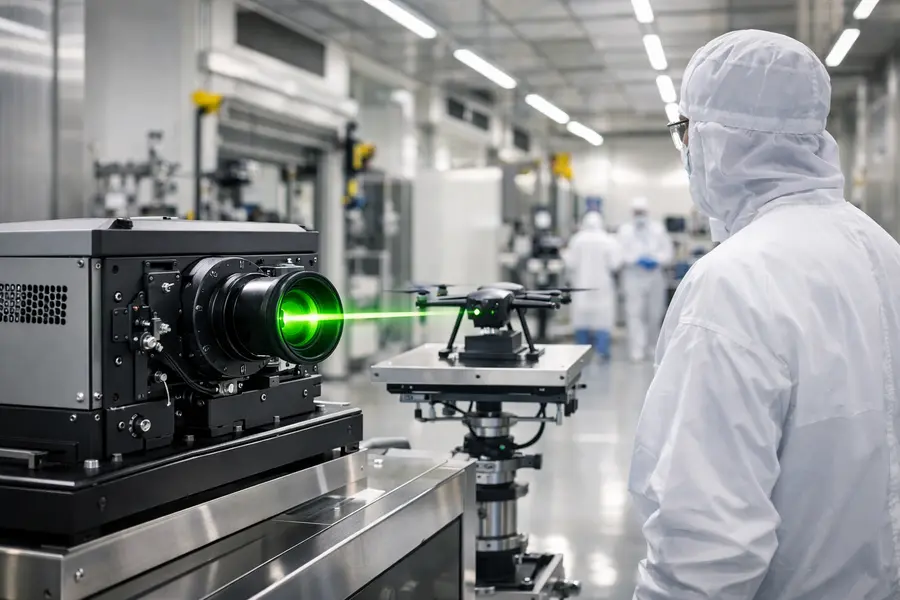
German defense spinout INLEAP Photonics closed a €20M seed round led by UVC Partners to scale its eye-safe, AI-guided laser drone-defense system toward mass production.
- INLEAP's FASTLIGHT SHIELD steers a laser beam 2,500x faster than conventional systems, targeting a drone's structural weak points within fractions of a second.
- The round draws investors from four countries: Germany, Poland, Estonia, and Denmark, reflecting broad European appetite for sovereign counter-drone capability.
- The company, founded in 2023 as a Laser Zentrum Hannover spinout, is already working with Germany's Federal Ministry of Defence and the Bundeswehr Cyber Innovation Hub.
Lead
INLEAP Photonics, the Hannover-based laser defense startup spun out of the Laser Zentrum Hannover research institute, closed a €20M seed round in September 2026 led by UVC Partners. Co-investors include HTGF from Germany, Balnord from Poland, Sentris from Estonia, and Scale Capital from Denmark. The capital will go toward expanding manufacturing and testing infrastructure and accelerating the path to mass production of its FASTLIGHT SHIELD system - a laser-based platform designed to neutralize drones by burning through their structural weak points in milliseconds.
The announcement landed against a stark backdrop: a drone attack on Leipzig/Halle Airport reinforced, once again, that civilian and military infrastructure across Europe faces a threat that traditional kinetic defenses handle poorly at scale.
How Does FASTLIGHT SHIELD Actually Work?
The system does not simply fire a laser at a drone and hope for the best. INLEAP's approach relies on AI-based analysis to identify structural vulnerabilities on an incoming target first, then directs a highly focused, high-energy light spot at that specific point. The beam-steering mechanism operates up to 2,500 times faster than conventional laser targeting solutions, which is what compresses the neutralization window into fractions of a second.
Crucially, the system is designed to be eye-safe - a distinction that matters commercially. Most high-powered directed-energy systems face sharp regulatory barriers in civilian airspace precisely because of retinal risk. INLEAP positions FASTLIGHT SHIELD as the only platform currently meeting the requirements of both civilian deployment environments and conflict-zone use cases, which broadens its addressable market considerably.
What Problem Does This Solve Better Than Existing Options?
Kinetic counter-drone systems - nets, interceptor drones, and jamming - each carry meaningful limitations. Nets and interceptors have low throughput against swarms. Jamming is increasingly ineffective against autonomous drones that don't rely on a live radio link. Directed-energy weapons offer effectively unlimited magazine depth at low per-shot cost, but prior systems have been either too slow, too dangerous for dense civilian areas, or too expensive for wide deployment.
INLEAP's beam-steering speed claims, if they hold up under independent testing, address the throughput problem. Its eye-safety certification target addresses the civilian deployment barrier. Neither claim has been publicly validated by a third party, and the company has not disclosed customer contracts, pricing, or operational range specifications.
Strategic Context
European defense spending has surged since 2022, and counter-drone technology has absorbed a disproportionate share of procurement interest. The conflict in Ukraine demonstrated that cheap commercial drones can inflict serious damage on expensive military hardware, which inverted the traditional cost calculus of air defense. Governments across NATO have since pushed aggressively for scalable, affordable intercept solutions.
INLEAP's investor base is itself a signal. Pulling in capital from five funds spanning Germany, Poland, Estonia, and Denmark suggests the company has positioned itself not as a German national-security play but as a pan-European defense asset. Poland and the Baltic states, which face the most acute near-term threat environment, bring strategic credibility to the cap table that goes beyond financial backing.
The company's existing engagement with the Bundeswehr Cyber Innovation Hub and the German Federal Ministry of Defence gives it a structured path toward procurement - a notoriously slow process that startups without institutional relationships rarely navigate successfully at seed stage.
What Does a €20M Seed Round Signal for This Sector?
A €20M seed is large by any standard and very large for a hardware defense startup still at the manufacturing scale-up phase. It implies investors are pricing in long procurement cycles and heavy capital requirements before recurring revenue materializes. It also implies they believe the regulatory and certification pathway is tractable within a few years, not a decade.
For comparison, defense-tech seed rounds in Europe averaged well below €10M as recently as 2023. The compression upward reflects both increased LP appetite for defense exposure and the recognition that hardware companies need substantially more capital at formation than software peers.
Outlook
INLEAP's near-term priorities are manufacturing scale-up and continued engagement with German federal defense procurement channels. The company will need to demonstrate repeatable performance in controlled environments and, eventually, field conditions before winning large contracts. The four-country investor base may accelerate introductions to non-German NATO procurement programs, which would reduce reliance on a single customer government.
The drone threat it targets is not going away. If FASTLIGHT SHIELD performs as described and clears the regulatory hurdles for civilian airspace deployment, the addressable market extends well beyond military bases to airports, energy infrastructure, and public venues. That expansion depends entirely on independent validation of its safety and performance claims - which this round does not yet provide, but funds the company to pursue.