Pomegra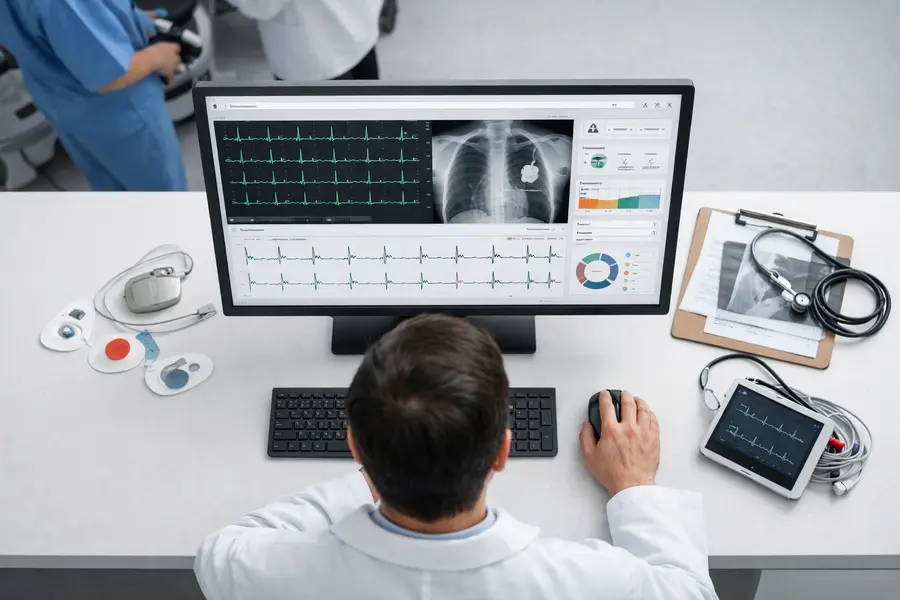
French cardiac AI firm Implicity closes a €35M growth round led by IRIS and Five Arrows to push its remote monitoring platform - proven to reduce patient mortality by 26% - into the US at scale.
Key Takeaways
- IRIS and Five Arrows (Rothschild & Co) co-led a €35M growth equity round in Paris-based Implicity, announced September 9, 2026.
- The company's AI platform already monitors 120,000+ patients daily across 250+ medical centers in the US, France, and Germany.
- Clinical data shows Implicity users experience 26% lower mortality and 4% fewer hospitalizations vs. conventional remote monitoring.
Lead: A Clinical Data Point, Not a Pitch Deck
Implicity, the Paris-based cardiac remote monitoring company founded in 2016, closed a €35 million growth equity round on September 9, 2026. The round was co-led by IRIS, a European tech growth capital firm, and Five Arrows, the alternative assets arm of Rothschild & Co. The company plans to use the capital to build out commercial teams in the United States, expand its footprint in Germany, and pursue selective acquisitions.
The headline figure for any medtech at this stage is clinical outcome, not valuation - and Implicity has one. Patients on its platform show 26% lower mortality and 4% fewer hospitalizations compared to those receiving conventional remote monitoring. That number did the fundraising for them.
What Does Implicity Actually Do?
The core problem Implicity solves is fragmentation. Cardiac implantable electronic devices - pacemakers, defibrillators, implantable cardiac monitors - are made by competing manufacturers, each running proprietary data portals. Clinicians managing large patient panels must check multiple systems, manually, to catch deteriorating signals. Most do not catch them in time.
Implicity aggregates all of that device data into a single AI-powered platform that triages alerts and surfaces the cases most likely to require immediate clinical attention. The product is not a hardware device; it is software as a medical device, meaning it sits on top of existing implanted hardware without requiring any new procedures for the patient.
Two features drive clinical differentiation. SignalHF, the company's heart failure prediction algorithm, gives clinicians early visibility into a patient's decompensation risk before symptoms become acute. The ECG Analyzer, which received FDA clearance, reduces false alarms by up to 76% - a number that matters in any cardiac unit where alarm fatigue is a documented patient safety risk.
Why Is the US the Priority Market?
The US is the largest single market for cardiac device monitoring, with millions of patients carrying implanted devices and a reimbursement structure that, unlike many European systems, already has established pathways for remote patient monitoring billing. Implicity is not starting from zero: the platform already operates across US medical centers and is part of its current 120,000-patient daily monitoring base.
The strategic logic is expansion, not entry. The €35M buys commercial headcount - sales, clinical specialists, account managers - rather than regulatory clearance or product development from scratch. That distinction matters for how quickly the capital can translate into revenue.
The previous funding round, a €21M raise, supported the platform's European build-out and early US presence. This round is structurally different: growth equity rather than venture, which signals that the investor base expects near-term revenue scaling, not further product validation.
What Does the Investor Mix Signal?
IRIS focuses on European tech growth companies with proven unit economics. Five Arrows, as Rothschild's alternatives vehicle, brings a different profile - access to healthcare networks, particularly in cross-border M&A contexts. The combination is deliberate. Implicity has flagged acquisitions as a use of funds, and having a Rothschild affiliate on the cap table is not incidental to that ambition.
Growth equity at this stage implies the company has cleared the "does it work" question and is now solving "how fast can it grow." The 26% mortality reduction, if it holds across larger populations and different healthcare systems, is a durable commercial argument - particularly in a US market where payers have growing appetite for outcome-linked reimbursement.
Competitive Pressure and the Consolidation Case
The cardiac remote monitoring space has attracted sustained investment over the past five years. Several established medtech names - some with direct device manufacturing relationships - also offer monitoring platforms, and the bundling risk is real: a device maker that offers its own proprietary monitoring software has a natural distribution advantage.
Implicity's counter-position is manufacturer neutrality. A hospital system running Medtronic, Abbott, and Boston Scientific devices simultaneously has limited appetite for three separate portals. A single platform that handles all of them, with AI triage on top, has a genuine workflow argument. Whether that argument is sufficient to hold off device makers who eventually build equivalent aggregation tools is the medium-term strategic question.
Acquisitions, mentioned explicitly in the use-of-funds disclosure, suggest Implicity intends to deepen its clinical or technical moat before that consolidation pressure intensifies.
Outlook
Implicity enters the US scaling phase with clinical evidence, existing market presence, and a capital structure suited to commercial acceleration rather than further product development. The 26% mortality reduction is a number hospitals and payers will engage with seriously. Execution risk now lives in commercial deployment - hiring, hospital contracting cycles, and the pace at which monitoring revenue scales against the new cost base. The next data point to watch is US patient volume growth over the following 12 to 18 months.