Pomegra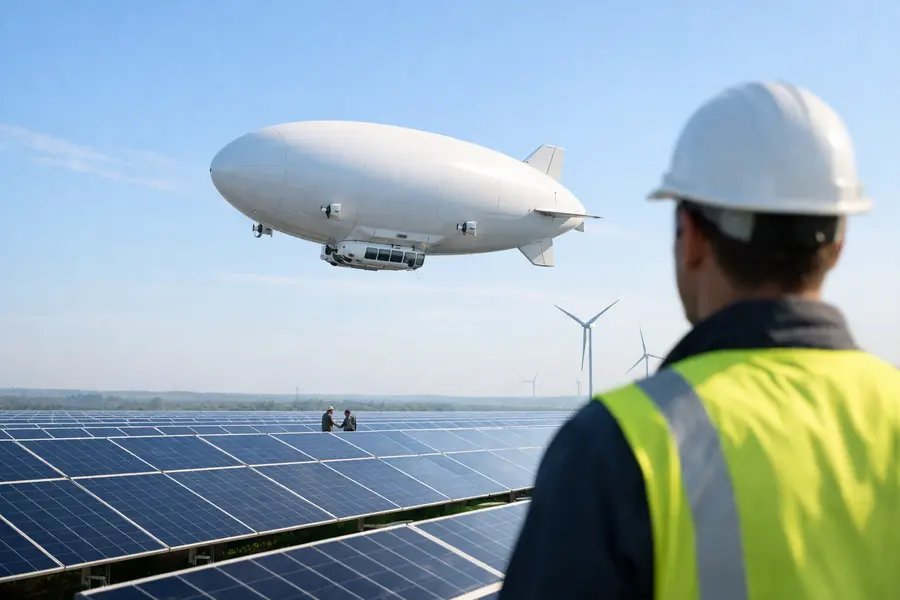
French startup HyLight raised €13M from Rubio Impact Ventures, DRW and Teampact Ventures to scale its hydrogen-powered airships that inspect power lines, pipelines and railways.
- HyLight raised €13M in October 2026, bringing total funding to about €16.7M since its €3.7M seed.
- Rubio Impact Ventures, DRW and Teampact Ventures are the new backers; Y Combinator and Ring Capital are returning.
- The company plans to grow from 4 to 15 airships operating at once in 2027 and to hire about 50 people.
Lead
HyLight, a Paris-area startup founded in 2022, announced a €13 million round on October 12, 2026. The money will fund fleet production, a data platform and expansion into Germany and the Netherlands. The company did not disclose a valuation or a formal round designation, and it named no single lead investor.
What Does HyLight Actually Build?
HyLight builds the HyLighter, a roughly 12-meter autonomous airship. It uses helium for lift and hydrogen fuel cells for electric propulsion. The company says it flies up to 10 hours, targets a range of about 350 kilometers, and carries up to 10 kilograms of sensors, including LiDAR, cameras and methane detectors.
The target is the helicopter. Utilities and rail operators still fly crewed helicopters along high-tension lines and tracks, and HyLight argues that airships do the same job more cheaply and with no direct emissions. CEO Martin Bocken has said a helicopter produces about one ton of CO2 per hour of flight. He has also said most power lines are still inspected by helicopter, as they were fifty years ago.
The company has logged more than 750 flight hours and inspected thousands of kilometers of infrastructure in France and other European markets. Its customers include Enedis, SNCF Réseau, Téréga, NaTran and VINCI. HyLight says France's civil aviation authority, the DGAC, and the EU Aviation Safety Agency have authorized its beyond-visual-line-of-sight operations over critical infrastructure.
Who Backed the Round and What Does It Say?
Three new investors joined: Rubio Impact Ventures, DRW and Teampact Ventures. Y Combinator and Ring Capital, which backed the earlier seed round, returned. Helmer Schukken, managing partner at Rubio Impact Ventures, said the firm sees "a team and a technology with the potential to change how we keep critical infrastructure safe."
The round is about 3.5 times the 2024 seed of €3.7M. That is a normal step up for a hardware company that has moved from prototypes to paying work. The absence of a disclosed valuation and a named lead leaves the terms opaque. A group of co-investors with an impact-fund and a trading-firm profile also suggests the pitch rests on both climate benefit and cost savings against helicopters.
How Will the Money Be Spent?
HyLight will spend the funds on industrialization, according to the company. A new production facility is already online. The company is bringing more manufacturing of strategic components in-house, which should cut dependence on outside suppliers and lower unit cost.
The fleet target is the clearest benchmark. HyLight operates four HyLighters today and wants up to 15 flying simultaneously in 2027. That means at least 11 additional airships in roughly a year, from a company that has built only a handful so far. The round also pays for about 50 hires across engineering, AI and data, operations, regulatory affairs and business development.
What Are the Risks and Competition?
Competition comes from two directions. Crewed helicopters are the incumbent, and fixed-wing and multirotor drones are the cheaper alternative for shorter jobs. Startups such as Kelluu, FuVeX, Terra Drone and Tethys Robotics also target infrastructure inspection with unmanned platforms.
The main uncertainty is repeatability. Authorization in France does not transfer automatically, and Germany and the Netherlands each have their own utilities, procurement habits and national aviation oversight. Hydrogen supply adds a second variable: a fleet of 15 airships needs reliable fuel logistics across several countries. Weather also limits lighter-than-air craft more than it limits helicopters.
What Comes Next for HyLight?
The next 12 months will test whether the company can build and certify aircraft at the pace it has promised. Reaching 15 simultaneous operations by 2027 would require both manufacturing yield and customer demand to hold up outside France. If the German and Dutch rollouts land, a larger round tied to commercial traction becomes plausible. If production slips, the gap between the fleet plan and the fleet in the air will show quickly.
Outlook
HyLight has €13M, a working product, a roster of French infrastructure customers and regulatory clearance for its core operation. It has not disclosed valuation, revenue or the cost per inspected kilometer. Those figures will determine whether airships displace helicopters at scale or stay a niche tool for long, linear assets.