Pomegra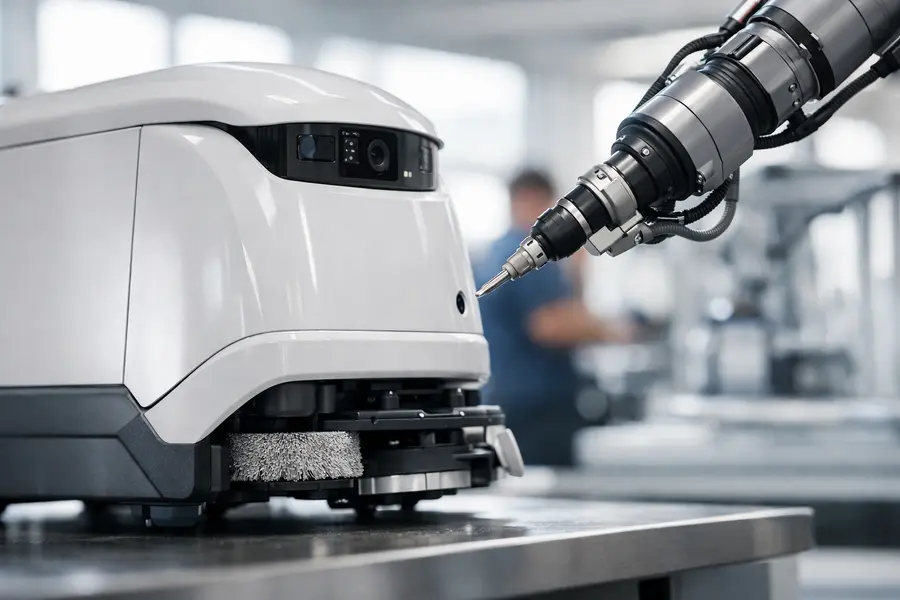
Singapore's Hivebotics secured $6M led by Vertex Ventures to scale its Abluo autonomous restroom-cleaning robot after logging nearly 10,000 operational hours across more than 20 commercial sites worldwide since its July 2024 launch.
Key Takeaways
- Vertex Ventures Southeast Asia & India led the $6M Series A, joined by Taiwan's Farglory Group affiliate Fareast Land Development and smart restroom maker Rigel.
- Abluo has logged nearly 10,000 operational hours across 20+ sites in Asia, Europe, the Middle East, and North America in roughly 12 months.
- Funds target volume production of Abluo, expansion into four core distributor markets, and deeper development of the HiveIntelligence AI software layer.
Lead
Hivebotics, the Singapore-based robotics company spun out of the National University of Singapore in 2021, closed a $6 million Series A on September 4, 2026. Vertex Ventures Southeast Asia & India led the round. Fareast Land Development - a subsidiary of Taiwan's Farglory Group - and Rigel, an Asian manufacturer of smart restroom products, joined as co-investors. Valuation was not disclosed. The capital is earmarked to move Abluo from pilot-scale deployments into full volume production.
What Does Abluo Actually Do?
Abluo is a mobile robot fitted with an articulated arm that cleans an entire commercial restroom - toilets, urinals, sinks, and floors - rather than only the floor, which is the limit of most competing cleaning machines. It operates without physical contact, deploying high-pressure steam, targeted chemical jets, vacuum extraction, and blow-drying in sequence. Onboard cameras identify each fixture type, and the HiveIntelligence software layer plans a cleaning route in real time on each deployment. The robot replaces roughly 30 minutes of manual labor per cycle with a five-minute human inspection, according to the company's published operational data from pilot sites.
That combination - full-restroom scope, no-contact hygiene, and AI-driven route planning - defines its differentiation in a market where autonomous cleaning typically means floor-scrubbing units. The distinction matters commercially: a machine that cleans only floors still requires a human for every other surface.
Why Did Vertex Back a Toilet-Cleaning Robot?
The 10,000-hour operational threshold is the credible answer. Pilot programs that generate four-figure runtime hours across hospitals, airport terminals, and shopping malls produce a dataset that investor diligence can interrogate - failure modes, maintenance intervals, cleaning consistency metrics. That evidence base is what separates a compelling demo from a scalable product. Hivebotics crossed 20 sites in four geographies inside 12 months of commercial availability, a pace suggesting genuine customer pull rather than subsidized trial placements.
The co-investor roster reinforces the commercial logic. Rigel manufactures smart restroom fixtures and brings a distribution network in markets where Hivebotics wants to grow. Farglory connects the startup to institutional real estate at scale. Both investors bring customer access alongside capital, which reduces the sales cycle risk that typically slows hardware startups.
What Comes Next for Hivebotics?
The immediate priority is production volume. Hivebotics crossed 100 orders during its pilot phase across Singapore, Hong Kong, and Abu Dhabi. Fulfilling that pipeline, while simultaneously building for the four markets its new distributor network will target, is a manufacturing and logistics challenge as much as a technical one.
The HiveIntelligence layer represents the longer-term margin story. Software that improves cleaning route efficiency or predictive maintenance scheduling does not carry the same per-unit cost as hardware. If the installed base grows to several hundred units, that software layer becomes a recurring revenue stream that shapes the company's financial profile well beyond the current round.
The global commercial cleaning market runs into the hundreds of billions of dollars annually. Hivebotics has not cited a specific addressable market figure, which is the right call at this stage - those projections tend to be reverse-engineered to justify a valuation rather than derived from deployable demand.
Outlook
Hivebotics enters the post-Series A phase with operational credibility its pitch could not have claimed two years ago. The 10,000-hour runtime across 20 sites gives it a defensible foundation for scaling. The path from $6M to a Series B will be determined by how quickly the company converts its order backlog into installed units and whether HiveIntelligence can demonstrate measurable performance improvements across a larger fleet. Neither is guaranteed, but both are now testable at real scale.