Pomegra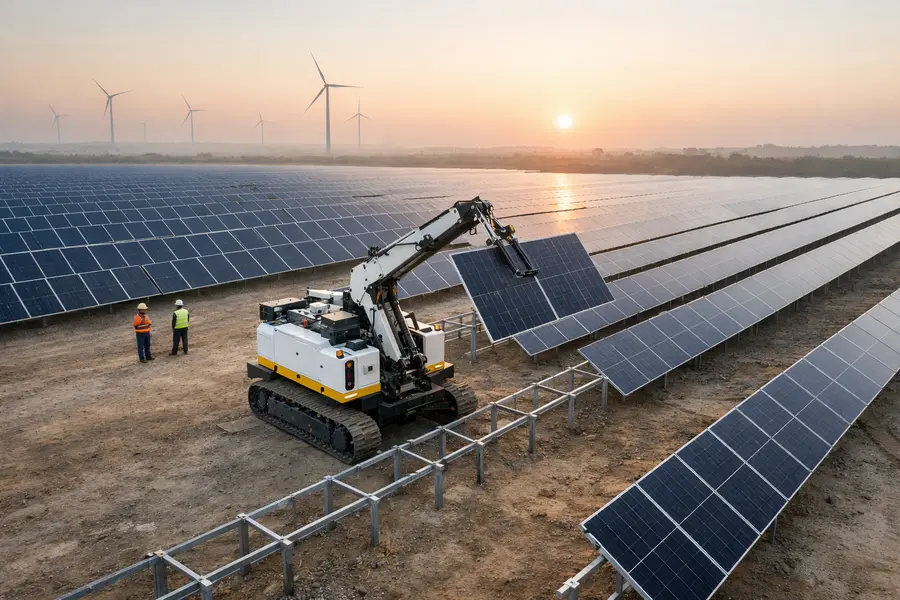
Gritt, whose AI systems bolt onto rented construction gear to install utility-scale solar panels, raised $32 million and exited stealth in July 2026 - backed by Obvious Ventures, Union Square Ventures, and a cluster of climate-focused funds.
Key Takeaways
- A $26M Series A led by Obvious Ventures brings Gritt's total funding to $32M, with seed capital from First Round Capital, Climactic, Congruent Ventures, and VSC Ventures.
- Gritt's robots push an eight-person crew's daily output from roughly 800 panels to 3,000-4,000 - using off-the-shelf skidders and Kawasaki robotic arms, not proprietary hardware.
- The company holds contracts to support 2.8 gigawatts of solar capacity over the next 18 months and plans to run 48 systems within six months.
Lead
Gritt, a physical AI startup founded by Carnegie Mellon roboticists Puneet Puri and Vishal Dugar, announced a $26 million Series A on July 21, 2026, bringing its total capital raised to $32 million. The round was led by Obvious Ventures, with Union Square Ventures and Active Impact Investments joining in. Seed investors First Round Capital, Climactic, Congruent Ventures, and VSC Ventures backed the company before it emerged from stealth. Valuation was not disclosed.
The company's AI-controlled systems attach to standard construction equipment - rented skidders and Kawasaki robotic arms - rather than building robots from scratch. They unload large glass solar panels and position them on metal frames with sub-millimeter accuracy, leaving workers to fasten the connections.
What Does Gritt Actually Build?
Gritt is not selling robots. It is selling throughput. The company deploys its AI-controlled systems on client job sites, running them on leased off-the-shelf hardware. That distinction matters: capital costs stay off Gritt's balance sheet, and the model resembles a services play more than a hardware manufacturer's.
The software handles the hard part - precise positioning on uneven terrain, panel by panel, across sprawling utility-scale sites where small placement errors compound. An eight-person crew operating without Gritt installs around 800 panels a day. With the system running, that same crew reaches 3,000 to 4,000. The company says it has already placed tens of thousands of panels with minimal breakage across more than seven active job sites.
Why Is Solar Construction Getting Automated Now?
The bottleneck is labor, not panels. The U.S. solar pipeline has grown faster than the workforce trained to build it, and utility-scale farms - which can cover thousands of acres and require millions of panel placements - are especially exposed. Installation timelines slip, costs rise, and contracted capacity misses grid interconnection windows.
Gritt's pitch lands in that gap. The company holds agreements to support 2.8 gigawatts of solar capacity over the next 18 months, a number that implies a committed customer base rather than a speculative pipeline. Whether those agreements are binding contracts or letters of intent has not been publicly specified.
The broader trend is clear: construction automation has attracted a wave of investment as labor shortages and infrastructure spending combine. Gritt joins a field that includes several well-funded competitors, though few have focused exclusively on solar farm installation at this stage.
What Does This Round Signal About the Seed?
The seed backers - First Round Capital, Climactic, Congruent Ventures, VSC Ventures - represent a mix of general venture and climate-focused capital. A $26 million Series A following that group suggests meaningful traction was demonstrated before the round closed. Obvious Ventures, which focuses on sustainability, took the lead, with Union Square Ventures adding its imprimatur.
No revenue figures were released. The company's plan to scale from a handful of sites to 48 active systems within six months is ambitious; hardware deployment at that pace requires not just capital but logistics, trained operators, and reliable supply chains for the equipment it does not own.
Outlook
Gritt's approach - software-first, hardware-light, deployment-focused - positions it closer to a construction tech company than a robotics manufacturer. That has financing advantages and operational risks in roughly equal measure. The 2.8 GW contracted pipeline is a credible near-term anchor. Scaling to 48 systems in six months will test whether the model holds under pressure. The climate investor base behind the round is betting it does.