 Pomegra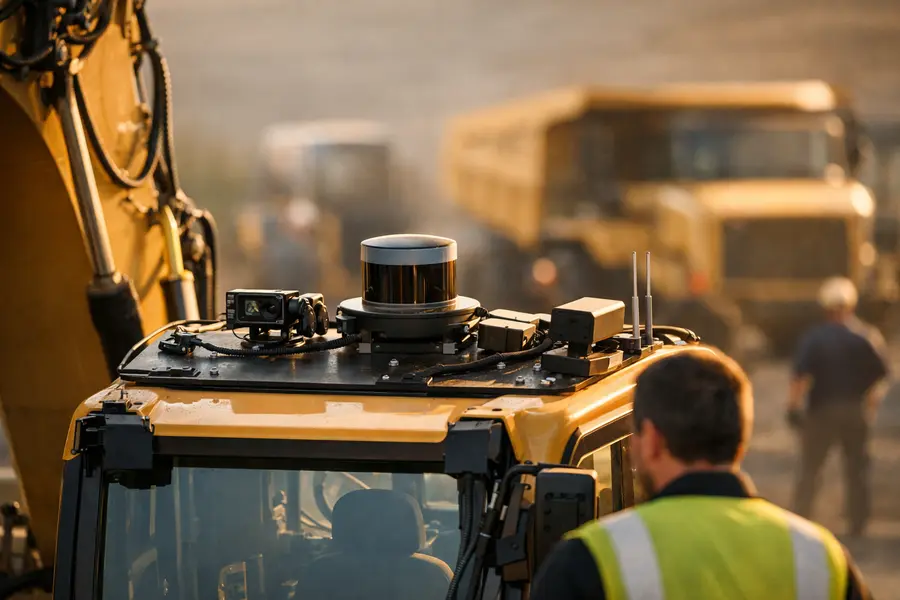
Swiss ETH Zurich spinout Gravis Robotics closed a $200M Series A from SoftBank alone at a $1B valuation, becoming Europe's newest robotics unicorn with its retrofitting technology for heavy machinery.
Key Takeaways
- SoftBank is the sole investor in a $200M Series A the company claims is the largest in construction robotics history.
- The Gravis Rack retrofit kit makes existing Caterpillar, John Deere, Volvo, and a dozen other machinery brands autonomous.
- The round values the Zurich startup at $1B post-money, nine months after it closed a $23M raise.
Lead
Gravis Robotics, the Zurich-based construction autonomy startup founded in 2022, announced on August 17 that it has raised $200M in a Series A round led and solely funded by SoftBank Group. The round values the company at $1 billion post-money, making it Europe's latest robotics unicorn. The financing follows a $23M raise in November 2025 - implying the company's valuation scaled by more than 40x in under a year.
What Does Gravis Robotics Actually Build?
The company's core product is the Gravis Rack, a hardware-software system of sensors and compute that straps onto existing heavy machinery and makes it autonomous. The Rack works across more than a dozen brands and models, from roughly 10-tonne excavators up to large earthmoving equipment from Caterpillar, John Deere, Volvo, Hitachi, JCB, and others. No new machine purchase required.
The Rack ships in two modes. The first, called Gravis Copilot, keeps a human in the cab while providing real-time 3D terrain guidance and hazard detection. The second runs the machine without continuous manual input, letting a single operator supervise multiple units from outside the cab. Gravis says the system delivers productivity gains of up to 30% while reducing on-site safety incidents. Systems are currently deployed across four continents, with customers that include Holcim, Taylor Woodrow, and HD Hyundai.
The company is a spinout from ETH Zurich, co-founded by CEO Ryan Luke Johns - an architect and roboticist who holds a Guinness World Record for the largest dry-stone wall constructed by a robot - alongside CTO Dominic Jud and ETH Zurich robotics professor Marco Hutter, who serves on the board.
Why Would SoftBank Write a $200M Check Alone?
SoftBank's sole participation in the round is notable. Most rounds this size carry two or more institutional investors to spread risk. A single-check $200M Series A points to either strong exclusivity demand from the startup or a high-conviction bet SoftBank chose not to syndicate. The Tokyo-listed conglomerate has a long history of placing concentrated bets in robotics - it owned Boston Dynamics for several years before selling to Hyundai in 2021.
For SoftBank, the construction equipment market provides scale. Global construction output is projected to exceed $15 trillion annually by 2030, and the vast majority of the world's excavators and earthmovers are already purchased - making a retrofit play more capital-efficient than a hardware-from-scratch approach. Selling autonomy software as a layer on top of existing iron also sidesteps the manufacturer relationships that might otherwise block a new entrant.
The $1B valuation on a $200M check implies SoftBank paid roughly 20% ownership for the round, though exact ownership and secondary components were not disclosed.
How Does This Compare to Gravis's Last Round?
The gap between $23M at undisclosed valuation in November 2025 and $1B post-money in August 2026 is steep by any standard. Nine months is a short interval to justify that kind of step-up. Gravis has not publicly disclosed revenue or deployment unit counts, making it difficult to anchor the valuation in fundamentals. The company's claim that this is the largest Series A in construction robotics history is plausible on face value - no close competitor has publicly matched that figure - but it says more about investor appetite than market traction.
Construction tech broadly has struggled to demonstrate durable margins at scale. Gravis's retrofit model reduces upfront hardware cost compared to full-stack robotics competitors, which should help customer acquisition. Whether the autonomous operation mode can withstand the demanding conditions of active job sites - mud, vibration, variable terrain, regulatory constraints - over multi-year deployments remains the central execution question.
Outlook
Gravis plans to use the $200M to expand its commercial deployment across markets and deepen the Rack's compatibility with additional machine types. The ETH Zurich lineage and the SoftBank relationship both bring credibility, but the company now carries a unicorn valuation with limited public financial disclosure to support it. The construction industry moves slowly; persuading site managers and equipment owners to hand control to an autonomous system takes time that venture capital timelines do not always accommodate. The next inflection point will be how quickly Gravis converts the capital into revenue it can disclose.