 Pomegra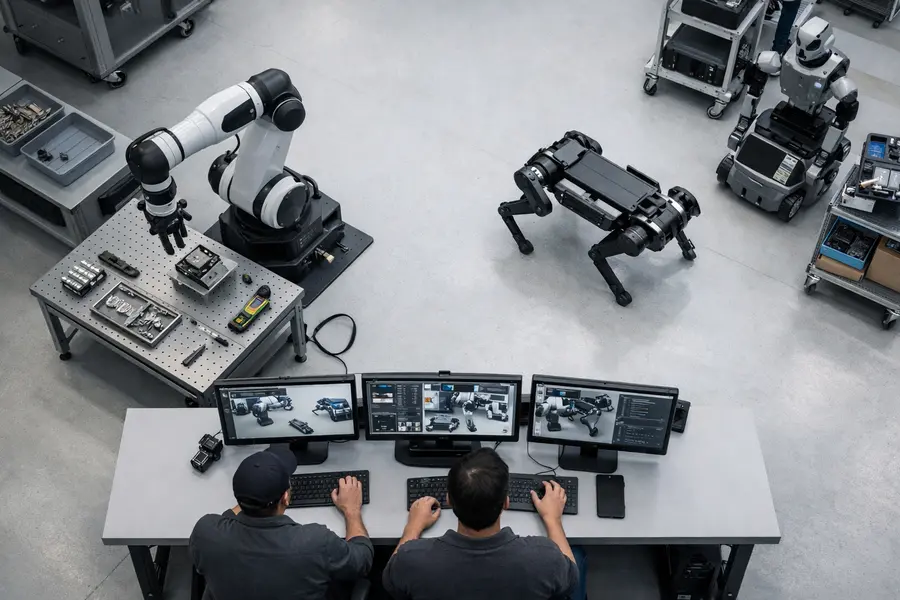
Ex-DeepMind founders Pete Florence and Andy Zeng raise $200M at a $3B valuation for their robot foundation model, two months after closing a $400M Series B at half that price.
- 8VC led a $200M Series B extension valuing Generalist at $3B, up from $2B in June 2026.
- The round brings total Series B capital to $600M raised in under three months.
- Generalist's Gen 1.5 model can learn new physical tasks from video demonstrations as short as three seconds.
Lead
Generalist, the San Francisco-based robotics AI company founded by former Google DeepMind researchers Pete Florence and Andy Zeng, has raised roughly $200 million in a Series B extension led by 8VC, pushing its valuation to $3 billion. The close was disclosed in a federal securities filing on August 24, 2026, and follows the company's $400 million Series B announced in June at a $2 billion valuation - a 50% step-up in eight weeks.
What Does Generalist Actually Build?
The company's core bet is that the robotics industry does not need bespoke software for each machine. Its foundation model - currently at version Gen 1.5 - runs across different robot bodies without engineers hand-coding tasks for each one. A single trained model can be dropped into a new hardware platform and pick up physical skills from short video demonstrations, sometimes clips as brief as three to twelve seconds. The claim is generalization at the model layer, not at the integration layer.
Florence serves as CEO. Andy Zeng, lead author on Code as Policies and a significant contributor to Google DeepMind's embodied AI research, is Chief Scientist. CTO Andrew Barry joined from Boston Dynamics. The founding team's combined publication record covers some of the most-cited work in robot learning from the past decade, which goes a long way toward explaining why capital has moved quickly.
Why Is the Valuation Moving This Fast?
Generalist went from seed to a $2 billion Series B in roughly 18 months. It is now at $3 billion before most enterprise customers have had meaningful time to deploy the product at scale. The implied logic from investors is that the robot foundation model category will consolidate fast, and early technical credibility is worth paying for before revenue materializes.
The prior $400M round was led by Radical Ventures. 8VC's entry as lead on the extension signals a second major institutional bet from a different LP base within the same round structure. Other backers include Nvidia, Union Square Ventures, Bezos Expeditions, and AI researcher Fei-Fei Li. That list covers hardware supply chain, developer ecosystems, and deep-pockets generalist capital - a coalition that mirrors what worked for the prior generation of foundation model companies.
The skeptical read is that the June-to-August valuation jump has less to do with new commercial evidence and more to do with category pricing in a market that has watched OpenAI and Anthropic command ever-larger multiples on pre-revenue potential.
What Comes Next for the Robot Brain Race?
Generalist said the new capital will fund compute, headcount, and expansion across a broader range of supported robot hardware. That last point matters: the value of a foundation model scales with the number of hardware platforms it runs on, and hardware diversity is currently the limiting factor for adoption.
The broader competitive field is crowding. Physical Intelligence (Pi), another foundation model robotics startup, has separately raised at a $2.4 billion valuation. General Intuition is reportedly finalizing a round at $6 billion. What separates these companies in the near term is deployment track record - how many robots, running which tasks, in which environments, with what failure rates. None have published that data at scale.
Generalist's Gen 1.5 milestone - mastering tasks from a few seconds of video - is technically notable, but lab demonstrations and production reliability are different things. The company has not disclosed customer names, deployment numbers, or commercial revenue.
Outlook
Generalist now holds $600 million in Series B capital and a valuation that has tripled in under two years. The 8VC-led extension validates continued institutional appetite for robot foundation model companies, but commercial proof of the core thesis - that one model can meaningfully generalize across diverse hardware and tasks - remains the open question. The next meaningful data point will be production deployments, not fundraising announcements.