Pomegra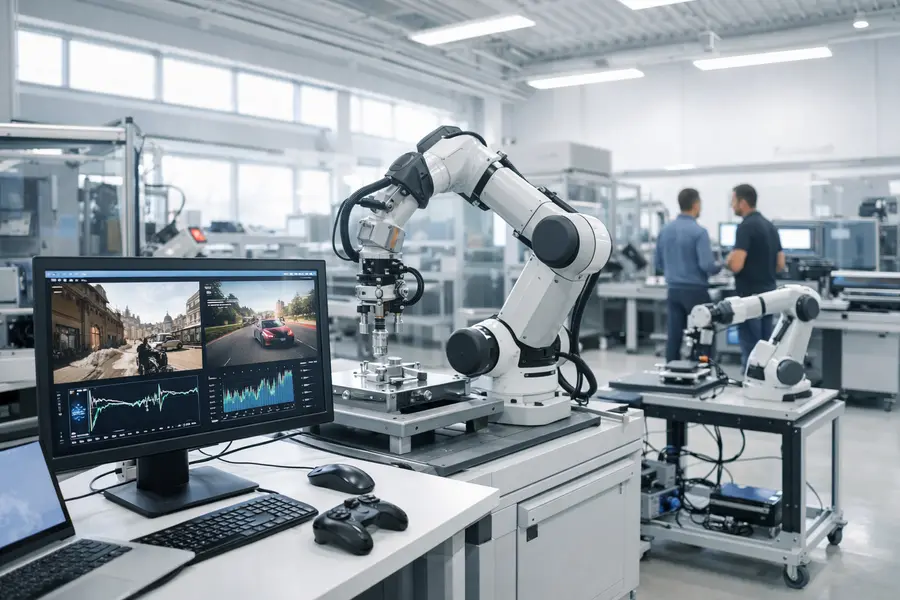
General Intuition raised $220M at a $6.2B valuation, led by Valor Equity Partners, to build world models from gameplay footage for robotics and simulation.
Key Takeaways
- General Intuition raised $220M in a Series B at a $6.2B valuation, led by Valor Equity Partners.
- The valuation is nearly triple the $2.3B set in its $320M Series A in June 2026.
- Total funding now exceeds $650M since the October 2025 spinout from Medal.
Lead
General Intuition, a New York-based AI lab that trains models on video game footage, closed a $220M Series B on September 29, 2026, at a $6.2B valuation. Valor Equity Partners led the round. Atreides, Seven Seven Six, Point72, Khosla Ventures and General Catalyst also participated. The company has raised more than $650M in under a year, and it has disclosed no revenue figures.
What Does General Intuition Actually Build?
General Intuition builds two kinds of models: action models that decide what an agent should do, and world models that predict what happens after it does it. The training data comes from Medal, the game clip-capture platform the company spun out of in October 2025. Medal reports more than 17 million monthly active users and uploads that are on track for roughly 3 billion clips a year, each tagged with player inputs.
That tagging is the point. Most video datasets record what happened on screen. Medal's clips also record what the player pressed, which gives a model a link between action and consequence. CEO Pim de Witte has described the approach as predicting the actions people take in games, "as opposed to the art."
In June the company released MIRA, a playable multiplayer world model built with Epic Games and the AI lab Kyutai. Trained on ten thousand hours of Rocket League footage, it runs in real time at 20 frames per second from keyboard input. The company says it can run indefinitely without diverging, a common failure in generated video.
Why Did the Valuation Nearly Triple in Three Months?
The valuation rose from $2.3B to $6.2B in about three months because the company has moved its pitch from game AI to robotics and autonomous driving, where investors are paying for scarce training data. The earlier rounds were smaller: a $133.7M seed in October 2025 and the $320M Series A led by Khosla Ventures. Valor, known for its SpaceX stake, is making what TechCrunch described as its first investment in an AI lab.
A step-up of that size with no disclosed revenue says more about demand for embodied-AI exposure than about commercial traction. The company says it is testing its technology with a limited number of customers in robotics, simulation and entertainment. De Witte has argued that simulated driving data is large enough to matter, saying more people play with steering wheels than Waymo has cars. It is a claim about data volume, not about whether game physics transfer to real roads.
How Will the Money Be Used?
General Intuition says it will spend the capital mainly on hiring AI researchers, with teams expanding in New York and Europe. Earlier reporting on the round also pointed to compute spending and improvements to its general model. It has opened a waitlist for partners that want early access to its models.
Headcount and compute are the costs that matter here. Frontier-style training runs are expensive, and a company that has raised more than $650M will be measured against labs with far larger budgets.
What Comes Next for World Models?
The next test is whether models trained on games can guide machines outside them. Robotics developers have few large, action-labeled datasets, which is the gap General Intuition is targeting. Competing approaches train on real robot demonstrations or on synthetic environments built by physics engines, and both are expensive to scale.
Several outcomes are plausible. Early partners could show that game-derived policies reduce the real-world data a robot needs. They could instead find that the domain gap requires heavy fine-tuning, which would narrow the advantage. Without named customers or revenue, the company's own reports of pilots remain the main evidence.
Outlook
General Intuition now holds one of the largest war chests among world-model startups, and its $6.2B valuation assumes that gameplay data generalizes to physical systems. The Medal data gives it an asset that is hard to copy. Whether it converts into paying robotics and driving customers will decide if the valuation holds at the next raise.