 Pomegra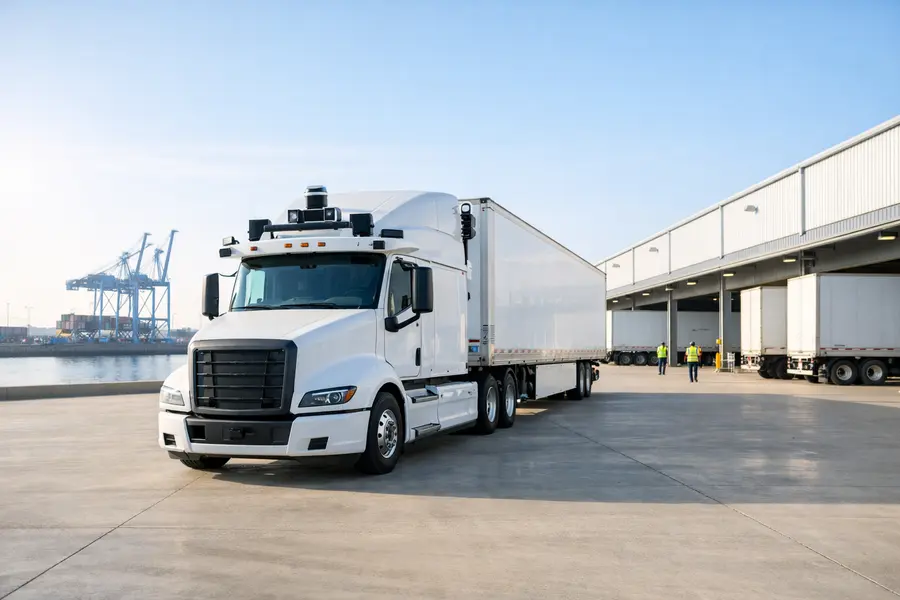
Autonomous freight startup Gatik has raised $200 million in a Series D round co-led by the Qatar Investment Authority and Koch Disruptive Technologies, bringing its total capital raised to roughly $500 million.
Key Takeaways
- Gatik's $200M Series D was co-led by QIA and Koch Disruptive Technologies, with ARK Invest and Arca Continental among participating investors.
- The company has logged 85,000 fully driverless orders and holds more than $600M in contracted revenue.
- A multi-year PepsiCo deployment spans Texas, Arizona, and Arkansas with 41 autonomous Isuzu box trucks.
Lead
Gatik, the Canadian-founded autonomous trucking company headquartered in Mountain View, California, announced the close of a $200 million Series D on August 25, 2026. The round was co-led by the Qatar Investment Authority and Koch Disruptive Technologies, the venture arm of Koch Industries, with additional participation from ARK Invest, Millennium Management, Intact Private Capital, and Arca Continental. The company cited accelerating demand from Fortune 50 retailers, grocery chains, and consumer packaged goods companies as the primary driver for the raise. Valuation was not disclosed.
What Does Gatik Actually Do?
Gatik operates autonomous middle-mile freight - the short, fixed routes between warehouses, distribution centers, and retail locations that require predictable repetition rather than open-road unpredictability. The company's software stack runs on Isuzu box trucks outfitted with cameras, radar, and lidar. Unlike highway-focused competitors chasing long-haul routes, Gatik has staked its commercial thesis on the roughly 5-to-150-mile corridor that most retail supply chains depend on daily. That narrower operational domain allowed the company to reach fully driverless operations faster than rivals targeting more complex environments.
Why Did QIA and KDT Write the Check?
The investor mix tells a specific story. QIA, Qatar's sovereign wealth fund, has been expanding its exposure to industrial automation and supply chain infrastructure across North America - Gatik fits that thesis cleanly. Koch Disruptive Technologies, meanwhile, sits inside one of the largest private industrial conglomerates in the United States, one with direct exposure to logistics costs. Neither investor is betting on a technology concept; both are placing capital on a company with a deployed, revenue-generating network.
The metrics Gatik disclosed support that framing. More than $600 million in contracted revenue and 85,000 completed driverless orders, alongside a 99% on-time delivery rate, are operating numbers rather than projections. For institutional investors now wary of autonomous vehicle timelines that have slipped repeatedly across the industry, Gatik's ability to point at trucks already moving product without a safety driver carries real weight.
How Does the PepsiCo Partnership Factor In?
The PepsiCo deal is Gatik's most visible commercial anchor. The partnership - announced as a multi-year agreement and described as the largest commercial autonomous freight deployment to date - put 41 driverless Isuzu box trucks into PepsiCo's supply chain across Texas, Arizona, and Arkansas. The trucks move snacks and beverages between manufacturing facilities, warehouses, and approximately 250 retail locations. PepsiCo went fully driverless with Gatik in June 2025, meaning no human safety operator sits in the cab during commercial runs. On-time delivery in that network has exceeded 98%.
The deal matters beyond its scale. PepsiCo is a Fortune 50 buyer with existing logistics infrastructure, cost discipline, and skepticism baked into its procurement culture. Winning and then expanding a commercial deployment with that kind of customer functions as a credibility signal that venture case studies alone cannot replicate.
Competitive Position
The autonomous trucking sector has thinned considerably since 2021. Several well-funded competitors shut down or were absorbed after failing to close the gap between demonstration miles and commercial deployment. Gatik's survival - and its current fundraise at a larger round size than its Series C - implicitly raises the question of whether the prior round's valuation was defensible. The company has not commented on that directly, and the current round's undisclosed valuation means the comparison cannot be made cleanly. What is visible is that the company now carries forward capital while commercial operations remain running.
New deployments are expected to follow the PepsiCo model: fixed routes, high frequency, defined service windows. The $200 million will fund geographic expansion and fleet growth rather than fundamental R&D pivots.
Outlook
Gatik enters the back half of 2026 with a fully deployed driverless network, a flagship Fortune 50 customer, and institutional backing from sovereign and industrial capital. The company's short-corridor focus has kept it out of the regulatory complexity that has slowed competitors targeting highway autonomy. Whether $600 million in contracted revenue translates into margin at scale remains the open question - middle-mile unit economics under autonomous operation are not yet publicly verified. The next test is whether Gatik can replicate the PepsiCo playbook across additional enterprise accounts at a pace that justifies the capital stack now accumulating behind it.