Pomegra
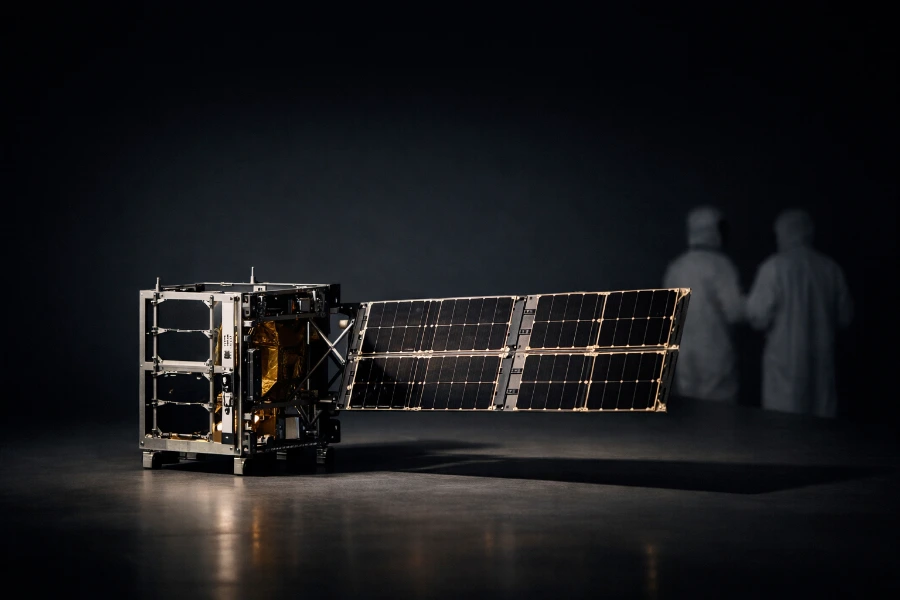
French startup Gama has closed a €15M (about $16.6M) seed round to build a production line for Wing, an ultra-light deployable solar array for satellites.
Key Takeaways
- Gama raised a €15M seed (about $16.6M) from Transition, Planet A, Draper Associates and Manta Ray.
- The money funds a Wing production line near Paris and about 60 hires.
- A first demonstration unit is scheduled for summer 2027. Valuation is undisclosed.
Lead
Gama, a Paris-area space hardware company, announced on November 12, 2026 that it had raised a €15M seed round, equal to roughly $16.6M. Investors are Transition, Planet A, Draper Associates and Manta Ray. No single lead was named in the announcement, and the company did not disclose a valuation.
The proceeds will pay for Gama's first production line for Wing, a deployable solar array built for high-power satellites. The line will sit at the company's site in Ivry-sur-Seine, near Paris. The round also covers expanded testing and about 60 engineering hires, which would roughly triple a team of around 30.
What Does Gama Actually Make?
Gama makes Wing, a complete power unit rather than a bare panel. It combines solar generation, an array rotator for sun tracking, power management and optional energy storage. It also includes the control software that keeps a satellite stable while carrying a very large array.
The cost approach is the notable part. Gama adapts high-volume terrestrial silicon cells, originally made for rooftop solar, for use in orbit. These cells reach roughly 20% efficiency, against about 32% for the germanium-based cells common on high-end spacecraft. The company is betting that cheaper cells, lighter structures and software pointing will win on cost per watt even with the efficiency gap.
Gama says it can deliver in about six months once the line runs. Chief executive Andrew Nutter has pointed out that conventional space-grade cells come from a small group of suppliers, with lead times that can reach a year or more.
How Did a Solar Sail Company Get Here?
Gama began in 2022 as a solar-sail developer and flew its Gama Alpha demonstrator in 2023 with support from France's space agency, CNES. It then pivoted to solar arrays, keeping its expertise in folding large, thin structures into small launch volumes. Its earlier funding was a reported €2M round backed by Bpifrance, CNES and angel investors.
The new round is more than seven times that size. For a seed, it is large by European space standards, though the company has not yet flown a Wing unit. Investors are paying for a manufacturing plan and a customer relationship, not for flight heritage.
Who Is Buying, and When?
Gama's named customer is Eclipse Space, a constellation platform builder founded by former SpaceX Starlink engineers. The two signed a partnership in September 2026 covering satellite platform supply. The first demonstration unit is scheduled for summer 2027, so revenue-scale production is at least a year away.
That timeline matters because the seed money buys a factory and a team, not a track record. Until a Wing array deploys and performs in orbit, the claims on cost and lead time remain projections.
Why Is Power the Constraint?
Falling launch costs have shifted the bottleneck. Satellites with larger payloads, and operators building bigger constellations, now need more electrical power than the existing supply chain can deliver quickly. Nutter has described power as "the new ceiling" for satellites after launch costs dropped. Planet A co-founder Nick de la Forge has called energy in orbit "becoming critical infrastructure."
Gama is not alone. Rocket Lab, which owns SolAero, has launched silicon-based arrays in 2026, and Redwire introduced its ELSA array in March 2026. Established suppliers already hold flight heritage and customer relationships that a new entrant must displace.
What Comes Next for Gama?
The immediate tasks are hiring and construction. Gama must stand up the Ivry-sur-Seine line, qualify its cells for the orbital environment and deliver the summer 2027 demonstration unit to Eclipse Space. Success would give European satellite bus makers a domestic alternative to a small set of suppliers. A slip would strain a company that has raised once at scale and has no revenue from flown hardware.
A follow-on round will probably hinge on how that first array performs in orbit, and on whether Gama can sign customers beyond Eclipse Space.
Outlook
Gama's €15M seed gives it money to move from demonstrator to factory, with a silicon-cell design aimed at cutting cost and lead time for large satellite arrays. The open questions are in-orbit performance, manufacturing yield and customer breadth beyond Eclipse Space. The summer 2027 demonstration unit is the next test.