Pomegra
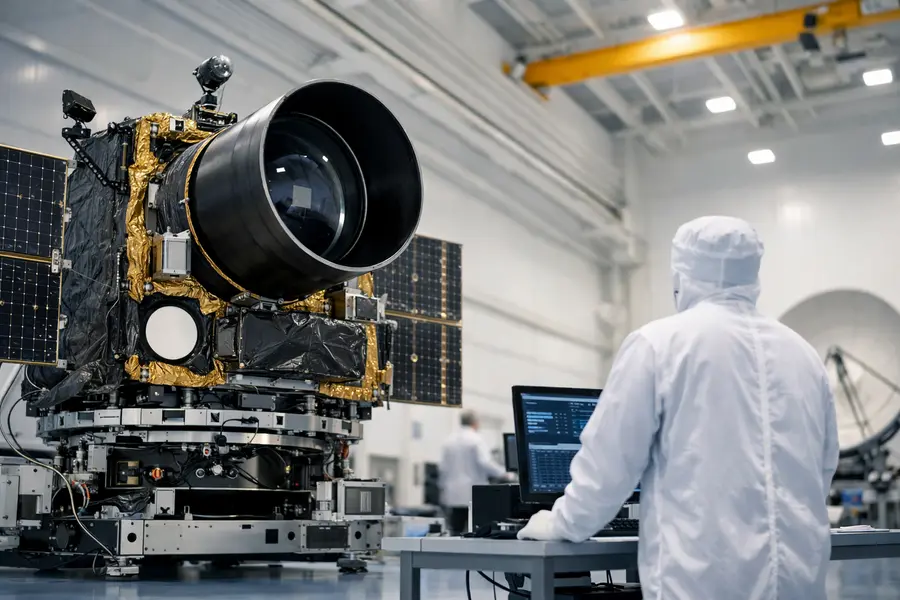
London's Foundational exited stealth with a €9.6M pre-seed round, the largest of its kind for a European space startup, to sell millimetre-precision satellite tracking.
Key Takeaways
- Foundational raised £8.2M (€9.6M, $10.8M) in pre-seed funding, with Inflection named as lead investor.
- The round is billed as the largest pre-seed ever raised by a European space technology company.
- Its ground stations cost about 30 times less than legacy laser-ranging facilities.
Lead
Foundational, a London spacetech company founded in 2025, emerged from stealth on 1 October 2026 with £8.2M (€9.6M, or $10.8M) in pre-seed funding. Inflection is named as lead in trade coverage of the round. BACKED, Final Frontier, Adjacent and Type One Ventures also took part. The company is automating Satellite Laser Ranging (SLR), a technique that fixes the position of satellites and orbital debris to millimetre precision. Valuation was not disclosed.
Who Is Behind Foundational?
Foundational was co-founded by Hira Virdee, the chief executive, and Dave Gooding. Virdee founded Lumi Space in 2018 with backing from the European Space Agency and the UK Space Agency. Foundational builds on laser-ranging technology originally developed at Lumi, which continues to operate as a separate company.
That lineage matters for a pre-seed round of this size. Investors are underwriting a team that has already shipped laser-ranging hardware, not a concept. It also explains how a company founded in 2025 can claim early customers.
What Does Foundational Actually Sell?
Foundational sells a vertically integrated SLR network made of three parts. Retroreflectors mounted on satellites bounce laser pulses back to the ground. Automated ground stations fire eye-safe lasers and time the returns, tracking objects up to 2,000km away. A software platform called Origin processes the measurements and delivers them to customers, including through an API.
The company says its stations are fully automated, weatherproof and cost roughly 30 times less than legacy facilities. SLR is widely regarded as the gold standard for orbit determination, but it has relied on expensive, manually operated observatories. Virdee has said the method has been too costly and too complex to use at scale. Foundational's pitch is that automation removes that constraint.
The product displaces the small, mostly academic network of staffed laser stations, and to a lesser degree the radar and optical tracking that operators use for collision screening. Those methods are cheaper per observation but less precise.
Why Does Millimetre Precision Matter for Orbital Safety?
Precise tracking matters because collision avoidance runs on uncertainty: the larger the error in an object's position, the more manoeuvres an operator must perform to stay safe. ESA's 2026 report counts about 45,000 tracked objects in orbit and estimates 1.5 million pieces of debris. Each close approach forces operators to weigh a fuel-burning manoeuvre against a collision probability.
Tighter position data shrinks that uncertainty. Virdee says better measurements help operators identify collision risks, plan safer manoeuvres and make better use of their spacecraft. The company also points to secondary uses, including atmospheric modelling and geodetic data products.
One limit applies. Ranging works best on objects carrying retroreflectors, so the debris-tracking claim depends on the lasers returning usable signals from uncooperative targets. The company has not published figures on how many debris objects its network can range today.
How Is the Money Being Used?
The funding will go toward building more ground stations, manufacturing space hardware in-house, raising retroreflector production and developing the data platform. A split between those items was not disclosed, and neither was a station count.
Early customers include commercial satellite constellation operators, ESA, UK government bodies, aerospace manufacturers and research institutes. Individual customers have not been named, and no contract values or revenue figures have been published. For a pre-seed company that is normal, but it means the round rests on team pedigree and the cost claim more than on commercial traction.
Is a Record Pre-Seed Round a Signal or a Stretch?
A £8.2M pre-seed is roughly several times the typical size for the stage, and the "largest in European space" label reflects how capital-intensive the business is. Ground stations, optics and flight hardware cost real money before the first invoice. The investor mix, from London generalists to a Nordic space-focused fund and US early-stage firms, suggests the round was assembled across three markets rather than led by a single specialist.
The label also carries a caution. A round this large at day one sets a high bar for the seed raise that follows. Foundational will need to show paying, repeat customers and a growing station network before then. The 30x cost advantage, if it holds in operation, is the number investors will test first.
Outlook
Foundational enters a market where tracking demand grows with every launched constellation and every debris-generating event. Its advantage is a team with prior SLR experience and a stated cost gap against legacy stations. Open questions are the size of its network, named contracts and its performance on debris without retroreflectors. The next 12 months of station deployments and customer announcements will show whether the record pre-seed buys a durable position or just a head start.