Pomegra
German spacetech Dcubed raised €27.2 million in a Series A+ led by Warsaw Equity Group to quadruple output of satellite release actuators and solar arrays.
Key Takeaways
- Dcubed raised €27.2M in an oversubscribed Series A+, announced November 2026, led by Warsaw Equity Group.
- Funds will quadruple production in Germany and the US and bring the ARAQYS solar array family to market.
- The Munich company has 87 employees, 170+ customers and 500+ products flown in space. Valuation is undisclosed.
Lead
Dcubed, the Munich-based maker of spacecraft deployment hardware, has closed a €27.2 million Series A+ round, the company announced in mid-November 2026. Warsaw Equity Group led the round. The European Innovation Council (EIC) Fund, HTGF Opportunity Fund, and existing investors BayBG and Expansion also took part. Dcubed did not disclose a valuation.
The company will spend the money on industrializing production of its release actuators and solar arrays in Germany and the US, expanding its workforce, and launching ARAQYS, a new family of high-power solar arrays.
What Does Dcubed Actually Sell?
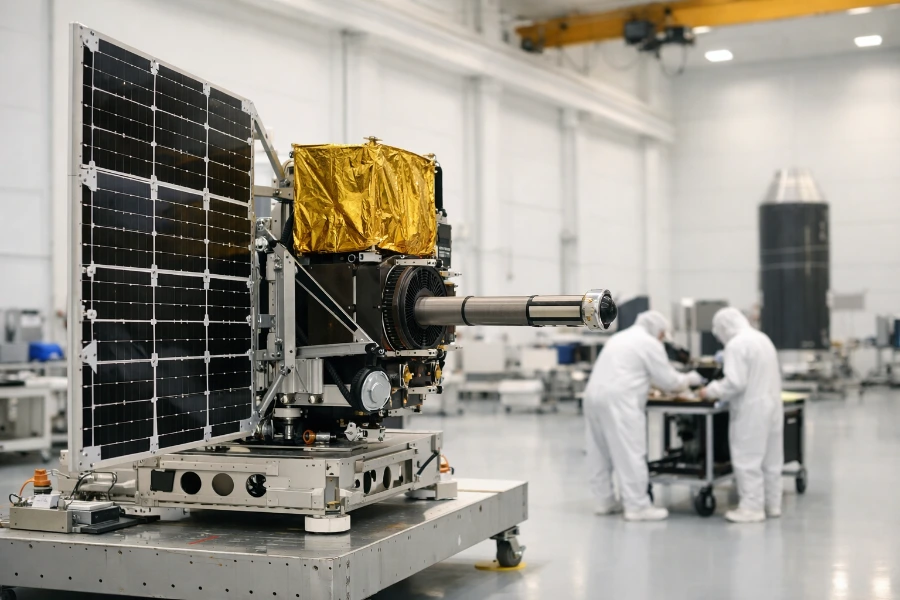
Dcubed sells mechanical hardware that spacecraft need to unfold, release and power themselves once in orbit. Its catalog includes release actuators such as release nuts and pin pullers, deployable structures, and solar arrays in both off-the-shelf and custom versions. Founder and CEO Thomas Sinn started the company in 2019.
The installed base is the strongest argument in its favor. Dcubed counts more than 170 customers worldwide and more than 500 of its products operating in space. It employs 87 people across Bremen and Munich in Germany and Denver in the US.
These parts are unglamorous but unforgiving. A satellite whose solar wing fails to deploy is a lost mission, so buyers favor suppliers with flight heritage over cheaper newcomers.
How Does This Round Compare With Its Previous Funding?
The Series A+ is more than six times larger than the €4.4 million Series A Dcubed announced in August 2024. That earlier round was led by Expansion and BayBG, with HTGF, Aurelia Foundry, Ventis, Rymdkapital and Decisive Point Europe participating.
The "A+" label signals a bridge between a small Series A and a full Series B. It also tells readers that the company is scaling manufacturing before it has raised a conventional growth round. Without a disclosed valuation or revenue figure, the step-up is hard to judge. Investors in the earlier round did return, which suggests the first tranche of capital produced results they liked.
The mix of backers is also notable. A Polish private equity-style investor leading, alongside a European Union innovation vehicle and German public-linked seed funds, points to a financing built around industrial capacity rather than pure venture growth.
What Is ARAQYS and Why Does It Matter?
ARAQYS is Dcubed's bet on cheaper electricity in orbit. The first architecture, HALO, uses an origami-style folding design to pack large solar panels into a compact launch volume. Dcubed plans to fly a 2 kW HALO array in 2027 on its ARAQYS-D3 mission aboard a SpaceX rideshare flight.
Power is a bottleneck for larger satellites, and for the growing number of constellations and in-orbit services that need more watts per kilogram. Moving from component supplier to power-system provider would raise Dcubed's content per spacecraft. It also exposes the company to competition from established solar array makers with deeper balance sheets.
Sinn has framed the goal as making space hardware as easy to buy and use as products on Earth, paired with affordable power through ARAQYS.
Why Does the US Expansion Matter?
Manufacturing in Denver gives Dcubed a domestic supply option for American customers, who often prefer or are required to buy from US-based suppliers on government-linked programs. The company's plan to quadruple capacity across both countries suggests it expects demand from constellation builders and launch rideshare customers to rise. Fourfold capacity is a large commitment for a company of 87 people, and execution on hiring and qualification will matter more than the headline figure.
What Comes Next?
The 2027 orbital test of the 2 kW HALO array is the main milestone. A successful flight would give ARAQYS the heritage that satellite buyers demand and could support a larger round. A failed or delayed test would leave the company dependent on its actuator business while it carries a much bigger cost base.
Two other variables will shape the picture: how quickly new factory capacity fills with orders, and whether Dcubed can win power contracts against incumbents. The next financing will likely reveal valuation and revenue for the first time.
Outlook
Dcubed enters 2027 with fresh capital, a proven actuator business and an untested solar product. The €27.2 million round funds a manufacturing build-out on two continents, while the HALO orbital demonstration will determine whether ARAQYS can turn a component supplier into a power systems company.