Pomegra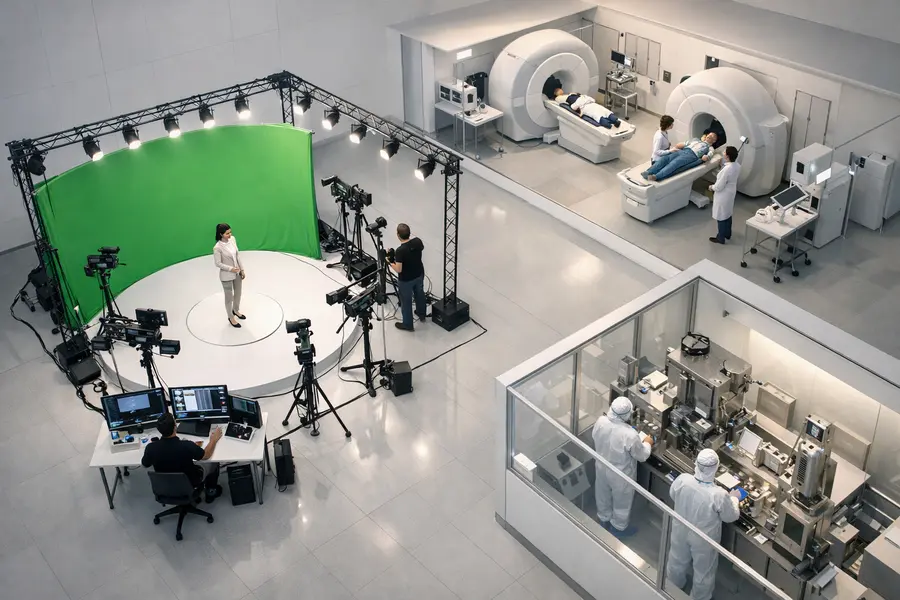
India's Brahma AI, the enterprise audiovisual AI platform with Warner Bros. and the NBA as anchor clients, raised $150M at a $2B valuation in a round led by Multiples Alternate Asset Management.
- Multiples is investing $100M across two vehicles, split between Brahma AI Holdings and Brahma AI Services India
- The company holds a 2026 Technology & Engineering Emmy and counts Mayo Clinic among its global enterprise customers
- Brahma AI was assembled from DNEG, Prime Focus Technologies, and Metaphysic, integrating three AI stacks under one platform
Who Just Bet $100M on AI-Generated Digital Humans
Brahma AI, the enterprise audiovisual AI platform founded by Prabhu Narasimhan, raised $150 million in a preferred-share round on September 23, 2026, reaching a $2 billion valuation. Multiples Alternate Asset Management, India's established private equity firm, anchored the deal with $100 million committed across two structures - $54.36 million via Multiples Private Equity Gift Fund IV into Brahma AI Holdings, and the rupee equivalent of roughly $45.64 million via Multiples Private Equity Fund IV into Brahma AI Services India. The remaining $50 million came from other investors, and the company says a further $100 million of investor interest is in play.
The valuation implies that, in under two years of formal operation, a platform stitched together from three acquired entities commands a price tag that rivals mid-sized Indian technology listed companies. That is either a sign of serious enterprise traction, or a reflection of how compressed AI funding multiples have become in 2026.
What Does Brahma AI Actually Build?
The company describes itself as an AI-native operating system for enterprise audiovisual content, a description that covers a lot of ground. It splits into two products. Brahma AI Core is the content intelligence and management layer - it lets large organizations index, search, and manage existing video and audio archives. Brahma AI Studio is the creation platform built on top of that archive, supporting visual AI, voice localization, multilingual performance dubbing, workflow automation, and the feature that draws most attention: interactive digital humans.
The digital humans product is close to launch. When it ships, it will let enterprise customers - think a broadcaster, a sports league, or a hospital network - deploy AI-generated interactive representations of real people or branded personas at scale. The company positions this as model-agnostic, meaning it is not tied to a single foundation model, which gives it flexibility as the underlying AI market shifts.
Its four target verticals are media and entertainment, sports, healthcare, and advertising. Anchor customers include Warner Bros., the NBA, and Mayo Clinic. Strategic distribution partners include Google, Japanese advertising giant Hakuhodo, and DNEG.
Why Is Multiples Writing a $100M Check Here?
The private equity logic is straightforward on the surface: Brahma AI has paying customers in three industries with large content budgets and acute localization needs. Warner Bros. alone spends billions annually on content production and distribution across dozens of languages. The NBA's global expansion into Asian and European markets creates an obvious demand for multilingual, personalized content at speed.
Healthcare is the more unusual vertical. Mayo Clinic's involvement signals that AI-generated digital humans may have use cases in patient education, clinical training, or physician-facing communications that go well beyond what the entertainment sector imagines. If Brahma AI can demonstrate measurable outcomes in a regulated environment like a hospital network, that alone expands the addressable market considerably.
What Multiples is buying is not just technology. It is the accumulated IP from three organizations. DNEG, one of the world's largest visual effects houses, acquired Prime Focus Technologies in July 2024, adding enterprise content management infrastructure. Brahma AI then folded in Metaphysic, a UK-based startup known for synthetic likenesses and AI-generated facial performances, integrating its teams and technology by November 2025. The result is a stack with depth in both post-production visual effects and enterprise software - a combination competitors would have difficulty replicating quickly.
How Rare Is This India-Origin Enterprise AI Deal?
In the Indian startup funding context, a $150 million single round at $2 billion is a meaningful outlier. Most Indian enterprise software startups raise at far lower multiples and take longer to reach ten-figure valuations. Brahma AI reaching this mark before its second birthday reflects both the global premium on AI infrastructure and the specific backing of DNEG Group, which lends the company institutional credibility that pure-play AI startups rarely have at this stage.
The 2026 Technology and Engineering Emmy Award for visual AI technology adds a credential that matters in the media vertical - it is peer validation from the broadcast industry, not a VC-adjacent accolade.
Outlook
Brahma AI enters the final quarter of 2026 with capital, an Emmy, and three enterprise anchors across different industries. The near-term test is whether interactive digital humans can move from close-to-launch to deployed-at-scale for its existing customers. The broader question is whether a platform built on DNEG's production heritage can sell as fluently into healthcare and sports technology buyers as it does into entertainment studios. With $100 million more in reported investor interest remaining on the table, the company has options for how much further it wants to stretch the round before testing those assumptions.