Pomegra
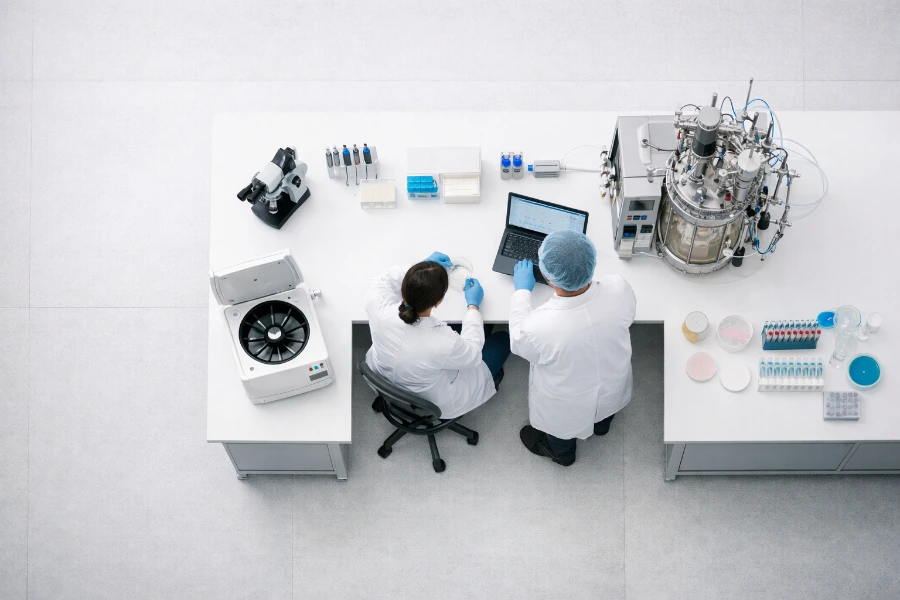
Lithuanian AI enzyme designer Biomatter raised an $18M Series A led by Astanor to build a 2,000 m² lab in Vilnius and expand its US commercial team in 2027.
Key Takeaways
- Biomatter closed an oversubscribed $18M Series A on November 12, 2026, led by Astanor.
- UVC Partners, Inventure and Metaplanet, all existing backers, also joined; valuation was not disclosed.
- A 2,000 m² design and testing facility in Vilnius is due to open in 2027, with a bigger US push alongside it.
Lead
Biomatter, a Vilnius-based company that designs custom enzymes with machine learning, announced an oversubscribed $18M (about €16.2M) Series A on November 12, 2026. Astanor led the round. Existing investors UVC Partners, Inventure and Metaplanet took part. The company did not disclose valuation, revenue or headcount.
The money will fund a 2,000 m² enzyme design and testing facility in Vilnius, scheduled to open in 2027. It will also pay for a larger commercial team and a bigger presence in the United States, where roughly half of Biomatter's customers already sit.
What Does Biomatter Actually Sell?
Biomatter sells enzymes designed to order. A customer specifies the chemical reaction it needs, and the company builds an enzyme for that reaction instead of tweaking one that already exists in nature. Every design is tested in a wet lab before it ships.
The company was founded in 2018 and is led by CEO Laurynas Karpus. It has delivered more than 50 custom enzymes to over 25 enterprise customers in Europe, the US and Japan. Named customers include AstraZeneca, BASF, Sanofi, Kirin Holdings, Neogen and Tereos.
Two delivered products show the range. One is a reverse transcriptase with improved oxidation resistance, sold by Thermo Fisher Scientific under the Invitrogen SuperScript V name. The other is a methylase for mRNA vaccine manufacturing that works without S-adenosylmethionine, a costly cofactor.
Karpus framed the goal as making a custom enzyme "as easy to order as a catalog product, including for reactions that don't have one today."
Why Is Biomatter Building a Physical Lab?
Biomatter is building a lab because the bottleneck in enzyme design is testing, not modeling. Computational models can propose thousands of candidates, but each one still has to be expressed, purified and measured. Current Biomatter programs run for weeks. The company says the new facility should cut design cycles to days.
The lab also builds a proprietary asset. Biomatter says its enzyme dataset extends well beyond what exists in nature, and every tested design adds to it. That makes the lab a data engine as much as a service center, which is a more defensible position than a model alone.
The capital cost is the risk. A software-style narrative sits awkwardly beside a 2,000 m² facility, and the round's size suggests investors are funding a measured build-out rather than a large platform bet. The company did not disclose the construction budget or what share of the $18M it absorbs.
What Does the Round Say About the Market?
The round shows continued investor appetite for AI-first biotech tooling in Europe, though at modest check sizes. Peers named in coverage of the deal include Cradle, Imperagen and ZYMVOL, along with Generare and Epoch Biodesign among comparable European biotech investments. None of them has settled the question of whether design software or physical throughput captures the margin.
Market projections give the sector a tailwind. The global engineered enzymes market is forecast to grow from $3.3 billion in 2026 to $7.3 billion by 2033, a compound rate near 12%. Such forecasts usually come from the research firms that sell them, so the figure is best read as direction, not a promise.
The round's structure is more informative than the headline. Three existing investors returned, and the round was oversubscribed. That points to continued confidence from insiders, though Biomatter has not disclosed the size or terms of its earlier funding, so step-ups in valuation cannot be measured.
Who Is Astanor and Why Does the Lead Matter?
Astanor is a Europe-based venture firm that invests in food, agriculture and industrial biotechnology. Its lead role gives Biomatter a backer whose portfolio overlaps with the agricultural and industrial customers the company wants to reach. UVC Partners, a Munich-based fund, stays on the cap table from earlier rounds.
For Lithuania, the deal adds to a short list of deep-tech startups raising growth capital from international funds. Biomatter published research in Nature Machine Intelligence in 2021, and the Series A extends that scientific base into a commercial footprint.
What Comes Next?
Biomatter has two milestones to hit. The Vilnius facility has to open on schedule in 2027, and the US team has to turn an existing customer base into larger contracts. Enterprise buyers in pharma and diagnostics tend to run long procurement cycles, so revenue effects of the US push will likely arrive after the lab opens.
Competition is the other variable. If rivals match the weeks-to-days turnaround, speed stops being a differentiator, and the proprietary dataset becomes the main moat.
Outlook
Biomatter now has $18M, a lead investor in Astanor and a 2027 deadline for its Vilnius lab. Undisclosed valuation and revenue leave the round hard to benchmark. The test is whether faster physical testing converts 25 enterprise customers into repeat, larger orders, particularly in the US.