Pomegra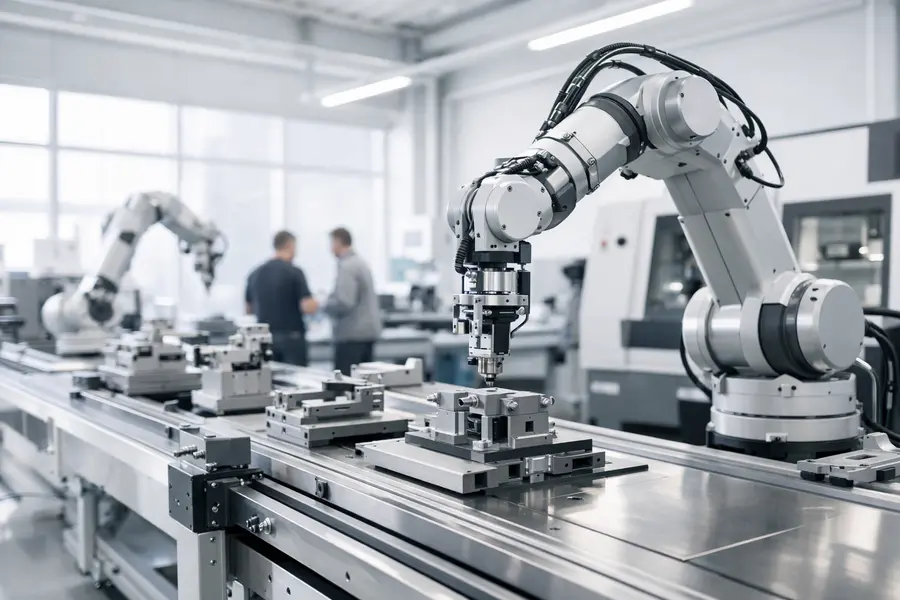
Travis Kalanick's physical AI holding company Atoms closed a $1.7B equity round led by a16z to automate food, mining, and transport with specialized robotics.
Key Takeaways:
- Andreessen Horowitz led the $1.7B equity round with Ben Horowitz joining the Atoms board; valuation was not disclosed.
- Atoms combines CloudKitchens and Pronto - a heavy-industry automation firm acquired in March 2026 - under three divisions: Food, Mining, and Transport.
- Co-investors include Bain Capital, Fifth Wall, and Uber, the company Kalanick co-founded before his 2017 ouster.
Lead
Atoms, the physical AI and industrial robotics holding company run by Uber co-founder Travis Kalanick, raised $1.7 billion in equity on July 22, 2026. Andreessen Horowitz led the round, with general partner Ben Horowitz taking a board seat. No post-money valuation was disclosed. At $1.7 billion, the raise ranks among the largest single funding rounds in robotics this year - in a market that pulled in $55.8 billion globally through early June 2026, nearly double the prior full-year record.
What Is Atoms and How Does It Make Money?
Atoms is a holding company, not a single-product robotics startup. It was built around two businesses. The first is CloudKitchens, the ghost kitchen platform Kalanick launched after leaving Uber in 2017. The second is Pronto, a heavy-industry automation firm formerly led by self-driving pioneer Anthony Levandowski, which Atoms acquired in March 2026. Under the Atoms name, those assets now operate as three divisions: Atoms Food, running automated cooking platforms and restaurant software; Atoms Mining, deploying autonomous heavy machinery at remote extraction sites; and Atoms Transport, handling robotics across industrial logistics hubs.
The business model sets Atoms apart from most robotics vendors. Rather than selling machines, the company owns and operates them - a services-and-infrastructure approach that generates recurring revenue but concentrates capital expenditure on Atoms' balance sheet. That operating logic explains why the round is structured as equity rather than debt: Atoms needs capital to deploy machines at scale, not to fund pure software development.
Why Did a16z Bet on Specialized Industrial Robots Over Humanoids?
Andreessen Horowitz chose to lead a purpose-built industrial robotics round at a moment when most large AI bets are flowing toward general-purpose humanoids. The thesis behind that choice is timing and environment. Controlled industrial settings - mines, commercial kitchens, logistics corridors - have defined workflows and customers carrying measurable labor costs. Purpose-built machines can displace specific tasks in those environments within current commercial timelines. General-purpose humanoids, by contrast, require dexterous manipulation, unpredictable spatial awareness, and broad deployment density that most operators are not yet willing to finance. Kalanick's background scaling a high-volume, operationally intensive marketplace at Uber lent credibility to a pitch built around deploying physical infrastructure at scale.
Uber itself co-invested in the round alongside Bain Capital, Fifth Wall, Chemistry, A\*, K5 Global, Abstract, SV Angel, and Alpha Square Group. Uber's participation carries both symbolic and practical weight: the company Kalanick built and was removed from in 2017 is now writing checks into his next venture.
What Does the Missing Valuation Tell Us?
Atoms declined to disclose a post-money valuation - a deliberate choice for a company whose component parts carry complicated histories. CloudKitchens was valued at roughly $15 billion during the ghost kitchen boom of 2021, a figure that aged poorly as restaurant delivery economics tightened and the ghost kitchen category contracted. Publishing a current valuation would invite direct comparison to that peak. The omission does not signal weakness; it manages a narrative.
What the round size does confirm is that investors are pricing in a long capital runway. Deploying and operating robotics infrastructure across mining, food production, and transport logistics does not return capital on a three-year venture timeline. The $1.7 billion gives Atoms room to build machine density before any pressure to monetize at scale.
Outlook
Atoms enters the second half of 2026 with $1.7 billion in equity and a mandate to expand machine deployments across three industrial verticals. The a16z endorsement and Horowitz's board seat will smooth procurement conversations with large industrial operators who treat venture backing as a proxy for company durability. The harder test is operational. Kalanick demonstrated he can build and scale logistics networks, but running fleets of physical machines across active mine sites and factory floors differs meaningfully from running a marketplace. The next significant disclosure will likely be revenue data, not another funding announcement.