 Pomegra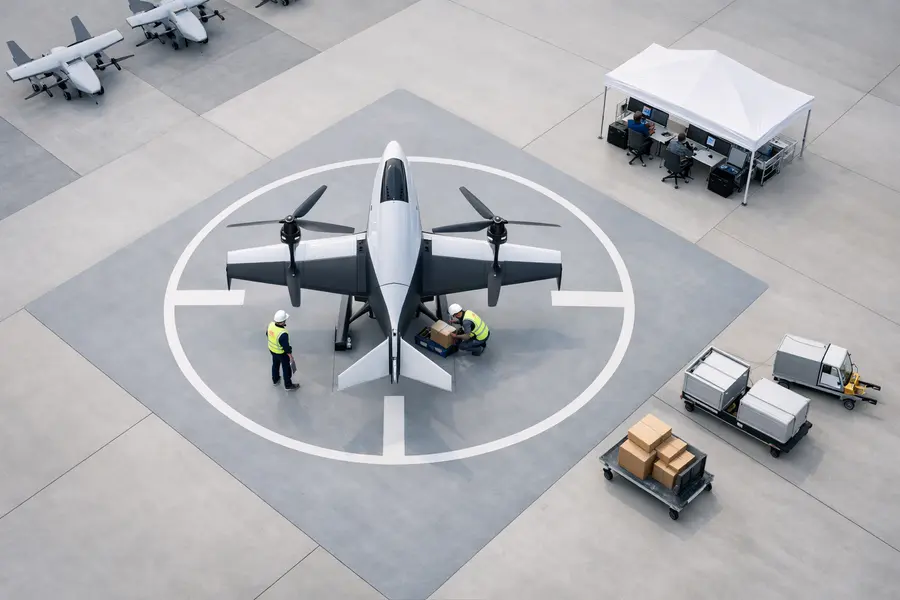
Bengaluru startup Airbound closed a $37M Series A led by Greenoaks to scale a tail-sitter cargo drone that achieves three times the industry standard payload ratio.
Key Takeaways:
- Greenoaks led the $37M round; DoorDash, Lightspeed, Lachy Groom, and Humba Ventures also participated.
- Airbound's V1 drone carries 1 kg on a 1.5 kg frame - three times the payload efficiency of the industry norm.
- An Andhra Pradesh government contract targets 10,000 daily flights across three districts for retail, e-commerce, and healthcare.
Lead
Bengaluru-based Airbound closed a $37 million Series A on August 25, 2026, with Greenoaks leading the round and DoorDash, Lightspeed, Lachy Groom, and Humba Ventures joining. The raise brings the company to nearly $50 million in total funding since its March 2023 launch - and arrives on the back of a state-level deal that could make it one of the largest drone delivery operators in the world by flight volume. Airbound has logged more than 13,000 autonomous missions with zero failures. The Series A is now the mandate to go much bigger, much faster.
What Does Airbound Actually Build?
The core product is a blended-wing-body tailsitter: a fixed-wing aircraft that launches and lands vertically, eliminating the need for runways or launch infrastructure. The current V1 weighs 1.5 kilograms and carries 1 kilogram of payload, a ratio that runs three times better than the industry norm of 4:1 aircraft-to-payload weight. Most competing commercial drones are heavy relative to what they haul; Airbound's design inverts that equation.
The drone is autonomous end-to-end. Airbound has demonstrated the model with hospital network Narayana Health, completing more than 1,000 flights carrying diagnostic samples roughly 2.5 miles in seven minutes - a route that takes three to five hours by truck.
Why Is $37M Arriving Now?
The timing tracks the Andhra Pradesh agreement, which commits to scaling an aerial delivery network across three districts to 10,000 flights per day - covering retail, e-commerce, and healthcare logistics. Achieving that volume requires between 250 and 1,000 aircraft, depending on route lengths; Airbound estimates the lower end of that range is more likely given the density of the network.
Airbound has already demonstrated manufacturing scalability. The company went from producing two aircraft per month to two per day in under a year, and it is now targeting 20 per day. The Series A provides the capital to accelerate that production curve before the Andhra Pradesh agreement demands it.
What Does the Andhra Pradesh Deal Signal for Drone Regulation in India?
India's drone policy has moved in a liberalizing direction since 2021, with DGCA easing airspace rules and state governments increasingly signing framework agreements with commercial operators. A 10,000-flight-per-day commitment from a state government - one of the largest such agreements globally - is a signal that regulators have enough confidence in autonomous drone operations to approve them at scale, not just in controlled pilots.
That regulatory backdrop is what makes the Andhra Pradesh deal worth more than its face value. It creates a live, large-scale test environment that no competitor currently has access to. If Airbound executes on the contract, the operational data becomes its most defensible asset.
How Does This Compare to Previous Airbound Rounds?
Airbound raised an $8.65 million seed round in October 2025, led at that stage by Grad Capital and other early backers. The jump to a $37 million Series A, with Greenoaks - a fund known for concentrated bets in high-conviction markets - leading the round, represents a material step up in institutional backing. DoorDash's participation is notable: it is a strategic signal from one of the world's largest last-mile delivery operators that drone economics are getting close enough to trucking costs to warrant a direct stake.
Valuation was not disclosed.
Manufacturing as the Bottleneck
The drone industry's persistent problem is that hardware is hard to scale. Software companies can grow with a headcount and a cloud bill; drone manufacturers have to build physical units, manage supply chains, and maintain quality control at volume. Airbound's production ramp - two per month to two per day - is a credible proof point, but 10,000 daily flights implies sustained manufacturing output at a scale few drone companies have reached globally.
The Series A capital is directed primarily at production capacity, which means the company's next 18 months are more about factory output than product development. That is a different kind of execution risk than most early-stage hardware companies face.
Outlook
Airbound enters its next phase with a state-level contract that would validate its business model if executed and a hardware edge in payload efficiency that competitors have not publicly matched. The gap between a framework agreement and 10,000 daily operational flights is large - it involves fleet deployment, maintenance infrastructure, pilot networks, and regulatory clearances across three districts. Whether the Andhra Pradesh target holds its timeline will determine how much of the $37 million is enough. The production ramp, the Narayana Health track record, and the investor lineup all point in the same direction. The Andhra Pradesh rollout will say whether the arrow lands.