Pomegra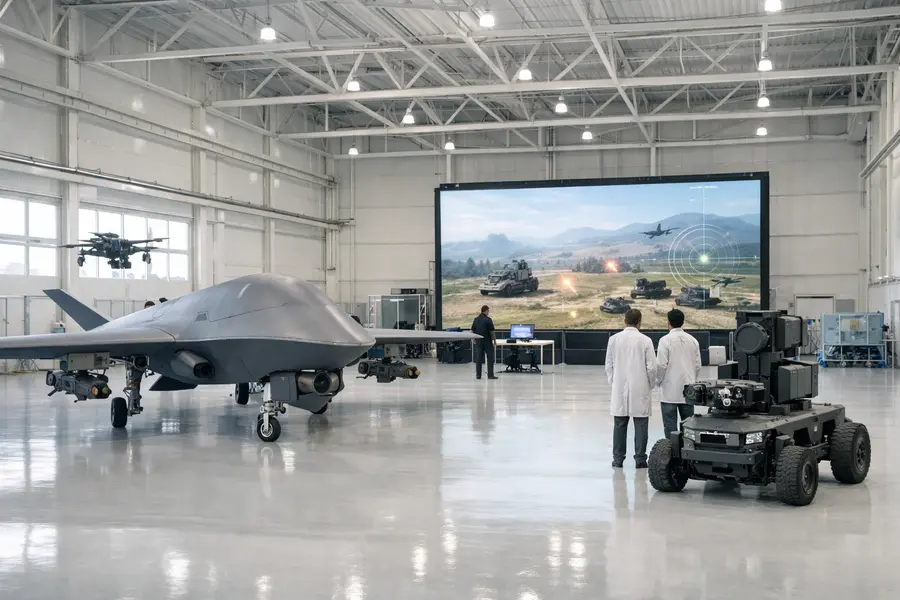
British defence startup Agon raised $30M in seed funding from Lux Capital and Northzone to build synthetic battlefields where autonomous weapons train against adaptive AI adversaries.
- Agon closed $30M across a $7M pre-seed and $23M seed round, one of Europe's largest defence tech seed rounds of 2026.
- The platform trains autonomous weapons and counter-drone systems at machine speed against AI adversaries modelled on live conflict intelligence.
- Founders bring Anduril, British Army, and defence-unicorn pedigree; chairman David Helgason previously built Unity Technologies.
Lead
Agon, a London-based defence technology startup, emerged from stealth on July 29, 2026 with $30 million in combined seed funding to build what it describes as synthetic battle arenas - virtual environments where AI-powered autonomous systems rehearse combat scenarios against adaptive adversaries. The seed round, totalling $23 million, was led by Lux Capital and Northzone, with a prior $7 million pre-seed backed by Lakestar, 201 Ventures, and D3. Valuation was not disclosed. The raise ranks among the largest defence technology seed rounds in Europe this year.
What Does Agon Actually Build?
Agon's platform is a simulation infrastructure, not a weapon. It creates high-fidelity synthetic battlefields where autonomous systems - counter-drone platforms, loitering munitions, AI-guided sensors - can train against adversaries that adapt in real time, drawing behaviour patterns from live conflict intelligence. The goal is volume and speed: a synthetic arena can run thousands of training iterations in the time a physical range completes one.
The practical problem Agon is targeting is straightforward. As European defence companies race to field autonomous systems, they face a training data bottleneck. Real firing ranges are slow, expensive, geographically constrained, and produce limited data variety. Classified operational data from allies is rarely shared across borders. Agon's pitch is sovereign synthetic data at scale - generated inside secure environments that European defence buyers control.
Why Is This Round Significant for European Defence?
Europe's defence autonomy push is accelerating but running into infrastructure gaps. Governments are spending heavily on autonomous platforms - drone swarms, counter-UAS systems, uncrewed ground vehicles - yet the AI training pipelines that make those systems reliable lag behind procurement ambitions. Agon is positioning synthetic environment infrastructure as the missing layer.
The $30 million figure is notable for a seed-stage company in a sector where most early rounds stay below $10 million. It signals that generalist venture capital, not just defence-focused funds, is comfortable writing large cheques into pre-revenue European defence tech. Lux Capital, which has backed hardware and deep-tech companies in the US defence ecosystem, brings cross-Atlantic context. Northzone, a Nordic fund with a consumer and enterprise software history, is a less obvious fit - its presence suggests Agon's commercial architecture attracted attention beyond traditional defence investors.
Who Built Agon?
Co-founder Tristam Constant spent 13 years in the British Army before moving into the defence-tech industry, first at Applied Intuition and then as Senior Director for Europe at Anduril Industries, the US autonomous systems company that has become a reference point for the new defence-tech model. Co-founder Junaid Hussain previously co-founded Cambridge Aerospace, a British defence company that reached unicorn valuation, and Iconic, a Google-backed AI and gaming firm. The combination of operational military experience, Anduril's playbook, and scaled startup execution is uncommon at the seed stage.
Chairman David Helgason, who founded and led Unity Technologies before its IPO, brings a specific credential: Unity built the simulation and game engine infrastructure that underpins a significant share of existing military training software. His involvement is strategic context as much as governance.
What Comes Next for Agon's Platform?
The company has existing partnerships with European defence autonomy companies, though none were named publicly at launch. A second office in Berlin, alongside London headquarters, positions Agon within Germany's expanding defence-tech cluster and close to NATO institutional customers.
The broader sector dynamic works in Agon's favour near-term. European governments have accelerated defence budgets since 2022, and autonomous systems spending is growing faster than overall defence outlays. The EU's defence investment frameworks increasingly prioritise sovereign capability - including AI training data that does not depend on American or non-European providers. Agon's pitch maps directly onto that preference.
The harder question is competitive differentiation at scale. Several US companies offer synthetic training environments for defence applications, and the gap between simulation fidelity and real-world performance remains an unsolved problem across the industry. Whether Agon's European positioning and live-conflict-intelligence adversary modelling create durable advantages - or simply early-mover timing - will depend on contract wins the company has not yet announced.
Outlook
Agon enters a defence-tech market that has more capital than it did two years ago but still relatively few exits to validate the category. The $30 million raise buys time to land anchor contracts with European defence primes or government customers. The founding team's credentials are strong; the product addresses a real procurement gap; the investor base spans both deep-tech and growth-stage conviction. Execution against sovereign European defence procurement cycles - which move slowly even in periods of urgency - remains the central test.