 Pomegra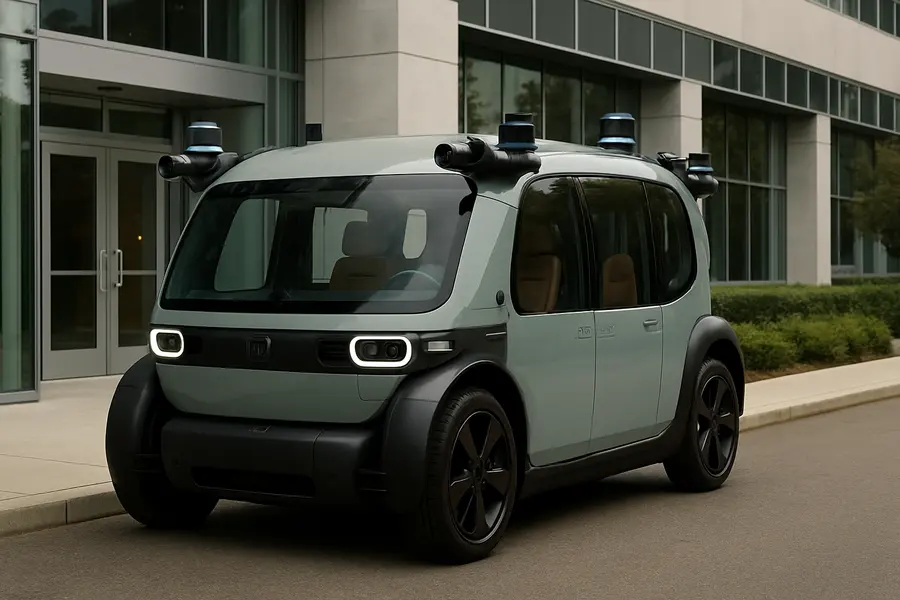
I have sufficient data. Writing the article now.
- Zoox's Hayward, Calif., facility targets 100 redesigned vehicles per week to fuel a 10-city U.S. expansion later this year.
- The NHTSA commercial exemption covering up to 2,500 driverless vehicles remains under review after the public comment window closed in April 2026.
- Zoox plans to begin charging for rides in San Francisco and Las Vegas in 2026, marking its first revenue-generating commercial deployments.
---
Amazon's Zoox revealed an upgraded purpose-built robotaxi with ergonomic and sensor improvements as the AMZN subsidiary targets paid commercial service launches across ten new U.S. cities in 2026.
What Happened
Amazon's self-driving subsidiary Zoox unveiled the "next evolution" of its distinctive purpose-built robotaxi on June 24, 2026, showcasing interior and exterior upgrades designed for comfort, rider clarity, and large-scale manufacturability. The updated vehicle — which maintains its signature bidirectional, steering-wheel-free pod format — is set to enter large-scale production at Zoox's Hayward, California facility imminently, with availability to paying riders targeted for later this year.The announcement positions Zoox ahead of a significant geographic expansion, with paid commercial service earmarked for Dallas, Denver, Detroit, Houston, Las Vegas, Orlando, San Antonio, San Diego, Washington D.C., and Nashville — all in 2026.
Design Overhaul
The redesigned vehicle focuses on passenger experience and operational legibility. Interior changes include aloe-green seating with stone-gray flooring and trim, ergonomic curves and added padding in headrests, enlarged cupholders, and a fluted wireless charging pad engineered to prevent phones from sliding during maneuvers. Higher-quality touchscreens and a deliberately uncluttered cabin — described by Chris Stoffel, Zoox's director of robot industrial design, as "a simple elevated interior design that doesn't demand a rider's attention" — round out the cabin refresh.
On the exterior, Zoox enlarged and relocated its proprietary bidirectional reflectors, the colored indicators that allow riders, pedestrians, and law enforcement to distinguish the vehicle's front from its rear — a critical safety element for a car with no fixed orientation. Two-way audio capability at the door interface was also added. Core vehicle specifications remain unchanged: four-wheel steering, a top speed of 75 mph, seating for four passengers, and a 40-sensor array combining cameras, radars, lidars, and infrared detectors.
Regulatory Dimension
Commercial deployment hinges on a pending decision by the National Highway Traffic Safety Administration. Zoox filed a petition requesting a two-year exemption from eight federal vehicle safety standards — provisions written for human-operated vehicles that mandate features such as steering wheels, pedals, and rearview mirrors. The petition seeks authorization to operate up to 2,500 vehicles annually during the exemption period.
NHTSA closed the public comment window on April 10, 2026; a decision remains outstanding. The agency previously granted Zoox a demonstration exemption in August 2025, the first such federal clearance for an American-built automated vehicle, enabling limited public road testing. U.S. Transportation Secretary Sean Duffy characterized that milestone as "a major step toward a streamlined pathway to scaled commercial deployment of novel AV fleets."
Competitive Context
The robotaxi sector is accelerating rapidly, and Zoox faces a substantial operational gap relative to its primary rival. Waymo, the Alphabet-backed leader, reported approximately 450,000 weekly paid rides and 14 million total trips served in 2025, with active commercial deployments in San Francisco, Phoenix, Los Angeles, Austin, and Atlanta. Waymo plans to add more than 2,000 autonomous vehicles to its fleet through 2026.
Zoox, by contrast, currently offers free rides in San Francisco, Las Vegas, Austin, and Miami — a deliberate sequencing strategy that prioritizes safety data accumulation over near-term revenue. The company's purpose-built vehicle architecture — designed from inception without a driver's seat or traditional controls — represents a structurally different bet: optimized for ride economics and passenger density rather than retrofitted from an existing consumer platform, as most competitors have done.Production capacity at the Hayward facility is targeting 100 vehicles per week, with an annual run rate potential of approximately 10,000 units, contingent on regulatory clearance.