Pomegra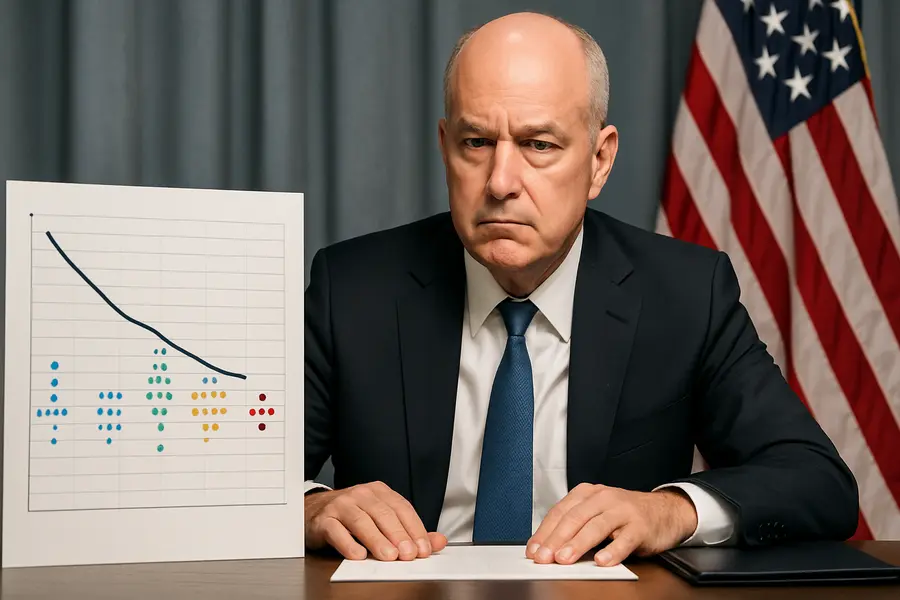
Fed Chair Kevin Warsh withheld his dot plot entry and dropped forward guidance at his first FOMC meeting, signaling a shift toward deliberate ambiguity in central bank communication.
- The Fed held rates at 3.50%–3.75%; the median dot plot projection moved to 3.8% from 3.4% in March, with nine of 18 officials seeing at least one hike in 2026.
- Warsh refused to submit a Warsh dot entry, calling the practice "not helpful in the conduct of policy" — the first Fed chair to formally opt out.
- Five task forces will review fed forward guidance, the balance sheet, data sources, productivity, artificial-intelligence impact, and inflation frameworks by year-end.
Lead
Washington, June 18, 2026 — Federal Reserve Chair Kevin Warsh withheld his own projection from the central bank's Summary of Economic Projections at the conclusion of the June 17 Federal Open Market Committee meeting — the first time in the modern era that a sitting Fed chair has formally declined to submit a dot plot entry. The committee held the federal funds rate steady at its current target range of 3.50%–3.75%, while announcing the immediate abandonment of explicit fed forward guidance, marking the most consequential shift in Fed communication philosophy since Ben Bernanke institutionalized transparency after the 2008 financial crisis.What Happened
The FOMC voted unanimously to leave rates unchanged. The post-meeting statement was materially shorter than its predecessors and stripped of language that had signaled an easing bias, a phrase that markets had used as a near-term anchor for rate-cut expectations.
At his first post-meeting press conference, Warsh confirmed the abstention directly: "I did not submit a dot for me. It's not helpful in the conduct of policy." He added that he had "refrained from offering any projections of my own, consistent with my long-held views on the SEP, at least as currently structured."
Warsh encouraged other FOMC participants to continue submitting their own projections, and all 17 other officials did so. The resulting dot plot, stripped of the chair's entry, reflected a hawkish pivot: nine officials see at least one rate increase before year-end 2026, eight favor holding steady, and one projects a cut. The median estimate for the fed funds rate at end-2026 moved to 3.8%, up 40 basis points from the 3.4% median recorded in the March projection round.
Market Reaction
Treasury yields climbed across the curve following the release. The two-year note, the maturity most sensitive to near-term policy expectations, rose as the repriced dot distribution shifted rate-cut bets further out. Equity markets registered initial volatility before partially recovering, with rate-sensitive sectors — real estate, utilities, and growth-oriented technology — underperforming on the session. The U.S. dollar firmed modestly against major peers.
The Dot Plot Debate
The dot plot, formally the Summary of Economic Projections, was introduced in 2012 under Chair Bernanke as a mechanism to anchor long-run expectations and reduce uncertainty about the Fed's reaction function. Critics, including Warsh during his academic and policy career, have argued that the tool creates the opposite effect: it commits the committee to stale forecasts, reduces operational flexibility, and invites the market to trade mechanical extrapolations rather than underlying economic fundamentals.
Warsh's decision to withhold his dot reflects a broader philosophical alignment with Alan Greenspan-era practice, under which the Fed communicated through deliberate ambiguity — sparse statements, limited press conferences, and no published rate-path projections — leaving markets to infer policy intent from data and outcomes rather than official forecasts. Warsh stated publicly during his Senate confirmation hearing that he does not believe forward guidance tied to economic data strengthens the conduct of monetary policy.
Revised Economic Projections
Despite the chair's absence from the projection grid, the broader SEP painted a more challenging macroeconomic picture than the March round. Officials raised their 2026 inflation outlook to 3.6% on the headline measure and 3.3% for core, which excludes food and energy. GDP growth was trimmed slightly to 2.2%, down 0.2 percentage point from March. The unemployment forecast was revised to 4.3%, a 0.1 percentage-point improvement.
The combination of stickier inflation and resilient labor markets has reduced the mathematical case for near-term easing and hardened the hawkish tail of the distribution.
Communication Overhaul Underway
Warsh announced the formation of five task forces charged with examining Fed communications, the central bank's balance sheet, the data sources underpinning its models, productivity and labor dynamics, the economic impact of artificial intelligence and other transformative technologies, and the Fed's inflation framework. He indicated that the review would conclude by year-end and could result in structural changes to how frequently the committee meets, how often press conferences are held, and whether the dot plot is retained in its current form, modified, or discontinued.
"By year-end, there will be a review about communication broadly — press conferences, dots, meetings, transcripts, minutes," Warsh said. "I'm pretty open-minded about what they could be."
Outlook
The June meeting establishes Warsh's tenure as a deliberate break from the post-crisis transparency consensus. By withholding his Warsh dot and declaring the end of fed forward guidance in the same session, he has made the Fed's communication posture itself the central policy variable of his early chairmanship. Markets must now reprice not just the rate path, but the framework through which that path will be signaled — a recalibration that will likely keep volatility elevated across rates markets through the remainder of 2026.