Pomegra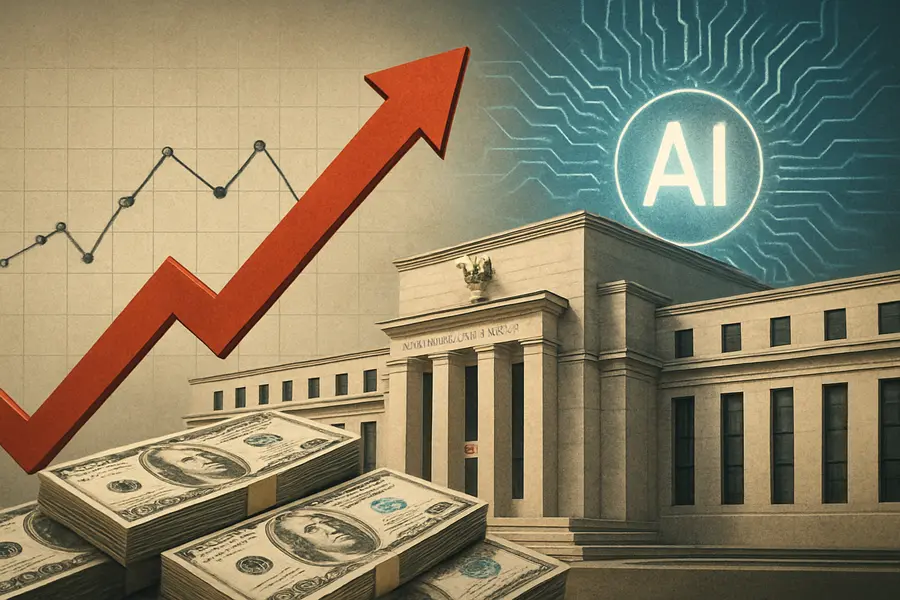
Lead
Federal Reserve Chair Kevin Warsh declared at the European Central Bank's annual Sintra Forum on July 1, 2026, that US prices remain "too high" despite growing optimism among policymakers about artificial intelligence's capacity to suppress long-run inflation. Speaking alongside ECB President Christine Lagarde, Bank of England Governor Andrew Bailey, and Bank of Canada Governor Tiff Macklem, Warsh signaled that the Fed's rate path will be guided by current data rather than forecasts of technology-driven productivity gains that could take a decade or more to materialize.
- Warsh told Sintra panel: "Prices are too high," reaffirming the Fed's 2% inflation target with a narrow mandate.
- US headline CPI rose 4.2% year-over-year in May 2026; core PCE held at 3.3%, both well above target.
- Nine of 18 FOMC members project at least one additional rate hike; futures markets assign 56% odds of tightening by year-end.
What Warsh Said
On the main Sintra panel, Warsh offered three crisp statements of intent. "Prices are too high, and I don't think I'm the only one on this stage that's recommitted to deliver price stability," he said, also adding that the Fed "will deliver price stability" and that the commitment is "strong, unanimous, and unambiguous."
Warsh simultaneously offered measured optimism on Fed AI dynamics, noting that he views artificial intelligence as a disinflationary force — a technology with "huge implications" for interest rates — while cautioning that the productivity windfall from AI is unlikely to provide any near-term offset to still-elevated consumer prices.
The distinction matters: US rate path decisions must be anchored to conditions in the present tightening cycle, not a 10-year horizon in which AI-driven productivity improvements might structurally lower prices.
Inflation Picture
The Fed's discomfort is grounded in hard data. US CPI rose 4.2% year-over-year in May 2026, with a monthly gain of 0.5%, bringing the three-month annualized pace to 8.2%. Core CPI, which strips out food and energy, ran at 2.82% annually, with a three-month annualized rate of 3.17%.
The Fed's preferred inflation gauge — the PCE price index — painted a similar picture. Headline PCE came in at 4.07% year-over-year, with a three-month annualized pace of 6.3%. Core PCE, the metric most directly tied to FOMC deliberations, stood at 3.41%, more than 140 basis points above the 2% target. June CPI figures are scheduled for release on July 14, with June PCE data due July 30.
At the June 17 FOMC meeting — Warsh's first as chair — the committee held the federal funds rate at 3.50%–3.75%, citing persistent price pressures. The FOMC's revised Summary of Economic Projections lifted the 2026 year-end inflation outlook to 3.6% headline and 3.3% core PCE.
The AI Tension
Before assuming the Fed chairmanship, Fed Chair Kevin Warsh publicly argued that generative AI would function as a disinflationary force comparable to the internet boom of the 1990s, capable of lowering production costs and boosting total factor productivity across broad sectors of the economy. That view has not changed, but its policy relevance has become a source of deliberate restraint.
Warsh's position at Sintra — and in testimony before his May 2026 confirmation — is that central bankers cannot responsibly discount current inflation by pricing in future technology productivity gains that remain speculative in their timing and magnitude. "Once you let inflation take hold in the economy, it's more expensive and harder to bring it down," he told the Senate Banking Committee in April 2026.
Inflation expectations, which the Fed monitors carefully, have shown some improvement. Warsh noted at Sintra that short-term inflation expectations "have come down" over the most recent four-week period, a development he characterized as constructive but insufficient to alter the policy stance.
Fed's New Operating Style
Beyond the US rate path debate, Warsh has introduced a notable shift in how the Fed communicates. The June 17 FOMC statement was reduced from more than 300 words to roughly 130, with all forward guidance stripped from the document. "Forward guidance was not well-suited to the current policy conjuncture," Warsh said, a view echoed by several counterparts at Sintra. The ECB and Bank of England have similarly pulled back from explicit rate signaling.
Warsh also announced the formation of five internal task forces to review the broad conduct of monetary policy — an acknowledgment that the institutional lessons of the 2021–2024 inflation episode have not been fully absorbed.
Market Reaction
Markets initially interpreted Warsh's Sintra comments as modestly hawkish. Futures pricing as of June 30 assigns a 56% probability to at least one additional rate increase before year-end, with implied rates rising toward 3.8% by September 2026 and approaching 4.0% late in the year. Nine FOMC members project one or more hikes in 2026, eight expect rates to remain unchanged, and one expects a cut.
The path the Fed chooses will be sensitive to the next two inflation prints — June CPI and PCE data — as well as the July 29–30 FOMC meeting, where Warsh has declined to provide any pre-commitment.