Pomegra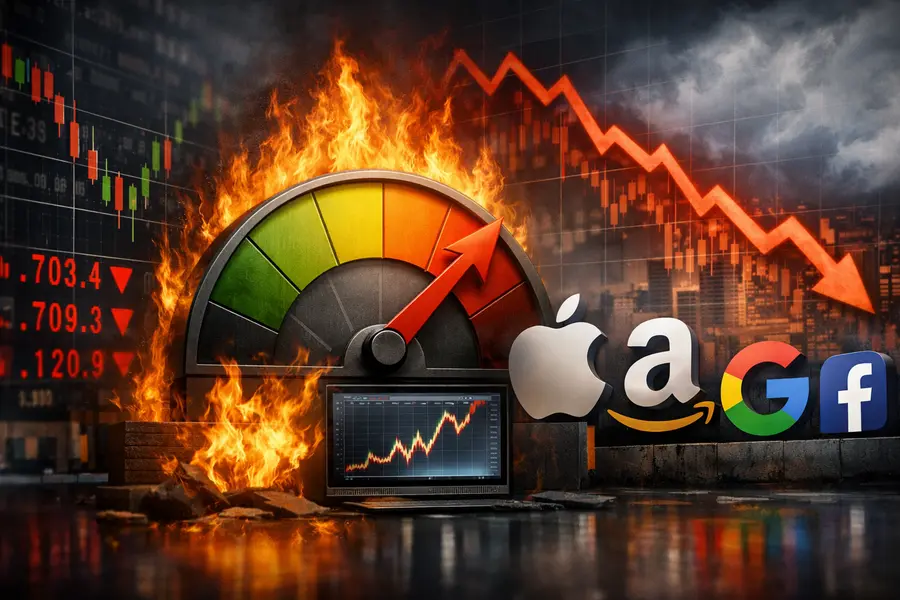
Wall Street's VIX fear index edges higher as Alphabet and Tesla kick off Big Tech earnings season, amplifying stock market uncertainty across major indices.
- The VIX fear index climbed to 17.73 on July 22, up 6.55% intraday, as investors awaited Alphabet and Tesla results after the closing bell.
- Alphabet beat revenue estimates with $119.8B in Q2 sales but shares fell 2.9% after-hours on a projected $195B–$205B capex commitment for 2026.
- Tesla posted record deliveries of 480,126 vehicles and $28.2B in revenue but missed on EPS at $0.33 vs. $0.53 expected, sending shares lower.
Lead
The CBOE Volatility Index — Wall Street's primary fear index — extended its climb on Wednesday, July 23, hitting 17.73 during the session, a 6.55% intraday rise, as investors shed risk ahead of quarterly earnings from Alphabet and Tesla, the first major names in a pivotal Big Tech reporting season. The move marked the sharpest single-session gain in the VIX index in over two weeks, underscoring the degree of stock market uncertainty concentrated in the near-term options market ahead of results that will set the tone for the remainder of the summer earnings cycle.
What Happened
Major U.S. equity benchmarks slipped across the board on July 22. The S&P 500, which had already retreated 3.3% from its June 2 record high of 7,609 to trade around 7,354, extended losses, while the Nasdaq Composite registered its second consecutive down session. Oil prices added to the pressure, climbing on continued tension surrounding the U.S.–Iran conflict and tightening supply outlooks, weighing on consumer-facing sectors and compressing margin assumptions for logistics-heavy companies.
The day's central event arrived after the close. Alphabet (GOOGL) reported Q2 2026 revenue of $119.8 billion, a 24% year-over-year increase and a clear beat against the $116.93 billion consensus estimate. Google Cloud was the standout, surging 82% to $24.8 billion, driven by enterprise demand for AI infrastructure. Google Search revenue rose 17% to $63.3 billion and YouTube advertising climbed 13% to $11.1 billion. Operating income reached $40.77 billion. Despite the headline beats, Alphabet shares fell 2.9% to $331.91 in after-hours trading — the market's verdict focused squarely on capital expenditures. The company raised its 2026 capex guidance to a range of $195 billion to $205 billion, a commitment that alarmed investors already scrutinizing the return timeline on AI infrastructure spending.
Tesla (TSLA) also reported after the bell. Revenue reached $28.24 billion, a 26% year-over-year increase and a beat against estimates near $25.71 billion, supported by record quarterly vehicle deliveries of 480,126 units — 25% above the year-ago quarter and roughly 74,000 units above analyst consensus. Operational results were far more troubling. GAAP operating income collapsed 57% to $398 million, compressing the operating margin to 1.4% from 4.1% a year earlier. Non-GAAP earnings per share came in at $0.33, well below the $0.53 expected. Capital expenditures surged 142% to $5.79 billion, generating negative free cash flow of $1.09 billion for the quarter. Tesla shares also declined in after-hours trading.Market Volatility Context
The pickup in the VIX index — which measures the implied volatility priced into S&P 500 options over the next 30 days — reflects a specific dynamic that has characterized the July earnings run-up: the gap between tech-sector volatility and broader market volatility has widened to historically unusual levels. The spread between the Nasdaq-100 Volatility Index (VXN) and the VIX reached 12 points, the widest margin in at least 23 years, signaling that options traders are pricing concentrated risk in mega-cap technology names far above what the headline VIX suggests for the broader market.
Over the trailing 52 weeks, the VIX has ranged between 13.38 and 35.30. At Wednesday's levels of roughly 17–18, the index sits in its lower historical quartile — suggesting that while the fear gauge has moved, it has not broken into territory associated with systemic market stress. The more telling signal lies in the composition of that fear: it is narrowly focused on a handful of AI-intensive technology platforms facing the same question simultaneously — whether unprecedented capital outlays are generating returns fast enough to justify current valuations.
Strategic Context: AI Capex Under the Microscope
Both Alphabet and Tesla, in different ways, are in the middle of a capital intensity inflection. Alphabet's $195B–$205B capex commitment for 2026 follows a year in which Cloud revenue re-accelerated sharply, but the forward guidance implies spending will materially outpace revenue growth in the near term. With more than 87% of the 40 S&P 500 companies that had already reported Q2 results coming in above estimates, the bar for a positive market reaction was elevated entering Wednesday's session.
Tesla's situation is structurally distinct but carries the same core tension. Record deliveries demonstrate execution on the manufacturing side, but operating margin erosion to 1.4% raises questions about pricing power, product mix, and the cost trajectory of its autonomous and AI programs. With capex nearly doubling year over year, the market is assessing whether Tesla's AI ambitions represent a credible return pathway or a cost center that will continue pressuring near-term profitability.
What Comes Next
The Big Tech earnings wave continues through the following week, with Meta Platforms, Microsoft, and Amazon all scheduled to report. Collectively, their results will either validate or challenge the AI infrastructure thesis that has underpinned the S&P 500's 9% advance in 2026. Options pricing into those reports remains elevated. Separately, the Federal Reserve's next rate decision looms as an additional catalyst, with uncertainty around the timing and magnitude of any move adding a macro overlay to already elevated stock market uncertainty. Crude oil's trajectory — tied directly to geopolitical developments in the Middle East — remains the principal exogenous risk variable for the remainder of the quarter.
Outlook
The rise in the VIX fear index heading into the first major week of Big Tech earnings reflects a market finely balanced between strong top-line momentum and deepening concern over the return profile of AI-era capital expenditure. Alphabet and Tesla both beat revenue expectations by wide margins, but both stocks declined after hours — a pattern that captures the fundamental tension now driving market volatility news: revenue growth is not the question; margin sustainability and capex discipline are. With several of the largest companies by market capitalization still to report, the VIX index today is likely to remain sensitive to any surprise in guidance, spending forecasts, or signals on AI monetization timelines.
Mentioned tickers: GOOGL, TSLA, META, MSFT, AMZN, SPY