Pomegra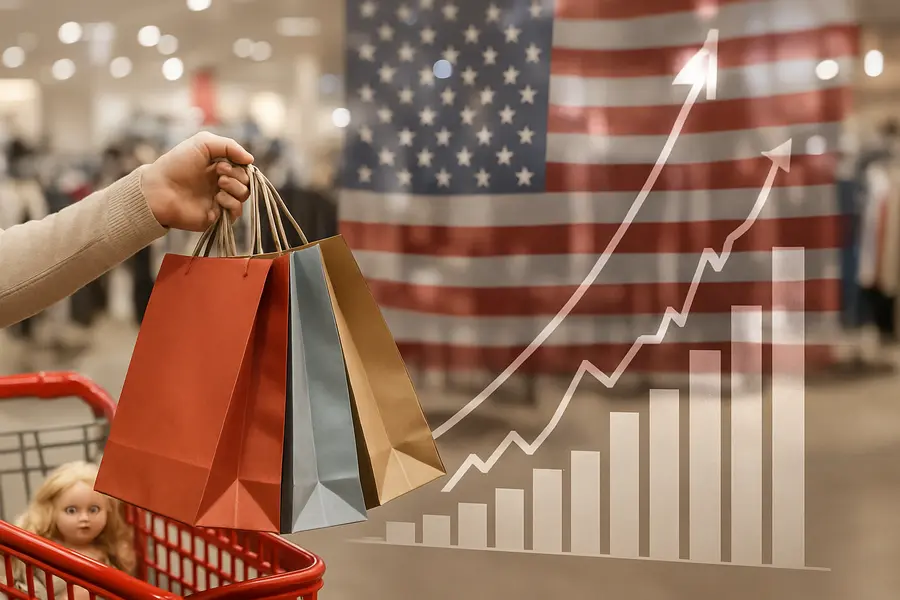
American consumers accelerated spending in May despite the Iran conflict and inflation pressures, reinforcing a resilient-economy narrative and narrowing the window for Federal Reserve rate cuts in 2026.
- US retail sales rose 0.9% in May, nearly doubling the 0.5% consensus forecast, with total sales reaching $763.7 billion.
- The "control group" — the GDP-linked core measure — gained 0.7%, signaling durable underlying consumer spending strength.
- Futures markets are pricing in zero Fed rate cuts for 2026 after the beat, with the benchmark rate holding at 3.50%–3.75%.
Lead
Washington, June 17, 2026 — US retail and food services sales climbed 0.9% in May to $763.7 billion, the Census Bureau reported Tuesday, nearly doubling the 0.5% gain economists had forecast and extending a streak of resilient consumer spending that has kept recession calls at bay despite elevated energy costs tied to the war with Iran. On an annual basis, US retail sales May figures advanced 6.9%, underscoring the durability of household demand heading into the Federal Reserve's summer policy calendar.What Happened
The advance estimate, drawn from the Census Bureau's monthly survey of retail and food services firms, showed gains across virtually every major category. Gasoline stations posted the sharpest monthly move — up 3.4% — reflecting elevated pump prices linked to Middle East supply disruptions. Even stripping out fuel, retail sales ex-gasoline rose 0.7%, signaling that energy alone cannot account for the breadth of the advance.
The control group — which excludes autos, building materials, food services, and gasoline and feeds directly into GDP calculations — rose 0.7% month-over-month, the most consequential sub-read for economists modeling second-quarter growth. Nonstore retailers, the category that captures e-commerce, posted a 12.2% year-over-year gain, the largest in the report and consistent with a sustained structural shift toward online purchasing.
Furniture stores, general merchandise, and food services and drinking places — the latter up 2.7% from May 2025 — each contributed to the advance. The breadth of the gain distinguishes it from earlier 2026 prints that were more narrowly concentrated in energy-sensitive categories.Market Reaction
Equity markets absorbed the print with muted enthusiasm. The data reduced probability-weighted bets on any 2026 easing from the Federal Reserve, with interest-rate futures fully pricing out rate cuts for the remainder of the year by mid-session Tuesday. The benchmark overnight lending rate sits at 3.50%–3.75%, where the Fed has kept it as Fed Chair Kevin Warsh navigates competing pressures: sticky inflation, geopolitical energy shocks, and White House preference for lower borrowing costs.
Treasury yields nudged higher on the release as traders recalibrated rate-path expectations. The consumer discretionary and retail sectors, while directionally positive on the underlying demand signal, faced modest pressure from the higher-for-longer rate read-through.
Why Consumers Kept Spending
Several structural tailwinds have shielded household budgets despite the war's energy price shock. A tight labor market — still generating sufficient payroll growth to support income — combined with equity markets near record highs and a strong tax refund season kept discretionary wallets open. Households also entered the conflict period with elevated cash balances accumulated during prior years of outsized savings rates.
Critically, consumers appeared to treat the Iran conflict as a temporary rather than permanent demand shock. That behavioral distinction explains why consumer spending held even as the Conference Board's sentiment index softened and gasoline costs pressed real purchasing power. The gains, however, are disproportionately concentrated among higher-income cohorts, leaving lower-income households more exposed to persistent food and energy inflation.
Fed Policy Dimension
The May retail beat complicates the Federal Reserve's communication task. Incoming data — including this report — gives the Fed no clear justification to ease monetary policy, and the dot plot's implicit expectation of a potential 2026 cut now looks difficult to execute without a meaningful deterioration in labor markets or a demand-side reversal.
Fed Chair Warsh has signaled a focus on revamping the Fed's communication framework. A peace deal between the US and Iran, confirmed by the White House in recent days, has pulled crude lower and eased near-term inflation expectations — but that channel works against rate cuts as well, since softer energy prices could leave the Fed's headline inflation metrics closer to target without any policy action required.For now, the Fed's dual mandate — maximum employment, price stability — does not argue for accommodation. The consumer spending data for May, combined with still-firm labor market readings, keeps the Fed in a prolonged hold posture.
Outlook
With US retail sales May printing above consensus and the control group advancing at a pace consistent with solid GDP growth, the second-quarter consumer narrative remains intact. The path for Fed rate cuts is narrower than it was in March. A sustained cooling in the labor market or a demand shock from geopolitical re-escalation represent the primary downside scenarios that could shift that calculus. Until then, the data supports the resilient-economy read that has persisted through tariffs, conflict, and elevated rates alike.
Mentioned tickers: XRT, SPY, XLY