Pomegra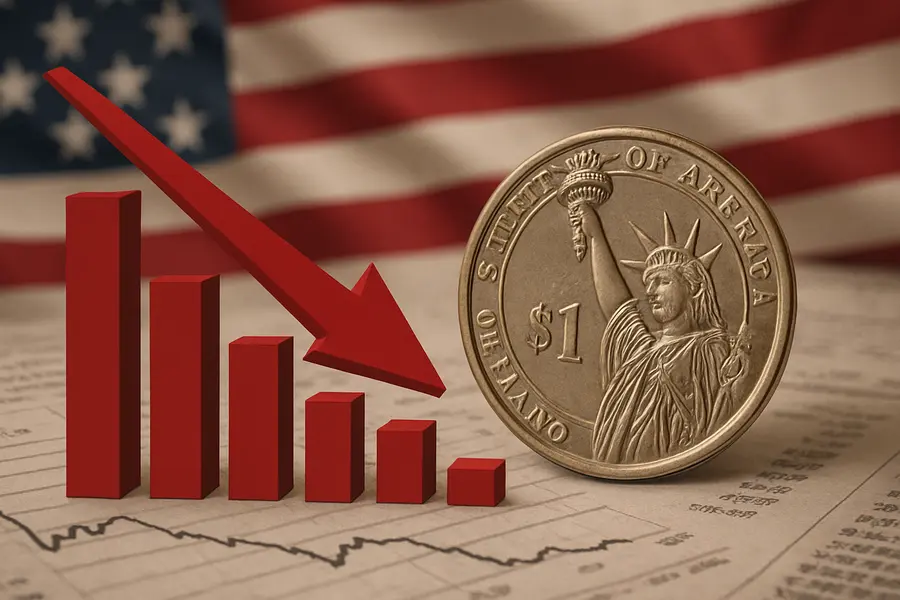
US GDP contracted 0.3% in Q1 2025, the first decline in three years, as import surges from tariff front-running erased five points of headline GDP growth and consumer spending lost meaningful momentum.
- US GDP contracted 0.3% annualized in Q1 2025 — first negative quarter since Q1 2022 — driven by a 41.3% surge in imports that subtracted over five percentage points.
- Full-year 2025 GDP growth settled at 2.2%, with Q4 2025 printing an anemic 0.5% as consumer and labor-market headwinds persisted through year-end.
- Consensus US economy forecast for 2026 stands at 1.8%–2.0%; Atlanta Fed GDPNow tracked US GDP Q2 2026 at 1.2% as of July 1, down sharply from 2.5% one week earlier.
Lead
The US economy contracted at an annualized rate of 0.3% in the first quarter of 2025, the Bureau of Economic Analysis (BEA) reported on April 30, 2025 — the first negative GDP growth reading in three years and a sharp reversal from the 2.4% expansion logged in the fourth quarter of 2024. The contraction was dominated by a single structural distortion: a record pre-tariff import surge that subtracted more than five percentage points from the headline US GDP figure, overwhelming positive contributions from business investment, consumer spending, and exports.
What Happened
Real GDP declined 0.3% on a seasonally adjusted annualized basis from January through March 2025. Imports — which reduce GDP under standard national accounts methodology — rose 41.3% in annualized terms, the steepest single-quarter surge in decades. Goods imports alone climbed 50.9% as manufacturers and retailers accelerated purchasing to beat impending tariff deadlines. Services imports grew 8.6%.Government spending declined in parallel, adding secondary drag. Consumer spending — approximately two-thirds of total US GDP — decelerated sharply from prior-quarter pacing, reflecting early signs of household-budget pressure. Business fixed investment and export growth contributed positively but were insufficient to offset the scale of the import distortion.
Stripping out net export effects, underlying domestic demand remained modestly positive — a distinction economists drew between a technically distorted quarter and an organically contracting economy.
Market Reaction
Equity benchmarks fell on the GDP release. Broad market indices extended losses before partially recovering as investors assessed the tariff-distortion thesis. Treasury markets rallied, driving 10-year yields lower as traders recalibrated Federal Reserve rate-cut expectations. The US dollar weakened against major peers.
Cyclical sectors — industrials, consumer discretionary, and materials — underperformed defensive segments including healthcare and utilities in the immediate trading session. Volatility gauges edged higher across equity options markets.
Economic Slowdown Signals
Behind the technical distortion, concurrent indicators signaled genuine economic slowdown momentum building in the underlying economy:
- Consumer fatigue: The personal savings rate fell to 2.6% by April 2026 from 3.6% the prior month, as households sustained spending by drawing on accumulated buffers. Real disposable income growth turned negative in multiple months across 2025.
- Labor market deceleration: US employers added approximately 181,000 total positions across all of 2025, compared to more than 1.4 million in the prior year — a steep decline even as headline unemployment remained contained.
- Leading indicators: The Conference Board's Leading Economic Index maintained negative six- and twelve-month growth rates throughout the period, a pattern associated with prior slowdown episodes.
- Consumer sentiment: Multiple surveys documented subdued household expectations, with elevated energy costs, trade-policy uncertainty, and lingering inflation cited as primary drags on confidence.
Full Year 2025 and the Q2 Rebound
The Q1 2025 contraction proved partially transitory: the front-loaded import surge dissipated in subsequent quarters, providing a mechanical tailwind to GDP growth in Q2 2025 and restoring positive momentum mid-year. Full-year 2025 US GDP growth settled at 2.2% — a moderate deceleration from 2.4% in 2024 but not a recession.
The final quarter of 2025, however, delivered another soft reading. Q4 2025 GDP printed at just 0.5% annualized, indicating that underlying expansion momentum had not fully recovered. Consumer spending rose only modestly, supported in part by savings drawdowns rather than income gains. Residential investment remained a drag throughout the calendar year.
US Economy Forecast and US GDP Q2 2026
Heading into mid-2026, the US economy forecast reflects tempered expectations. Consensus estimates cluster at 1.8%–2.0% full-year GDP growth for 2026, below the 2.2% recorded in 2025. S&P Global Ratings characterized its US GDP Q2 2026 outlook as "curb your enthusiasm," flagging resilient headline data against a narrowing base of support. The Conference Board projects 1.8% for the full year.
The Atlanta Fed's GDPNow model revised its US GDP Q2 2026 tracking estimate to 1.2% on July 1, 2026 — down from 2.5% on June 25 — as net exports' contribution fell to -1.62 percentage points following weaker trade data. The BEA's official Q2 2026 advance estimate is scheduled for July 30.
Recession probability assessments remain divergent: RSM US places 12-month odds near 30%, down from 40% in prior surveys, while the New York Fed's yield-curve model indicates approximately 15%. The Sahm Rule recession indicator stood at 0.10 as of May 2026, well below its 0.50 signal threshold. Deloitte projects fixed business investment growth of 6.1% in 2026, with AI-related capital expenditure identified as a key structural offset to consumption-side weakness.
Outlook
The Q1 2025 GDP growth print of -0.3% remains a cautionary marker in the current expansion — the quarter when front-loaded trade activity, decelerating consumer outlays, and reduced government spending converged to produce the first negative reading since 2022. Subsequent data confirmed the import distortion as the dominant driver, and a partial recovery followed. Yet the slow-growth signature of late 2025, persistent consumer balance-sheet erosion, and below-trend US GDP Q2 2026 tracking signal that the economic slowdown narrative has not been fully resolved. The July 30 BEA advance release will provide the next definitive test of whether the US economy is rebuilding durable momentum or entering a prolonged period of sub-potential GDP growth.