 Pomegra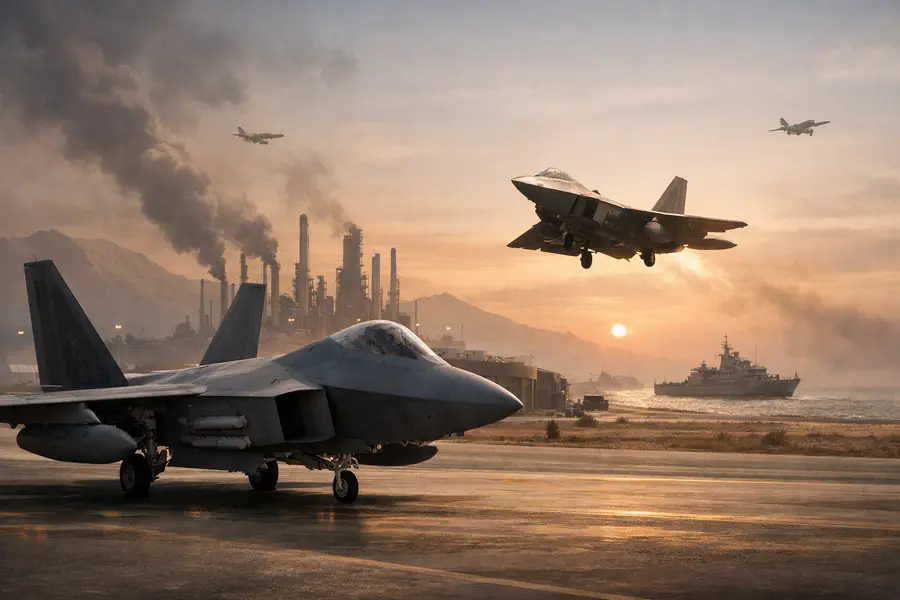
The United States Air Force has repositioned F-22 Raptor stealth fighters across the Middle East as renewed Iranian attacks on Strait of Hormuz shipping and U.S. bases threaten to collapse a fragile peace framework.
- U.S. Central Command struck more than 80 Iranian targets on July 7 after the IRGC attacked three commercial vessels in the Strait of Hormuz.
- Iran retaliated with drone and missile strikes on U.S. military installations in Kuwait and Bahrain, including the Fifth Fleet's home port at NSA Juffair.
- F-22 Raptors, drawn from the 1st Fighter Wing at Langley AFB, have logged more than 200 combat sorties in the CENTCOM theater since March, with Qatar and Pakistan now pressing both sides to salvage an interim deal.
Lead
WASHINGTON — The United States Air Force has sustained a forward deployment of F-22 Raptor stealth fighters in the Middle East as a direct signal of deterrence following the most intense week of U.S.-Iran military exchanges since the conflict began in late February. Twelve fifth-generation air-superiority jets, drawn from Langley Air Force Base's 1st Fighter Wing, have anchored the US F-22 deployment Middle East posture since late February 2026, flying more than 200 combat sorties while remaining undetected by Iranian radar networks. The latest escalation cycle, triggered by US Iran military escalation over Strait of Hormuz shipping attacks, has placed that posture under renewed pressure.
What Happened
The crisis reignited on July 6–7 when Iran's Islamic Revolutionary Guard Corps attacked three commercial vessels transiting the Strait of Hormuz. Two ships — the Qatari-flagged LNG tanker Al Rekayat and the Saudi supertanker Wedyan — were struck by projectiles; Al Rekayat suffered an engine-room fire and was evacuated. A third vessel was hit within 24 hours.
U.S. Central Command responded on July 7 with precision strikes against more than 80 Iranian military targets, including air-defense radar sites, anti-ship missile batteries, and IRGC small-boat facilities. CENTCOM launched a second round of strikes on July 8, describing the cumulative campaign as designed to "further degrade Iran's ability to attack commercial shipping and innocent civilian mariners."
Iran retaliated before dawn on July 9, with the IRGC executing a joint drone-and-missile barrage against Camp Arifjan and Ali Al Salem Air Base in Kuwait, and against Sheikh Isa Air Base and NSA Juffair in Bahrain — home to the U.S. Fifth Fleet. Sirens sounded at least three times across Bahrain; Qatar also reported inbound threats. At least 14 people were killed across two days of exchanges.
The F-22 Deterrence Posture
The US air force began repositioning scarce F-22 assets toward CENTCOM territory in late February, following the February 17 collapse of nuclear negotiations in which Washington's insistence on a full ban on uranium enrichment collided with Tehran's refusal. Twelve Raptors transited RAF Mildenhall and RAF Lakenheath before taking up station at Ovda Air Base in southern Israel — the first time F-22s had been positioned in Israel for potential real-world combat operations.
The aircraft represent a measurable draw on a limited inventory. With only 187 operational F-22s in the entire U.S. Air Force, a commitment of 12 to a single forward theater signals prioritization of CENTCOM risk management above other commands. During Operation Epic Fury beginning March 1, F-22s opened the campaign by suppressing Iranian S-300 and Bavar-373 surface-to-air missile batteries, clearing corridors for follow-on coalition strike packages — a mission profile that validated the stealth platform's role in penetrating layered air-defense networks.
The air force also returned aerial refueling aircraft to Middle East bases in early July as the latest escalation cycle intensified, extending combat radius for the fighter packages operating across the theater.
Strategic Context
The week of exchanges has placed the Memorandum of Understanding signed in mid-June — which inaugurated a 60-day peace negotiation process — under severe strain. President Donald Trump said at the NATO summit in Ankara that the MoU was "over," though he declined to formally terminate talks. Both sides accused the other of breaking the agreement first, marking the third time the United States had conducted major strikes against Iran while negotiations remained nominally active.
The Strait of Hormuz, through which roughly 20 percent of global oil and roughly one-third of seaborne liquefied natural gas passes, remains the primary economic lever in the conflict. The IRGC's targeting of commercial vessels is designed to impose systemic risk on global energy flows while compelling Gulf Arab states to pressure Washington. The U.S. response — coupling kinetic strikes with reimposed sanctions on Iranian oil exports — attempts to raise the cost to Tehran without triggering a full rupture of diplomatic channels.
Qatar and Pakistan, the two principal mediators in the Switzerland-based talks that produced the MoU, have signaled they will press for resumed negotiations. Qatari envoys traveled to Tehran in the days following the July 9 exchanges; Pakistani officials indicated technical-level talks could resume within days.
Geopolitical Dimension
The IRGC strikes on Middle East security infrastructure in Bahrain and Kuwait inject fresh risk into the Gulf Cooperation Council's relationship with the United States. Gulf Arab partners had already conditioned access to their territory for potential strike operations, pushing the U.S. toward Ovda as a forward operating hub. Sustained Iranian attacks on GCC soil could erode the public posture those governments have maintained — of neutrality with Washington — and could prompt U.S. base-access negotiations to become more politically complicated.
Tehran's dual-track approach — attacking commercial shipping while striking U.S. military installations — reflects an attempt to distribute escalation costs across multiple actors and avoid a scenario in which Iran alone absorbs retaliation. The logic constrains Washington's targeting calculus: each additional IRGC strike on a Gulf base increases pressure on allied governments that have asked the U.S. to limit its footprint.
Outlook
The deployment of F-22 stealth fighters to the CENTCOM theater, reinforced by refueling infrastructure returned to the region in July, leaves the United States in a position to escalate or constrain kinetic operations depending on how diplomatic efforts evolve over the coming weeks. Qatar and Pakistan face a narrowing window to restore the MoU framework before accumulated military exchanges render a return to negotiations untenable. The immediate variables — whether Iran suspends Strait of Hormuz operations and whether the U.S. agrees to a strikes pause — will determine whether the Middle East security situation stabilizes into a managed ceasefire or accelerates toward a broader confrontation.
Mentioned tickers: LMT, RTX, NOC, XOM, CVX