Pomegra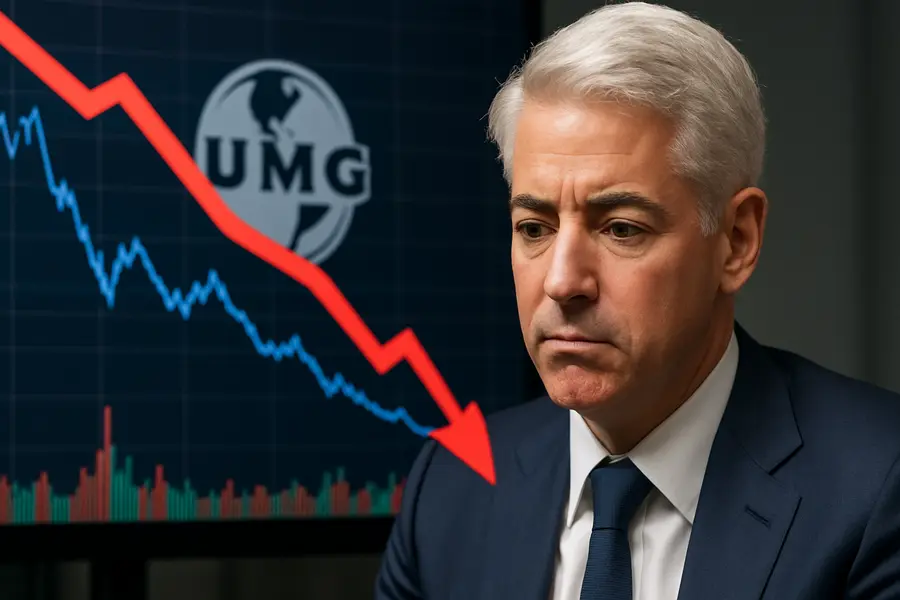
https://commons.wikimedia.org/wiki/Special:FilePath/Universal_Music_Group_UK_HQ,_King%27s_Cross_Central_development,_Pancras_Square,_London,_England_02.jpg
- UMG stock dropped nearly 7% in Amsterdam trading as Pershing Square placed ~80.6 million shares in an overnight sale priced at €17.66–€18.62 apiece.
- UMG's board unanimously rejected Ackman's unsolicited bid on May 29, 2026, at €30.40 per share, calling the offer a fundamental and material undervaluation.
- UMG repurchased 14.2 million of its own shares from Pershing Square for approximately €250 million ($290.8 million) as part of the exit transaction.
Universal Music Group shares fell nearly 7% on June 4 as Bill Ackman's Pershing Square Capital Management offloaded its entire 4.7% stake days after the board rejected his $64 billion takeover proposal.
Lead
Universal Music Group (UMG) shares fell nearly 7% on Euronext Amsterdam on June 4, 2026, after Bill Ackman's Pershing Square Capital Management launched an accelerated overnight placement of approximately 80.6 million shares — its entire 4.7% stake in the world's largest music industry conglomerate — following the supervisory board's unanimous rejection of his $64 billion acquisition proposal the prior week.What Happened
Pershing Square priced the placement at €17.66 to €18.62 ($20.48–$21.60) per share, a discount to UMG's most recent closing levels. UMG simultaneously announced it would repurchase 14,156,285 shares from Pershing at the floor price of €17.66, deploying approximately €250 million ($290.8 million) in buyback capital. The remaining roughly 66 million shares were placed with institutional investors through Bank of America.
The transaction effectively concluded Ackman's five-year involvement with UMG. He had built his position from 2021 onward, at levels significantly above the exit price. Ackman had already stepped down from UMG's supervisory board in May 2026, weeks before Thursday's sale.
The Failed Takeover Bid
On April 7, 2026, Pershing Square submitted an unsolicited, non-binding proposal to acquire UMG through a merger with Pershing Square SPARC Holdings, valuing the company at approximately €30.40 per share — a total enterprise value of roughly $64–65 billion.
On May 29, 2026, UMG's board voted unanimously to reject the proposal, stating it "fundamentally and materially undervalues UMG" and was "not in the best interests of UMG, its shareholders, artists, songwriters, employees and other stakeholders." That language closed the door on any friendly transaction.
Market Reaction
UMG stock had already shed roughly 20% since January 2026 before Thursday's sell-off, weighed down by the company's decision in March to shelve plans for a U.S. secondary listing. That listing had originally been championed by Ackman as a structural catalyst to close the discount between UMG's Amsterdam valuation and the multiples commanded by comparable U.S.-listed entertainment assets.The 52-week range for UMG has spanned €15.41 to €28.29, underscoring the magnitude of the retreat from recent highs. As of early June 2026, the stock carried a market capitalization of approximately €35.5 billion. Analyst consensus remained constructive, with an average 12-month price target of €25.81 and the majority of covering analysts carrying buy-equivalent ratings — but near-term sentiment has shifted decisively negative.
Strategic Context
Ackman's original investment thesis rested on two pillars: the structural growth of music streaming royalty income and a re-rating of UMG stock once a U.S. listing improved accessibility for North American institutional capital. Neither catalyst materialized on the anticipated timeline.
UMG's core music industry operations remain formidable. The company controls the deepest catalogue of recorded music and publishing rights in the world, with artist relationships spanning Taylor Swift, Drake, and legacy estates including The Beatles. Its significant stake in Spotify (SPOT) added both financial upside and volatility to the investment case — a complication Pershing Square cited as a factor in UMG's perceived undervaluation on Euronext Amsterdam.
The decision to pause the U.S. listing in March 2026, attributed to turbulent equity market conditions, left the valuation gap unresolved. The failed $64 billion bid was, in part, Ackman's attempt to crystallize that value through a take-private transaction after the public market route stalled.
Outlook
The departure of Pershing Square removes UMG's most vocal advocate for a U.S. listing and a higher share price. The placement overhang — approximately 66 million shares sold to outside buyers at a discount — is likely to suppress UMG stock in the near term. Whether management revisits the U.S. secondary listing as market conditions stabilize will be the pivotal question for remaining shareholders through the rest of 2026. The underlying streaming royalty business continues to compound, but the path to valuation re-rating has materially narrowed following Bill Ackman's exit.