Pomegra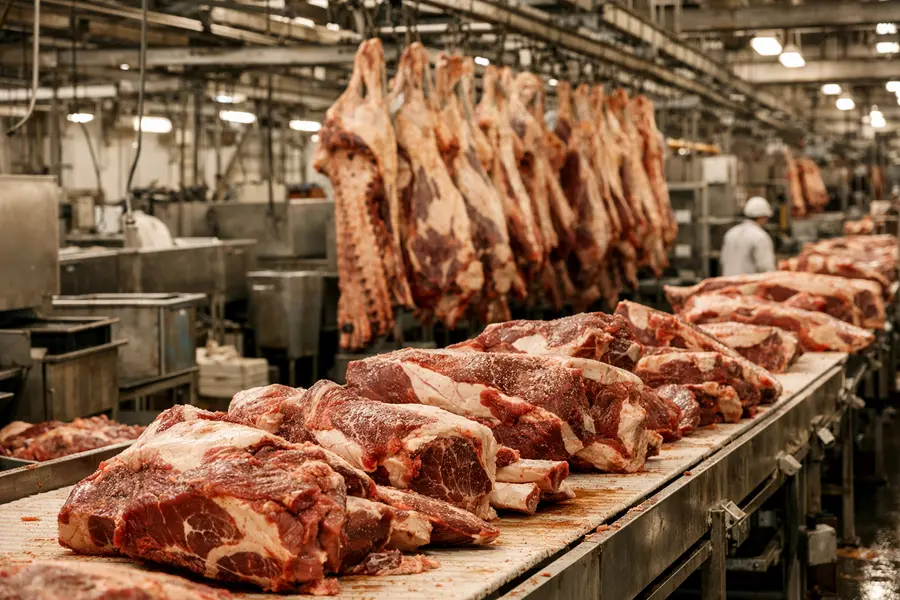
Tyson and JBS shares each drop more than 2.5% as President Trump vows an executive order letting farmers process and sell their own meat, branding the Big Four a monopoly.
- Trump announced on August 28 he is authorizing legal documents giving farmers and ranchers the right to process and sell their own meat.
- Cargill, Tyson Foods (TSN), JBS (JBSAY), and National Beef together control roughly 85% of U.S. meat processing capacity.
- TSN and JBSAY each fell more than 2.5% as investors priced in structural disruption and parallel DOJ antitrust risk.
Lead
President Donald Trump on August 28, 2026 announced he was directing legal documents to be drawn up granting farmers and ranchers the right to process and sell their own food, calling dominant processors Cargill, Tyson Foods (TSN), JBS (JBSAY), and National Beef "a nasty monopoly" that commands roughly 85% of U.S. meat processing capacity. TSN and JBSAY each fell more than 2.5% in premarket trading on antitrust disruption risk, registering the sharpest single-session declines for both names in months.
What Did Trump Announce?
Trump posted to Truth Social that he was authorizing legal documents to allow farmers and ranchers to independently process and sell their own food, a direct challenge to current federal law requiring all commercially sold beef, pork, and poultry to clear continuous USDA inspection before entering commerce. The proposed order would carve out new regulatory pathways for farm-level processing and direct-to-consumer sales -- mechanisms that the Big Four's dominant infrastructure and the existing Federal Meat Inspection Act framework have historically made commercially impractical for independent operators. The announcement escalates the administration's sustained antitrust campaign against concentrated protein markets, running alongside a Department of Justice investigation into whether leading meatpackers illegally coordinated to push beef prices -- now at record levels -- higher for consumers.
Why Did Meat Processor Shares Sell Off?
TSN and JBSAY fell because the announcement introduces tangible structural risk into a sector that has long benefited from near-impenetrable regulatory and capital barriers. Should the administration clear pathways for independent farm-level processing, volume throughput at large-scale plants could decline, pricing power would face new competitive pressure, and the precedent could accelerate broader antitrust enforcement targeting vertical integration across protein markets. Cargill and National Beef, both privately held, carry equivalent structural exposure without a direct equity price signal.
How Could the Order Reshape Meat Markets?
The administration faces a complex legal path before any executive order takes operational effect. The Federal Meat Inspection Act is statutory, meaning a presidential order cannot unilaterally override its inspection mandates without inviting immediate legal challenge from food safety advocates and incumbent processors. Enforcement of the DOJ's parallel pricing investigation adds a second regulatory front. Even a contested, unresolved order that drags through courts sustains a persistent discount on TSN relative to its historical earnings multiples and complicates capital allocation decisions for processors planning infrastructure expansion.
Industry Pushback
The National Cattlemen's Beef Association moved quickly to oppose the initiative. The group said it "strongly supports" increased competition and more opportunities for small and regional processors but drew a firm line at food safety, warning that weakening federal inspection standards risked undermining global confidence in the U.S. meat supply and could expose American beef exports to retaliatory non-tariff barriers from major importers. Broader agriculture trade groups echoed the safety concern.
Outlook
Trump's direct confrontation with Big Meat marks the most assertive federal challenge to protein market concentration in decades. TSN and JBSAY face prolonged dual-front uncertainty as the White House pursues executive deregulation for independent operators while the DOJ pursues antitrust enforcement against existing players. Legal timelines remain unclear, but a sitting president publicly branding four companies a monopoly controlling 85% of national processing capacity sustains durable headline risk. Beef price trajectories and any shift in USDA inspection policy are the near-term indicators to watch.
Mentioned tickers: TSN, JBSAY