Pomegra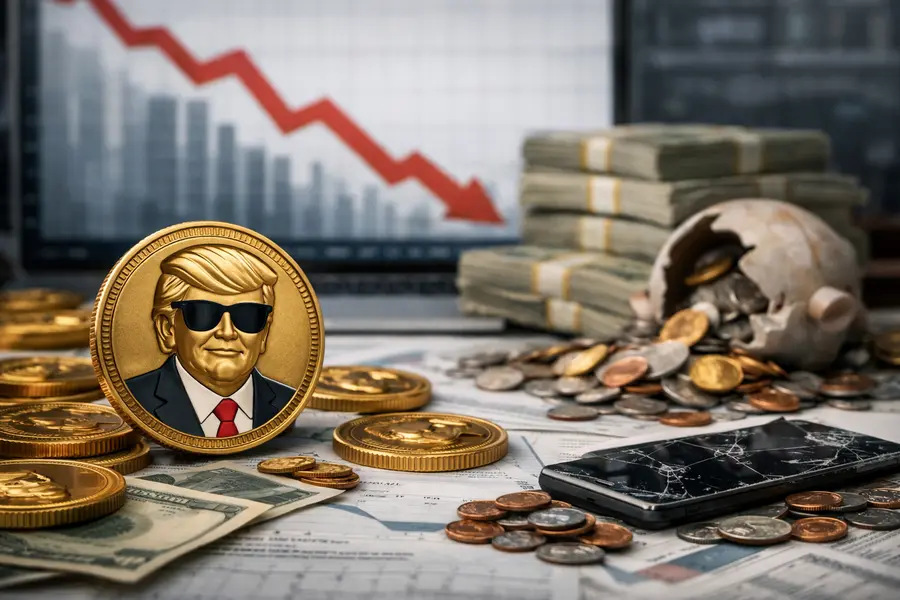
Nearly one million buyers of President Trump's $TRUMP memecoin have absorbed $3.81 billion in combined losses as the token trades 97% below its January 2025 launch peak.
- 988,905 wallets recorded losses on the $TRUMP token; the coin has collapsed from a peak near $75 to approximately $1.78.
- Trump-affiliated entities retained 80% of total token supply and collected an estimated $636 million in royalties regardless of price direction.
- Congressional investigators have opened inquiries into Trump's broader crypto ventures, including World Liberty Financial.
Lead
Blockchain analytics firm Nansen tracked roughly 1.48 million wallets that purchased the $TRUMP memecoin since its January 17, 2025 launch — three days before President Donald Trump's inauguration. Of those, 988,905 recorded net losses totaling $3.81 billion through the end of June 2026. The token, which briefly touched a market capitalization near $27 billion within 48 hours of launch, now trades at approximately $1.78, representing a 97% decline from its peak price of $73.43. The scale of Trump crypto coin losses has drawn fresh scrutiny from regulators, lawmakers, and market analysts tracking the growing intersection of political celebrity and digital assets.
What Happened
Trump announced the $TRUMP coin via Truth Social on January 17, 2025, framing it as a novelty collectible with no stated utility. The launch triggered an immediate speculative frenzy. Within 48 hours, the token's price surged to $73.43, minting paper fortunes for early buyers. The rally proved short-lived. Within two weeks, the price had dropped below $20. The October 2025 crypto market correction dragged it toward $3.80, and by March 2026 it had slid to $2.73. An all-time low of $1.50 was recorded in June 2026.
The tokenomics were structured to benefit insiders. Of the 1 billion total $TRUMP tokens issued on the Solana blockchain, only 200 million — 20% — were made available to the public at launch. The remaining 800 million were retained by two Trump-affiliated entities: CIC Digital LLC and Fight Fight Fight LLC, with gradual release scheduled over three years. That concentration of supply gave affiliated entities sustained leverage over market dynamics and a steady royalty stream tied to trading volume.
Asymmetric Returns
The Nansen data reveals a stark divide in outcomes. Fewer than 500,000 wallets — roughly one-third of all buyers — recorded profits, with combined gains of approximately $4 billion. Those returns were heavily concentrated among early entrants who sold into the initial price spike. The broad retail majority absorbed the losses.
Trump's financial disclosure for 2025 reported more than $1.4 billion in total cryptocurrency investor losses-adjacent earnings — gains generated while others were losing. The memecoin alone contributed an estimated $636 million in royalties, a structure that rewarded affiliated entities on each trade executed in the market, independent of whether the token's price was rising or falling. Critics have characterized this mechanism as a built-in extraction model: the president's entities collected fees while retail participants bore price risk.
Trump Crypto Investment: The Broader Ecosystem
The $TRUMP coin is one component of a larger Trump crypto investment architecture. Trump and his sons co-founded World Liberty Financial (WLFI), a decentralized finance platform that sold its own governance token, $WLFI. That coin has also declined sharply from its offering price. World Liberty Financial faces separate scrutiny: the Senate Permanent Subcommittee on Investigations has opened an inquiry into whether the firm's token sales violated government ethics requirements and whether counterparty relationships — including entities with alleged ties to sanctioned networks — ran afoul of federal law.
World Liberty Financial also drew comparison to collapsed crypto exchange FTX after it used billions of its own WLFI governance tokens as collateral to borrow stablecoins on an affiliated decentralized lending platform, a circular borrowing arrangement that raises questions about collateral integrity.
Regulatory and Political Dimension
The Securities and Exchange Commission under the current administration has broadly reduced enforcement activity against crypto projects. That posture has created a gap between the scale of retail losses and the regulatory response. Legal analysts applying the Howey test argue $WLFI may constitute an unregistered security — a classification that, if applied, could trigger retroactive liability for token issuers.
Congressional pressure is building. Democratic senators have formally requested probes into Trump's crypto ventures, citing potential conflicts of interest given the president's simultaneous role as policymaker setting crypto regulation and as a direct financial beneficiary of retail crypto participation. The GENIUS Act, a stablecoin regulatory framework signed into law in 2025, is expected by some legal experts to provide partial legal cover for World Liberty Financial's stablecoin operations going forward.
Market Reaction
The $TRUMP token's current market capitalization stands at approximately $398 million, down from a peak near $27 billion — a destruction of roughly $26.6 billion in market value from the high. Daily trading volume is near $80 million, a fraction of early-launch activity. The token continues to trade on major centralized and decentralized exchanges but has largely exited mainstream market commentary.
Outlook
The $TRUMP memecoin episode is likely to shape U.S. crypto policy debates for the near term. Roughly 989,000 retail participants have absorbed a combined $3.81 billion in Trump crypto coin losses while affiliated entities extracted hundreds of millions in royalties through a pre-structured supply advantage. Congressional investigations are in early stages; their outcome will depend in part on whether investigators can establish that promoter conduct crossed existing legal thresholds — a difficult bar given current enforcement posture. The broader pattern — tokenomics concentrating upside among insiders while distributing downside to retail buyers — has renewed calls for disclosure requirements on celebrity-endorsed crypto projects, a policy conversation with no clear legislative timeline.