Pomegra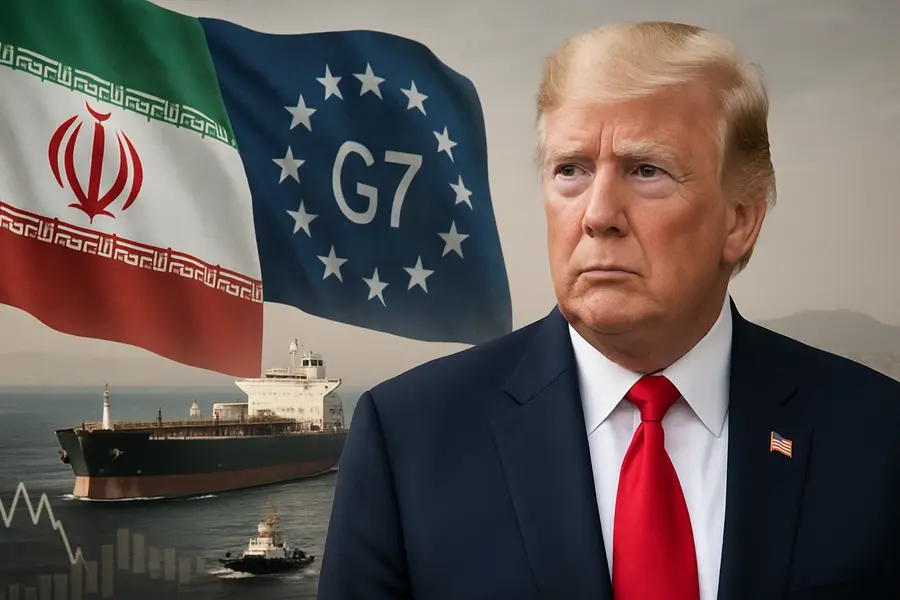
President Trump's declaration at the G7 that the U.S.-Iran ceasefire text is merely a memorandum of understanding — not a binding treaty — has kept crude oil markets on edge and Strait of Hormuz supply-risk premiums alive despite a three-month low in Brent prices.
- Trump calls the 14-point Iran accord "a memorandum of understanding," warning he could resume strikes if negotiations break down within the 60-day window.
- The Strait of Hormuz reopens toll-free to commercial traffic under the MOU; a permanent deal on nuclear material and sanctions must be reached before that deadline.
- Brent crude fell below $79/barrel this week — but analysts warn a geopolitical risk premium will persist until a legally binding agreement is finalized.
Lead
At the G7 summit in Evian-les-Bains, France, on June 17, 2026, President Donald Trump signed a 14-point memorandum of understanding with Iranian President Masoud Pezeshkian that halts military hostilities, reopens the Strait of Hormuz to commercial shipping, and sets a 60-day clock for a permanent nuclear agreement. Within hours, Trump told reporters the document carried no guarantees: "It's a memorandum of understanding. If I don't like it, we'll go back to shooting at them, dropping bombs on their head." That single statement reset market expectations, lifting crude's embedded risk premium off its intraday lows and renewing concern that the Hormuz chokepoint — through which roughly 20 percent of globally traded oil flows — remains vulnerable.
What Happened
The accord, signed digitally in English and Farsi and formally countersigned at a dinner in Versailles hosted by French President Emmanuel Macron, runs approximately one and a half pages and is explicitly framed as a framework for negotiation rather than a concluded treaty. Its core provisions: Iran grants toll-free safe passage through the Strait of Hormuz for 60 days; Washington lifts its naval blockade of Iranian ports; both sides observe a ceasefire; Israel terminates combat operations in Lebanon; and Iran reaffirms it will not develop nuclear weapons, with the disposition of its enriched uranium stockpile left to a "mutually agreed mechanism." The U.S. has additionally pledged to unfreeze approximately $100 billion in Iranian sovereign assets and to terminate all sanctions — contingent on a final deal being concluded.
Trump, asked whether the 60-day deadline was firm, replied: "I don't view it as hard." He also noted the document was "very important, but it might not be the kind of document I should be signing," reinforcing the impression that the White House regards the accord as an opening position rather than a binding commitment. G7 leaders endorsed the agreement in summit communiqué language stating they "support" the deal and are "ready to contribute to its implementation."
Market Reaction
Crude oil markets had moved sharply lower in the days preceding the formal signing, pricing in de-escalation. Brent crude fell below $79/barrel Wednesday — its lowest level since early March 2026 — while WTI hovered near $81/barrel, down from roughly $84 the prior week. U.S. retail gasoline declined to approximately $4.07 per gallon, compared with $4.16 a week earlier.The relief rally, however, stalled as Trump's "memorandum" characterization circulated. Analysts tracking energy markets noted that implied volatility in crude options remains elevated, reflecting residual concern that the 60-day negotiating window could collapse. Pricing models suggest a geopolitical risk premium of $5–$10/barrel is still embedded in forward curves, a figure that would evaporate only if a binding treaty were signed and Iran's enrichment infrastructure verifiably curtailed. French President Macron said the agreement "will soon enable a decrease in energy prices," a claim that energy traders are not yet discounting in full.
Geopolitical Dimension
The 2026 Strait of Hormuz crisis — which began on March 4, when Iranian forces declared the strait closed and carried out at least ten attacks on commercial vessels, killing five crew members — had reduced tanker transits by approximately 70 percent at its peak and sent global energy markets into their most severe supply shock since the 1970s. At the height of the crisis, Wall Street analysts modeled scenarios in which Brent crude surged toward $200/barrel if the closure persisted through the northern-hemisphere summer driving season.
The MOU's toll-free reopening provision addresses the immediate bottleneck, but structural vulnerabilities remain. Iran demonstrated it possesses both the capability and the willingness to shut the strait, a fact that will weigh on shipping insurance premiums, tanker routing decisions, and strategic petroleum reserve drawdown planning across OECD governments regardless of the near-term ceasefire. The provision negotiating the "future administration" of Hormuz passage through Oman introduces a new diplomatic layer whose resolution timeline is undefined.
Strategic Context
The 60-day negotiating window covers the hardest issues: the scale and timeline of Iran's enriched uranium stockpile reduction, the sequencing of sanctions relief against verifiable nuclear rollback, and a durable mechanism for international inspection. Each of these points has historically been a dealbreaker in prior U.S.-Iran talks. Trump's public framing of the MOU as reversible — combined with his stated indifference to the 60-day deadline — creates strategic ambiguity that may be intentional, giving Washington leverage in technical negotiations, but it simultaneously sustains the supply-risk discount that markets have not yet fully removed from crude prices.
G7 allies, who endorsed the accord, face their own exposure: European energy importers that rerouted LNG and crude shipments around Africa during the Hormuz closure absorbed significant freight cost inflation, and a return to pre-crisis shipping patterns depends on confidence in the durability of the MOU that Trump himself has publicly hedged.What Comes Next
Technical delegations from Washington and Tehran are expected to begin detailed nuclear negotiations within days. The 60-day clock means a final agreement — or its collapse — falls in mid-August 2026. Should negotiations stall, Trump has left open the option to resume military operations, a scenario that energy analysts say would push Brent sharply higher given refinery inventory depletion accumulated during the closure period. Even if a deal is concluded, PBS analysis indicates it could take weeks or months before oil flows normalize to pre-crisis volumes.
Outlook
The Trump Iran G7 signing represents a significant de-escalation relative to the acute supply shock of the spring, and Strait of Hormuz traffic is resuming. But the non-binding character of the MOU — confirmed by Trump's own language — means the market is not yet in a position to price out the Hormuz risk premium entirely. With a 60-day deadline, no hard timeline, and unresolved nuclear provisions, crude volatility is likely to remain elevated through the summer. The outcome of technical nuclear talks will determine whether the current sub-$80 Brent level holds or reverses sharply.
Mentioned tickers: XOM, CVX, BP, TTE, BNO