Pomegra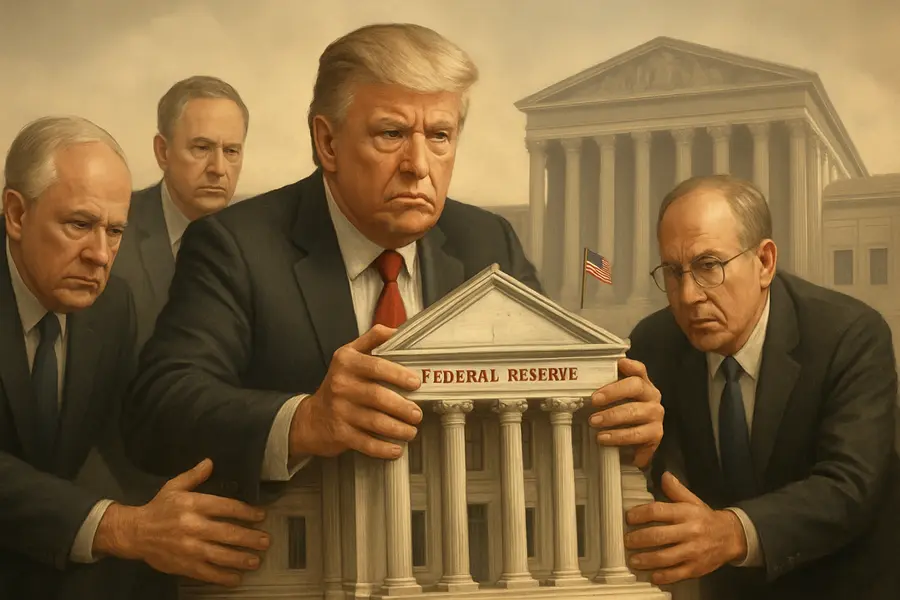
The Supreme Court's June 29 decision blocking the firing of Fed Governor Lisa Cook has intensified — not ended — White House efforts to restructure the central bank, with allies now turning to Congress and legal workarounds.
- The Supreme Court ruled 5-4 on June 29 to block Trump's removal of Fed Governor Lisa Cook, citing due-process violations.
- In a companion ruling, SCOTUS overturned the 91-year Humphrey's Executor precedent — granting Trump broader firing power over other independent agencies while explicitly carving out the Fed.
- Trump allies are now pursuing legislative routes and legal strategies to remove Fed board members, including former Chair Jerome Powell.
Lead
WASHINGTON — President Donald Trump and his inner circle are accelerating plans to reshape the Federal Reserve following a split Supreme Court ruling on June 29 that simultaneously expanded presidential power over independent agencies while shielding the central bank from immediate White House control. Top officials and outside allies are actively exploring legal mechanisms and congressional avenues to remove sitting members of the Fed's Board of Governors, with Lisa Cook and former Chair Jerome Powell identified as priority targets, according to reporting published July 2.
What Happened
The Supreme Court delivered a 5-4 decision in Trump v. Cook blocking the White House from dismissing Fed Governor Lisa Cook, ruling that Trump's August 2025 termination notice — delivered via the social media platform Truth Social — did not constitute proper legal notification and denied Cook the due-process right to contest the charges. The underlying allegation, that Cook falsified a mortgage application prior to her appointment, remains under litigation in lower courts.
In a separate but related ruling issued the same day, the court overturned Humphrey's Executor v. United States, a 1935 precedent that had prevented presidents from removing members of independent agencies at will for nine decades. That decision marks one of the most significant expansions of executive authority in modern American history — yet it came with a notable carve-out.
The Fed Exception
Chief Justice John Roberts, writing for the majority, drew a deliberate distinction between the Federal Reserve and other independent agencies. Roberts concluded that Congress specifically designed the Fed to operate with structural independence, citing its unique ownership structure, revenue model, and historical role as lender of last resort. "Any change in that scheme must come from Congress, not the courts," Roberts wrote.
The ruling effectively elevated the Fed to a category the court characterized as a "super-independent" institution, separate from the Federal Trade Commission, the National Labor Relations Board, and other bodies now subject to at-will presidential removal. The court left unresolved the broader question of whether Trump ultimately holds the legal authority to remove Fed governors — a deliberate punt that keeps the constitutional conflict alive for lower courts to settle.
Trump Allies' Counteroffensive
Within days of the ruling, Trump allies reframed their strategy. Rather than treating the SCOTUS decision as a ceiling, senior White House officials and outside advisers moved to exploit Roberts' language as a roadmap: if Congress must authorize structural change, the effort should move to Capitol Hill.
Legislative proposals already circulating in the 119th Congress include measures that would limit the Fed's authority to pay interest on reserves — currently the primary tool the central bank uses to set short-term borrowing costs — and separate proposals to tie monetary policy targets to federal debt-service metrics, an approach Trump has explicitly endorsed.
Jerome Powell has emerged as a parallel flashpoint. After Trump's nominee Kevin Warsh was confirmed as the new Fed Chair — Warsh has echoed Trump's preference for lower interest rates — Powell announced plans to remain on the Board of Governors beyond his chairmanship. Trump administration figures and allies responded with open frustration. If Powell does not resign before the end of 2026 and if Senate control shifts to Democrats, the White House calculates it could face unfavorable vote arithmetic on the Federal Open Market Committee for the remainder of Trump's term, diminishing Warsh's ability to steer monetary policy.Strategic Context
The campaign to restructure the Fed sits within a broader Trump second-term project of consolidating executive control over what administration officials have termed the "administrative deep state." The Humphrey's Executor reversal removes legal insulation from dozens of federal bodies, and the Fed exception — while real — may prove narrow. Roberts' opinion explicitly declined to rule on whether sufficient cause for firing a Fed governor could be established through a process more legally rigorous than a social media post.
Historical precedent adds urgency to the markets' concern. The 1970s offer the most cited parallel: President Richard Nixon's sustained pressure on the Fed to ease monetary policy ahead of his reelection contributed to the inflationary spiral that defined the decade and required the painful Volcker disinflation of the early 1980s to reverse. That episode is foundational to the modern consensus on central bank independence.
Market Reaction
Treasury markets registered the SCOTUS ruling with measured but discernible unease. Yields on 10-year Treasuries moved modestly higher in the days after the ruling as traders priced in a sustained period of institutional uncertainty at the Fed. Currency markets reflected similar caution, with the dollar weakening slightly against a basket of major peers. Equity investors have broadly retained a "wait and see" posture, given that Cook's reinstatement and the unresolved litigation preserve near-term policy continuity.
Outlook
The SCOTUS ruling has narrowed Trump's path to unilateral Fed control while signaling that a more durable reshaping must run through Congress — a legislative arena the White House is now actively targeting. Whether the Roberts carve-out survives further litigation, whether Powell elects to resign, and whether Congress advances legislation curtailing the Fed's operational tools are the three variables that will determine the degree of central bank independence the institution retains through the end of Trump's term. Markets will price each development in real time, with Fed policy credibility — and by extension inflation expectations — hanging in the balance.